
| Search our quarter-million Q&As |
Home of the finishing HOTLINE since 1989
-----:
Agitation air sizing and calculations for plating & anodizing
Quickstart:
Plating processes and their associated rinses usually benefit from agitation, and the most common method is "air agitation".
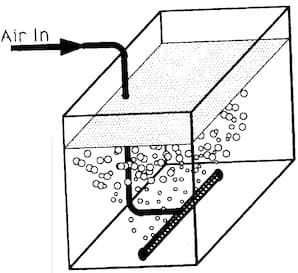
Air is pumped to pipes at the bottom of the tank and exits from holes in them, creating agitation as it races towards the surface.
Read on ...
Q. HELLO.
I'M A PROCESS ENGINEER IN THE PCB INDUSTRY. I WOULD LIKE TO GET SOME INFORMATION ON AIR CONSUMPTION IN THE ACID COPPER ELECTROPLATING PROCESS.
THANK YOU IN ADVANCE.
2001
A. I'm not sure what you mean by air "consumption". You do not "consume" air in acid copper plating, you are using air from a blower to agitate the bath (you are trying to rapidly replenish the copper concentration in the work/liquid boundary layer). As a rule of thumb, you would want to raise the solution layer about 3 cm (1") if you are looking for how much air you need.
There are also issues about sparger design and placement; you should consult with your supplier.

James Totter, CEF
- Tallahassee, Florida
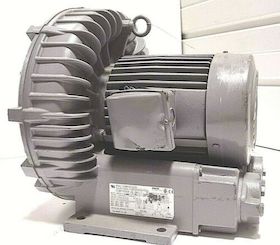
A. If your question is about how to size the blower, you need 1 pound/square inch/ 18 inches of solution depth, and 1 cubic foot/minute/linear foot of perforated pipe.
Perforated pipe: 3/32" diameter holes, spaced 3.75" apart. pipe diameter determined from cross sectional area of all drilled holes in the pipe. (3/4" schedule 80, .154" wall), this works out to no more than 10 feet long from the header.
Your supplier should be able to size the blower and pipes for you.


Tom Pullizzi
Falls Township, Pennsylvania
Mechanical Agitation Rather Than Air
Q. We use an emulsion clean prior to our alkaline clean for heavy degreasing and ink/stencil removal. Our current cleaner cannot be air agitated though due to quick foaming that overflows even at minimum air agitation. I am trying to research means of mechanical agitation that should reduce the foaming action. Any ideas?
The tank is 2'W x 5' L x 4' D SS. The first 8" or so are taken up with a burner tube for heating to 160 F.
Benjamin Curto- Ponderay, ID, USA
2001
(affil links)
free pdf is currently available from academia.edu
A. Hi Benjamin,
Yes, there are cases where air agitation isn't appropriate. You may want to consult the "Solution Agitation & Mixing" chapter I wrote in the Metal Finishing Guidebook ⇨
It covers most of the alternatives to air agitiation.
Good luck.

Ted Mooney, P.E.
Striving to live Aloha
finishing.com - Pine Beach, New Jersey
Need quick confidential answers? $25
Need project assistance? $100/hr.
A. Benjamin,
That 'chapter' of Ted's is more like a tome ... a vast data bank of options. Must have taken quite some time to collate!
I've only got one idea which you may have already thought about but didn't mention. Why not go out and find out who make foam suppressants? They do exist! Then, maybe, your emulsion may be inexpensive but possibly there are better ones that foam less.
Food for thought, anyhow.

Freeman Newton [deceased]
(It is our sad duty to advise that Freeman passed away
April 21, 2012. R.I.P. old friend).
Micro explosive air agitation in anodizing tank
Q. Has anyone tried using micro explosive air agitation in a production anodizing tank? What kind of results?
David A. Kraft- Long Island City, New York
2001
? Hi Dave,
I've never heard of it...but now my curiosity is sparked. Do you have any other info on this..ie, purpose/point, benefits/disadvantages?

Marc Green
anodizer - Boise, Idaho
A. I think I have heard the term micro-explosive agitation in connection with ultrasonic cleaning. It was related to certain agitation frequencies that allow better scrubbing of parts.
Mandar Sunthankar- Fort Collins, Colorado
A. Hi Dave! Hi also Marc!
Yes, that word MICRO EXPLOSIVE air agitation sure got me interested ... and Dave kindly told me that this emanated from AUTEL in Italy. A masterful use of the English language but not, however, precisely correct.
Please go the archives and have a gander at thread #
7718 (porous plastic pipe). This will explain Autel's modus operandi.
On looking at Autel's descriptive data, this is, it appears, the same as RCA Victor design where, the chemist of their R & D lab actually had TV 'windows' in the plating tank to see the action of the air bubbles. But these bubbles were in such huge quantities because of their extremely small size that they literally 'plated up' the glass view plate. The chemist seemed to be quite impressed.
To try to partially answer Marc's question, this design means that the reaction time of the 'air' or gas through a liquid is vastly improved in the same way that when making (powder) explosives or fireworks, l0 or 5 micron (better!) powder reacts so very quickly ... but if the granules were regular bubble size, all you'd get would be a fizz instead of a flash. Maybe that's WHY they called it a Micro EXPLOSIVE !
Cheers !
Freeman Newton [deceased]
R.I.P. old friend (It is our sad duty to
advise that Freeman passed away 4/21/12)
 Thank you for the explanation, Freeman...but hmmmmm..I'm still not sure of what the advantages of this would be. The whole point of agitation in anodizing is solution movement to prevent overheating of the parts..and if one can accomplish this by "drilling holes in PVC" then why would one want the "micro explosions"?
Marc Green
anodizer - Boise, Idaho
A. Hi Marc,
You are probably right about cooling agitation for anodizing but surely there must be other applications for the macro-bubble (micro explosion) design. Why else then would that Italian Company promote it?
The advantage of that system was be a super fast transfer of air
(i.e., oxygen?) into a solution. Cooling effect would be somewhat better due to the enormous surface area of the mini bubbles..
You would have a better idea of applications in the plating business than I. Anyhow it was the RCA chemist who wanted an ultra fast transfer... and succeeded.
I think I used linen & had it sewn into sleeves of the right diameter and used hose clamps to hold it down on the spacers. Terylene or Dacron would chemically be better but you'd probably need a few more psi to make it 'balloon' out due to its closer weave.
Freeman Newton [deceased]
R.I.P. old friend (It is our sad duty to
advise that Freeman passed away 4/21/12)
Who Makes Porous Plastic Pipe?
Q. Some years ago I became acquainted with porous PVC or polypropylene pipe that was useful for air agitation piping in plating and rinse tanks because it eliminated the need for drilling holes in the pipe. My article in the Metal Finishing Guidebook about "Solution Agitation and Rinsing" makes reference to the availability of this material. This has come back to haunt me because people keep asking me where to get it, and I no longer know of a source :-(
So, is anyone familiar with porous plastic pipe and who supplies it?
Thanks!
Ted Mooney, P.E.
Striving to live Aloha
finishing.com - Pine Beach, New Jersey
Need quick confidential answers? $25
Need project assistance? $100/hr.
2001
A. Ted,
Yes, a porous plastic pipe does exist, made from PVC and not, I think, from PP. This is something I've never used but apparently THIS is the way to go if you are in the Oyster business. I may be wrong
(am often wrong, says my wife) but I believe that this piping originated in Japan. Oyster breeders use it because being 'porous', marine life attaches itself to it quite easily unlike regular PVC pipe. Once marine life is 'aboard', then (but don't ask me why) the oyster seedlings (?) adhere to it. Then they grow. Then they get pulled up and ergo, a PEARL, perhaps. Where to get it? Certainly not from the regular plastic supply houses. Try a boat chandler ... or ask your favourite oyster Company or a hatchery. In Canada I'd go to the Dept. of Fisheries to find out or to the Hatchery Association.
Regarding useage for air agitation, wouldn't you need a helluva pressure? If you want to achieve micro sized air bubbles (I did this for a R & D project at RCA Victor in Montreal back in '65) there is one really super way. This demo unit had a TV front glass that clouded up with these little bubbles and pleased RCA very much. Also easy to make. EXAMPLE: Let's say we can use 1" dia PVC. Ah! At the beginning of the spray pipe, at the very end and at say 3 ft intervals, make some 1/2" to 1" thick rings @ 2" or so in diameter. The pipe itself could have a few fairly large holes in in BUT at the far end go to 3/8" dia. Why? Because when you start up the air, there will be a tendency NOT to force air out of all the farthest holes. Having done that, get some cloth. Say a boat TERYLENE sail cloth
(Polyethylene terephalate, I think it's properly called) from a chandler if you want some longevity. If you don't, use a shirt! Wrap the cloth over the 2" dia rings. Tie it down tightly. (an expert welder might be able to weld through the cloth to achieve this!). When you turn on the air under the water, the cloth will 'expand' and you will get superb distribution and clouds of super fine bubbles. This will achieve a very, very fast reaction versus normal agitation due to the enormous available surface area vis-a-vie regular agitation.
I hope this is of some interest. CHEERS !
Freeman Newton [deceased]
(It is our sad duty to advise that Freeman passed away
April 21, 2012. R.I.P. old friend).
A. Hi Ted,
There are a number of companies in USA making porous tubes. These micro-porous tubes can be made of several plastics, including PVC, PP and Teflon. For anodizing, PP porous tubes are pretty good and not too expensive. People should specify both pore size and tube dimension when they order the porous tubes. Porex Porous Products Group is one of them. However, porous tubing air agitation often causes problems with over foaming if organic additives are added to anodizing bath. People should be aware of its disadvantages when taking advantage of it.
Good luck.
- Grand Rapids, Michigan
A. Porous Plastic Pipe is available from Atlantic Screen & Manufacturing, Inc., Milton, De. Hope this helps.
Todd J. Syska- Clinton Corners, New York
A. We have been making high quality porous pipe for irrigation and aeration since 1989. It is appropriate for aquaculture, wastewater treatment, etc. It is also used for mixing/sparging.
Mike KelleyPrecision Porous Pipe - McKenzie, Tennessee
2001
A. WE MAKE A POROUS PIPE FOR AGRICULTURAL IRRIGATION AND HAVE LARGE SCALE OF FARM OF IRRIGATION THROUGH IT.
APPROTECH - VADODARA, INDIA
July 5, 2008
A. Sir, indeed micro porous pipe is available through ourselves, representing Approtech Porous Pipe, which is a micro porous pipe made from recycled rubber with an estimated life span of 50 years plus.
It is fabricated from typically waste rubber and polymers to create such a life span and has uses from sub surface irrigation, to aeration for fish, prawn and oyster tanks/farms.
Thank you.
- Seka, Thailand
October 22, 2008
A. Hi Ted,
You should also consider the UHMWPE material as an option. This engineering plastic material has very high melt viscosity, and in actual terms doesn't get melted. This is the very important property to maintain the actual pore size and porosity in the porous pipes.
UHMWPE also has very high chemical resistance, highest impact and abrasion resistance among all thermoplastics available. You can achieve pore size varying from 5 microns to 100 microns, giving effective filtration.
- Mumbai, India
May 7, 2009
A. We have had some success with rubber soaker hose. I believe it's made from recycled tires. Not perfect for all chemistries, but cheap and available. When used with air it wants to float. We put a small stainless rod inside and it stays down.
Brian Ward- Compton, California
August 26, 2010
Thanks for the good ideas, everyone!
Regards,
Ted Mooney, P.E.
Striving to live Aloha
finishing.com - Pine Beach, New Jersey
Need quick confidential answers? $25
Need project assistance? $100/hr.
Multiple threads merged: please forgive chronology errors and repetition 🙂
Design of a blower system for air sparging
Q. In a blower sparging system, what should the relationship be between the area of the discharge pipe from the blower and the total area from all of the sparger holes in the tanks? My gut tells me that the area from all of the holes should be less than the area from the blower to ensure that all of the holes discharge air; but how much less? I think that if it is very much less, we may be adding too much pressure for the blower to handle. If I am on the right track, is there any way to calculate the increased pressure at the blower due to that restriction?

Jon Barrows, MSF, EHSSC
Independence MO
2005
A. Hi Jon,
You worry too much, methinks.
You are right to assume that the area should be less than the blower outlet size ... one needs distribution even to the farthest hole.
If you are really worried, then test the motor output to ensure you are not overloading it.
I seem to remember that the farthest hole was a smidgen LARGER than the others to ensure that one achieved the right distribution. Most holes being, say, 1/8" and spaced at 6" to 12" apart.
Freeman Newton [deceased]
R.I.P. old friend (It is our sad duty to
advise that Freeman passed away 4/21/12)
You're probably right, I'm sure the system is a little more flexible than I have implied. I just want to get it right the first time if I can help it. Anyway, I think I found the missing piece that I needed in a technical bulletin from a regenerative blower company. It turns out that you want 1.0 in2 of total open hole area for each 62.5 SCFM in the system. That along with Ted's article in the Guidebook, gave me everything I needed to size the blower and agitation lines properly. Thanks.
Jon Barrows, MSF, EHSSC
Independence MO
A. Hi once again, Jon
Have a gander at thread #7794, The Court Industries application.
Yes, I know that this was for air ... it's just that water is a heavier medium, that's all.
The crux is to place a larger hole at the very end of the pipe to aid distribution ... but your 62-1/2 CFM is insignificant, I feel ... what matters is the PRESSURE your pump generates.
Something else, before I forget ... if you are using plastics, i.e., PVC pipe spargers, DON'T use an ultra small hole. Why? Because the drill bit will gum up and partially close those holes if, say, you use 1/16" dia.
Freeman Newton [deceased]
R.I.P. old friend (It is our sad duty to
advise that Freeman passed away 4/21/12)
Multiple threads merged: please forgive chronology errors and repetition 🙂
Sizing the Compressed Air Source
Q. I want to properly size the compressed air supply for agitation in copper electrowinning tanks. I am stuck on how to calculate the required CFM flow required. Tank size is 6.6m long x 1.4m wide x 1.2m deep. I have 86 cells.
Stephen MurefuRio Tinto Zimbabwe - Harare, Zimbabwe
2006
A. A fairly common air agitation sizing is 5 ^0.5 CFM per square foot of tank surface area (recalculate for metric). Use a throttling valve for adjustment and make sure your air supply is clean. High pressure blowers are commonly used in lieu of compressed air.
- Hickory, North Carolina USA
Ed. note: We're quite sure that Rick's posting was missing a decimal point before the 5.
A. Hi Stephen,
The volume of air required will be determined by three factors-
1. Depth of the tank will determine the pressure needed to ensure that the liquid does not enter the air line.
2. Diameter of the hole through which the air is to escape.
3. Number of holes in the piping.
Area of hole multiplied by number will give you the effective orifice size.
Head pressure (in Pascals ) "p"= d x g x h (d=fluid density approx. 1000kg/m3 for water, g= gravitational force approx. 9.8, h= tank depth in meters)
> From a table you should be able to find the flow through the effective orifice at the calculated pressure.
I would suggest that the supply air be filtered and dried at the highest possible pressure to ensure that there is no contamination(oil water emulsions/ dirt) introduced into the tanks and there after reduce the pressure and add a flow control valve and non return valve just to be safe.
If I can assist further please let me know.
Regards,
- Cape Town South Africa
Q. This topic is currently going on as one of my design job. I want to know the calculating amount of air required to agitate the tank mass and its pressure. The topic of sizing is still unclear; I am not understanding how to calculate amount of air required for agitation.
Anand S. Karmarkar- Pune, India
June 25, 2009
A. Hi, Anand. To set the stage, we are talking about plating and metal finishing tanks here. It isn't clear what your topic is, but if it's not metal finishing, then this has no validity.
Rick Hall gave a figure of .5 CFM per square foot of tank surface. That means you multiply the width of the tank by its length, express that in square feet, and multiple by 0.5.
This is, of course, just one designer's approach. Others say use 1.0 CFM per linear foot of air agitation piping. Some tanks, like rinse tanks, might have one row of pipe from one corner of a tank to the diagonal corner. Other tanks like nickel plating tanks would probably have a row between each anode and cathode bar.
You need sufficient pressure to push the air down against the hydrostatic pressure of the solution in the tank, plus some more for dynamic losses. Some designers say that a good number is one ounce of pressure per inch of solution depth.
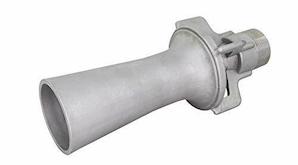
You might also consider that many new installations are moving from air agitation towards eductors. This is a system where venturi style eductors are put into the pipe, instead of holes, and the pipe is connected to a recirculating pump instead of an air supply. Good luck.
Regards,
Ted Mooney, P.E.
Striving to live Aloha
finishing.com - Pine Beach, New Jersey
Need quick confidential answers? $25
Need project assistance? $100/hr.
Air agitation energy consumption/costs
Q. Does anyone know how to calculate the cost of compressed air used in air agitation of plating and degreasing tanks. If we have a compressed air system operating at 100 psig and an air agitation pipe at the bottom of a plating tank containing 19 holes, each being 1/4 inch diameter, how much air (CFM) will flow through each hole?
S Podgorickplating shop employee - London, UK
March 24, 2010
A. Are you sure you want to use compressed air? Unless you've taken extraordinary precautions, there is a real possibility of blowing oil from the compressor into your plating tanks.
James Totter, CEF
- Tallahassee, Florida
A. Sir:
I have done many lab and plant experiments relating to bubbling air through process tanks. If quite a substantial volume of air is bubbled through a hot process tank, then the energy to maintain the temperature of the solution can be about double. This amount of air being about 4,000 cu ft/hour for a 30 foot long by 5 foot wide tank.
In a caustic tank I have some concern that the normal CO2 in the air could convert the NaOH to Na2CO3, thus reducing the strong caustic in solution.
For your question simply monitor your compressor regarding volume and run time.
Regards,
Galvanizing Consultant - Hot Springs, SD 57747
A. There are other factors to consider in the exact costs involved here. Size of the supply line, length of the supply line, any reductions in the air supply line, air leaks if any, temperature, multiple process ports (split-offs), specific gravity of the solution(s)(resistance). I can give you the basic electrical usage calculation though.
Multiply the following data. (hp)(0.746 Kw/hr)(hr/yr) ($/Kw hr)(% time)(% full load hp) divided by the efficiency of the motor. Instead of racking your brain with all these factors, why not have someone monitor the compressor to record the amount of time it has to run in an hours time with running your normal production. Then you can use the electrical usage formula I gave you. Good Luck!
fellow plater - Syracuse, New York USA
A. It is off point a little bit, but a useful rule of thumb to consider is that air compressors will deliver only about 4 cfm per horsepower whereas properly sized low pressure blowers deliver about 28 cfm or more per horsepower. In dollars per year these differences are amazing. Please don't consider using a 100 psi air compressor to agitate tanks that only require 3-4 psi of air pressure. Instead invest in a low-pressure blower which will pay for itself very quickly.
Another rule of thumb for air agitation is that mild agitation is considered to be around 0.5 cfm per square foot of tank surface area and vigorous (such as for hard anodizing) is going to be around 1.5 cfm per square foot of tank surface area. 0.5 cfm/ft2 is plenty for most purposes and anything above that is is probably wasteful. Your hole sizing is probably not optimized for the air agitation that you need. If you have a Metal Finishing Guidebook, then you should definitely read Ted Mooney's article entitled "Solution Agitation and Mixing". It is excellent.
Jon Barrows, MSF, EHSSC
Independence MO
Q. Whist I understand the need for air as a method of agitation I am constantly told by chemical suppliers that in certain acid coppers, whether for PCB or for other forms of plating, that air is essential in order to 'activate the additives'. The question that I would have is how much of the air is for activating additives and how much for agitation?
Robert Sawyerilter company - Manchester, United Kingdom
June 1, 2011
A. Hi Robert.
The additives comprise a very tiny portion of the solution, so any air consumed in oxidizing/activating them is surely trivial. I'd guess that 99.9999% or more of the air put into the tank comes out.
Luck & Regards,
Ted Mooney, P.E.
Striving to live Aloha
finishing.com - Pine Beach, New Jersey
Need quick confidential answers? $25
Need project assistance? $100/hr.
Air agitation blower problems
Q. Has anyone installed a filter between a HOFFMAN air agitation blower and plating line? We have 2 micron filtration on the inlet to the blower but would like to find a post filter system for the unit. ⇦ Answer?
Brian StoiberTechnical advisor - New Berlin, Wisconsin USA
Hoffman Blowers and Parts on eBay (affil link)
Q. In low pressure air agitation, approximately how many or how much CFM and PSI of free air am I going to supply at a 30 lbs can?
Thank you in advance!
- Quezon City, Philippines
April 11, 2016
? Hi Ricyl. Sorry, I cannot decipher "30 lbs can"; please try to re-word it for me. And what kind of electroplating are you doing?
Regards,

Ted Mooney, P.E. RET
Striving to live Aloha
finishing.com - Pine Beach, New Jersey
Need quick confidential answers? $25
Need project assistance? $100/hr.
A. Good day Ricyl.
Try a search for GAST BLOWERS. It will give you details on air sparger requirements.
Regards,
- TorOnto Ont Canada
Gast Blowers and Parts on eBay (affil link)
Q. How much CFM air agitation is required for hard anodizing process of aluminium? Our tank size is width-1.5m, length-4m and depth-2m. We are running total 5 tanks of this size by one compressor. So how much capacity is required for compressor?
Prakash ChaudharyVadodara, Gujarat, India
March 19, 2019
Treatment &
Finishing of
Aluminium and
Its Alloys"
by Wernick, Pinner
& Sheasby
on Amazon or eBay
or AbeBooks
(affil link)
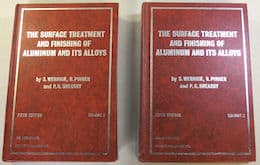
A. Hi Prakash. Wernick, Pinner & Sheasby ⇨
references T. Turner's Aluminum Association Finishing Seminar 1968 mention of 0.22 - 0.45 m3 of air per m2 of tank surface for decorative anodizing. Certainly the high end of this would be appropriate for hard anodizing. 0.45 m3/m2 of surface is very close to Jon's 1.5 CFM/ft2.
Be careful of the word "compressor" though. Regenerative blowers rather than air compressors should generally be used for air agitation.
And remember that the reason for using air agitation in hard anodizing is a bit different than the reason for using it in electroplating! In electroplating, its roles include general solution equilibrium and stripping small hydrogen bubbles off the surfaces of the work; but its main function in hard anodizing is to make sure the temperature of the parts does not rise; this requires more air discharge holes, and below each piece, not just anywhere.
Regards,
Ted Mooney, P.E. RET
Striving to live Aloha
finishing.com - Pine Beach, New Jersey
Need quick confidential answers? $25
Need project assistance? $100/hr.
Q. I just improved my electroforming setup and added much needed agitation. Currently I am using a water pump and I stuffed the end of the hoses, and punctured some holes to make some kind of an air wall. I thought it would agitate the solution more evenly. My problem is: water pump pumps too much air even on the lowest setting and that causes the solution to make bubbles and splatter around. First problem was my copper bar which I suspend my pieces got covered with copper sulphate crystals and it needed constant cleaning. Then I started using a bigger container and filled it halfway and put the bar on top so it wouldn't get covered with acid. It worked but I didn't realize the copper wires that I suspend the pieces were getting covered with acid heavily too, especially the first 1-3 cm. How can I prevent that? I thought maybe if I make my tanks even bigger , it would prevent the bubbles to pop so strong cause they would come from a longer distance but I really don't want to use bigger containers because of the cost and the plating speed. Has anyone encountered this type of problem? Thanks.
Cagin UcarChitta Studio - Turkey Canakkale
May 9, 2019
A. Hi Cagin. We readers don't know yet how big your tank is, or how deep it is, or how large the "water pump" is, or what kind of pump it is, or how big the hose is, or even what metal you are electroforming with 🙂
But it sounds like you have a grossly oversized air pump. The way air agitation is supposed to work is the air bubbles simply rise through the solution because air is lighter than the solution. Consequently, a deeper tank does not absorb their energy and slow them down. In your case it sounds like the volume is so great that you are literally spraying air out of your hose rather than just allowing it to gently float up.
I think the right answer is not to try to fix everything else to match your greatly oversized pump, but to use a more practical agitation system:
- You could recirculate the electroforming solution through that pump instead of using it to pump air.
- You could use a simple mechanical agitation system instead of air agitation.
- You could (perhaps, depending on the type of pump) use a valve or smaller diameter tubing to lessen the air volume -- or at least try drilling larger holes in the hose so gravity propels the bubbles rather than pump pressure spraying it.
Good luck
Regards,
Ted Mooney, P.E. RET
Striving to live Aloha
finishing.com - Pine Beach, New Jersey
Need quick confidential answers? $25
Need project assistance? $100/hr.
Q. Hi Ted. I didn't cover a lot of important information did I:)
First of all the pump I am talking about is a 10 watt aquarium air pump and the hose is a little less then 1 cm in diameter, I would check it but I am not at home. Right now the containers I am using are 3.5 gallons and about 11 inches deep, I have 3 of them. Also I am electroforming copper. I was having very heavy dendrite problem especially at the bottom of my pieces and agitation solved it. I will try bigger holes as you suggested and will get back to you. And also I am thinking about maybe I can use a simple "T" shaped plastic separator so less air will go through each hose. Thank you for your response.
Chitta Studio - Turkey Canakkale
A. Hi. It does sound to me like you could put a tee in the hose and bleed off some of the air 🙂
Regards,
Ted Mooney, P.E. RET
Striving to live Aloha
finishing.com - Pine Beach, New Jersey
Need quick confidential answers? $25
Need project assistance? $100/hr.
Sorry! Finishing.com is temporarily Read-Only.
Please maintain your bookmarks! Although Ted Mooney is retiring, finishing.com is not!
It will have a new owner/curator very shortly!