Summary for electroless nickel black spots Discussion
Electroless nickel plating black spots were reported after a UAN 28 spray test on high-phosphorus electroless nickel over 4140 steel, where the coating was about 20 µm thick and the customer required ASTM B733 SC2 service condition 2 performance for a fertilizer environment. Denuwan Devendra asked what might cause the discoloration. Leon Gusak said the first step is to contact the electroless nickel chemistry supplier, since they may know of similar defects. He noted he could not specifically judge the urea/ammonium nitrate test, but said black marks seen after extended water or salt spray exposure can be surface tarnish from nickel oxides or nickel sulfides if sulfur-containing additives were used. To check whether the coating is actually compromised, he suggested cross-sectioning a black spot and examining the nickel layer under a microscope, and also trying the ASTM B733 Ferroxyl test to see whether iron is reaching the surface through porosity or cracking.
October 4, 2021
Q. We are using electroless nickel plating (high phosphorous) process to get corrosion resistance.
As per ASTM B733, customer need service condition 2 (SC2) [13 micrometers thickness].
But our thickness is around 20 micrometers.
Base metal is 4140 (heat treated) and casted finish.
Customer use this part in fertilizer environment.
So as per customer request, we are spraying UAN 28 (solution of urea [30 g] and ammonium nitrate [40 g] in water [30 g]) to plated part in every 8 hours for 48 hours to test the corrosion resistance.
We have done many tests and recently we found that during this test there is some black color spots appear on the surface.
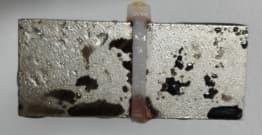
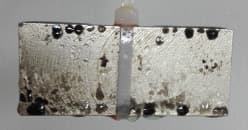
What could be the reason for this?
Denuwan Devendra
– Western province, Sri lanka
A. Hi Denuwan,
The best recommendation is to contact your electroless Nickel chemistry supplier. They may have information about such defects.
I cannot comment about Urea/Ammonium Nitrate corrosion test, but I have seen some similar black marks on electroless Nickel after extended water or salt spray exposure. It may be a surface tarnish: some micro-amounts of Ni Oxides and Ni Sulfides (if Sulfur is included in process additives).
To ensure that Nickel is not compromised and there is no base metal corrosion through Ni crack, probably you can try to cut (cross-section) the black dot and observe the Ni cross-section under a microscope. Also, probably you can try Ferroxyl test (mix of Ferricyanide with Chloride) – see ASTM B733. It is a test for coating porosity on iron based substrate. If iron/iron ions are accessible from coating surface, blue spots should appear.
Good luck.
Leon Gusak
– Winnipeg, Canada
October 14, 2021