
| Search our quarter-million Q&As |
Home of the finishing HOTLINE since 1989
-----Black oxide leaching in clean room
Q. I have a Black oxided assembly used in a clean room and have a leaching problem(sodium hydroxide). I cannot oil the assembly as it will inhibit the process. Thanks
Matthew Millermachine tool manufacture - Farmington, Connecticut, USA
2006
A. Do you mean caustic blackening solution is 'bleeding' out from the assembly?
Ideally, parts are black oxided before assembly.
If not feasible, rinsing must be improved. Follow MIL-HDBK-205A [link is to free spec at Defense Logistics Agency, dla.mil] (diagram p. 62, description p. 64):
Hot water, cold water,* hot dilute chromic acid.
*Repeat the hot water/cold water sequence as necessary to draw out the entrapped caustic solution.
Dry-touch rust preventatives can be used (instead of oil) on black oxide.
- Goleta, California
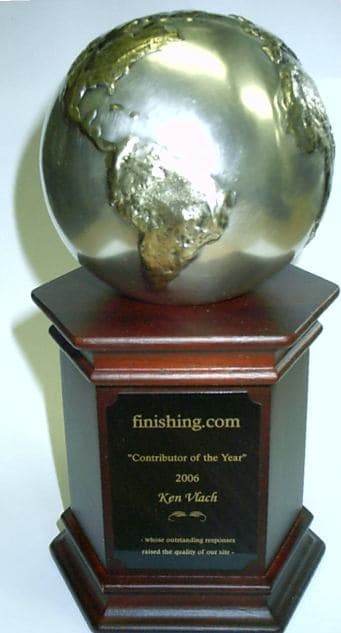 Finishing.com honored Ken for his countless carefully researched responses. He passed away May 14, 2015.
Rest in peace, Ken. Thank you for your hard work which the finishing world, and we at finishing.com, continue to benefit from.
2006
A. Hi Matthew. Gunsmith Rod Henrickson says in letter 13097 that you must boil in clean water for a half-hour to solve this problem. Good luck.
Regards,

Ted Mooney, P.E.
Striving to live Aloha
finishing.com - Pine Beach, New Jersey
Need quick confidential answers? $25
Need project assistance? $100/hr.
Is black oxide (Ebonol C) suitable for cleanroom use?
October 17, 2016Q. Hi,
We are a manufacturer of precision parts for a defence contractor who produces a number of laser type products.
The assembly of said products is carried out in a class 8 cleanroom due to the delicate nature of the lenses involved.
My issue stems from a specific part that we produce which makes up part of the finished chassis assembly.
The part in question is made from phosphor bronze and is required to have a black oxide (Ebonol C) finish. Our plating shop (sub-contracted) has informed us that the parts are first copper plated and then treated with Ebonol C.
We have had rejects from our customer due to cleanliness issues. The black oxide finish appears to have smut on the surface which is cosmetically undesirable and somewhat concerning to our customer as the finish readily transfers to white nitrile gloves worn by the assembly operators. Our customer describes it as surface contamination.
I understand that this effect can be reduced by application of oil, wax or enamel but our customer has a 'qualified' part which the design/spec cannot easily be changed and furthermore outgassing restrictions due to the coatings applied to the lenses.
Does anybody have any suggestions for how we may be able to reduce the appearance of surface smut and in some way seal the oxide surface?
Also are there any professional opinions on the suitability of Ebonol C in cleanroom applications?
Kindest regards
Tim
Product Assurance - Chelmsford, England
Sorry! Finishing.com is temporarily Read-Only.
Please maintain your bookmarks! Although Ted Mooney is retiring, finishing.com is not!
It will have a new owner/curator very shortly!