Summary for polyurethane foam mold coating Discussion
For a mold coating for polyurethane foam, the thread gives mixed advice. Greg asks about coating aluminum molds to reduce or eliminate mold release for soft, flexible automotive polyurethane foam. Guillermo Marrufo suggests two options, in order of cost/performance: electroless nickel plus Teflon particles, or sprayed-on and cured Teflon paint. Jordi Pujol disagrees that coatings solve the problem, saying he was never able to get good long-term results from PTFE, FEP, PFA, or ECTFE coatings and that foam began sticking again after about 20 days, so release agents were still needed. Jason G describes a different process using a Speedypacker and a plastic bag film that slides out easily, but that is not a mold coating. Yanick Borg offers WD-40 as an easy release aid for aluminum molds, noting it can act as a release film for cured polyurethane and epoxy resins. Overall, the discussion suggests coatings may help, but reliable release agents are still commonly needed.
Q. I am looking for a coating or finish I can use on aluminum molds that will reduce / eliminate the use of mold release. We make noise insulators for cars, and our product is a soft, flexible polyurethane foam (poly / iso mixture).
Greg F [surname deleted for privacy by Editor]
Automotive – Valparaiso, Indiana, United States
2005
A. EITHER OF THE FOLLOWING TWO OPTIONS IN ORDER OF COST AND PERFORMANCE DEPENDING ON SEVERITY OF YOUR MOLDING OPERATION AND EXPECTED DURABILITY.
1) ELECTROLESS NICKEL PLUS TEFLON PARTICLES.
2) SPRAYED ON AND CURED TEFLON PAINT.
Guillermo Marrufo
Monterrey, NL, Mexico
A. I’m afraid you will need to use release agents. I’ve made a lot of tests with different kinds of Teflon coatings (PTFE, FEP, PFA, ECTFE) and I never had good results. It lasts just 20 days, after this period the foam sticks onto the mould again.
Jordi Pujol
– Spain
A. I have used urethane moulds to make blocks and shapes extensively. The best results have come from a machine called a speedypacker. This machine pumps both part A and Part B into a plastic bag premixed. The bag is placed into the mould box. On removal the film that the bag is made from slides out of the mould easily. www.sealedair.com/instapak_home.htm
This site should give you a good example….. I had a special brew of urethane made to meet my required specifications. Re: Density = 32kg / m^3
Jason G [surname deleted for privacy by Editor]
Boat Manufacturer – Gold Coast, Australia
? I’m not sure if I fully understand your answer. What are the moulds of this speedypacker coated with?

Ted Mooney, P.E.
Striving to live Aloha
finishing.com – Pine Beach, New Jersey
Need quick confidential answers? $25
Need project assistance? $100/hr.
A. I believe he is talking about the type of foam packaging that manufacturers use to cushion their products for shipping ( i.e. electric motors from Grainger). The bag is the release agent, so the mold doesn’t need to be coated. The process wouldn’t seem to lend itself to close tolerance work.
Gary F [surname deleted for privacy by Editor]
– Flushing, New York
 Thanks Gary. I get it now.
Regards,

Ted Mooney, P.E. RET
Striving to live Aloha
finishing.com – Pine Beach, New Jersey
Need quick confidential answers? $25
Need project assistance? $100/hr.
Q. I have a similar problem with an Aluminum mold and I am looking for a solution. We tried a FEP coating but it has started to peel and chip. and our foam is sticking to the mold again.
We were using a aerosol silicone spray on it but its messy and expensive…Is there a solution?
Stu K [surname deleted for privacy by Editor]
– Trabuco, California, USA
2006
A. You might like to try Nanomouldrelease, its an anti-stick coating (< 200 nanometer) — works excellent on aluminum. Hope this helps..
johnny
Johnny Wong
– Singapore
April 13, 2008
A. Easy solution fellas. .
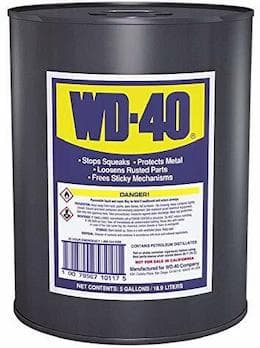
WD-40
⇦ on
or
Amazon [affil link]
. It has good adhesive qualities when sprayed on angled and convoluted surfaces(won’t run) … and the remaining film acts as a good release agent to cured epoxy and polyurethane resins on aluminium.
I suggest using the non-cfc bottled version for environmental reasons.
You could also try drilling holes at different centres to literally poke the cured material out.
Don’t forget that polyurethane and epoxy do not bond.
Epoxy bonds well enough with aluminium however it will not bond with polyurethane at all.
Yanick Borg
– Gold Coast, Australia
June 5, 2008
