Summary for blackening stainless steel and brass Discussion
blackening stainless steel and brass is the practical focus of this thread, even though the original question asked about anodizing zipper sliders made from those metals. Dan Brewer says a common route is black oxide chemistry, which is a conversion coating that can give a durable black finish, and suggests finding a local plating or coating shop. James Watts adds that Prismatic Stainless Steel is the only company he has heard of that developed and licenses an anodizing process for stainless steel. Ted Mooney answers a later question by noting that the process used to anodize steel is not the same as aluminum. In a 2008 follow-up about stainless steel meshes with uncolored spots, Ted suspects inadequate cleaning and recommends scrubbing sample parts with powdered pumice or Bon Ami before the acid dip to diagnose the problem.
adv.


Q. dear sir
We are manufacture of sliders for zippers from brass & stainless steel
We need the chemical processes for anodizing this material of black color just for color ‘
where do I go? thanks Eng. sh j
Sharbek jubran
paskal yiron israel
1999
A. It is very common to blacken stainless steel and brass using black oxide chemistry. This is a conversion coating process that will impart a nice, durable finish. Look in your local business directory for a plating or coating shop near you.
Dan Brewer
chemical process supplier – Gurnee, Illinois
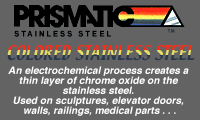
A. Doesn’t Prismatic Stainless Steel [from B&M Finishers, a finishing.com supporting advertiser] perform and license an anodizing process for stainless? They are the only ones that I have heard of that developed this process.
James Watts
– Navarre, Florida
Q. Is the process that’s used to anodize steel the same as aluminum?
Norman Ramirez
– Bay Point, California, USA
2004

Aluminum How-To
“Chromating – Anodizing – Hardcoating”
by Robert Probert
You’ll love this book. Finishing.com has sold a thousand copies without a return request 🙂
A. Anodizing of aluminum is a very widely practiced generic process and the colors are the result of dyes put into the pores; anodizing of stainless steel is done with proprietary processes and the colors are a partial wavelength interference effect like a drop of oil in a puddle; anodizing of steel is not possible to my knowledge.

Ted Mooney, P.E.
Striving to live Aloha
finishing.com – Pine Beach, New Jersey
Need quick confidential answers? $25
Need project assistance? $100/hr.
Q. Dear Sir,
We have some stainless steel meshes for anodizing. We are pretty sure they are “free of Oil or gunk” (washed throughly by weak acid). But we still got “uncoloured spots” after anodizing. We dunno what the problem is.
Sean Pat
Manufacturer – Hong Kong
June 16, 2008
A. Hi, Sean. I would suspect that the parts are not clean, and it sounds like you suspect that as well. Scrub some sample parts with powdered pumice
⇦ on
eBay or
Amazon [affil link] or Bon Ami
⇦ on
or
Amazon [affil link]
before the acid dip and see what you find out. Good luck.
Regards,
Ted Mooney, P.E.
Striving to live Aloha
finishing.com – Pine Beach, New Jersey
Need quick confidential answers? $25
Need project assistance? $100/hr.
Q. Is it possible to carry out anodizing of heat treated mild steel and how?
Sam yar
student – India
June 11, 2009
A. Hi, Sam. I’ve expressed my opinion that you can’t currently anodize steel … but the real question here is what do YOU mean?
What operation do you want to do to the steel, or what qualities or properties are you trying to impart to the surface?
Can you put steel parts into a tank and make them anodic — of course you can. But what you will do to the steel depends on what solution is in the tank, etc., and I don’t think there is any accepted thing you can do to it this way that will generally be beneficial 🙂
Regards,
Ted Mooney, P.E.
Striving to live Aloha
finishing.com – Pine Beach, New Jersey
Need quick confidential answers? $25
Need project assistance? $100/hr.