finishing.com logo
    HOME / sitemapFAQsBOOKSHelp WantedsAdvertiseContact   you are here: Hotline/Forum => Letter 17560 page 2

How to build a bottle cap table, page 2


1     2


September 3, 2009

Q. I am trying to make a beer-pong table about 8' x 3', how many bottles of Kleer Kote would it take to do it?

Josh Neal
Hobbyist - Tyler, Texas


September 3, 2009

A. Hi, Josh. Multiply the length in inches times the width in inches times the depth in inches for the volume of Kleer Kote needed in cubic inches. A gallon is 231 cubic inches, so divide by 231 for the volume in gallons. Good luck.

Regards,

pic of Ted Mooney Teds signature
Ted Mooney, P.E. RET
finishing.com
Brick, New Jersey

js bottlecap table

September 22, 2009

! After reading this thread I ordered 4 gallons of Kleer Kote from US Composites. I laid around 1500 caps on a 2 1/2' x 6' folding table. I used a drizzle coating of Kleer Kote to seal the caps down to the table before pouring a partial flood poor. I'll have plenty of Kleer Kote left, probably more than a gallon. Thanks for all the great advice.

James Sampson
- Mary Esther, Florida


September 14, 2009

Q. How do you achieve a continuous edge? I would like the side of the table top to have the same lacquer finish as the surface. My fear is that even when using a removable metal fence, the lacquer will adhere to the material and/or loose some of its natural luster.

Does anyone have experience with this treatment?

Wm. Shook
- Laguna Beach, California


November 23, 2009

A. Re: Wm. Shook's continuous edge question...

All the poker tables we make have this continuous edge. What we do is build an outside "fence" with wood that's about as tall as the bottle caps. Then, when we resin, we pour 1-2 layers higher than the outer fence. The resin drips down the edge, and you have to smooth it out continuously as it dries. Also, watch the bottom...you'll get drips, and these will dry rock-hard. You either gotta wipe them off when they're wet, or come back and grind them off.

Jeremy

Jeremy Melis
- Dallas, Texas

jm bottlecap table t


September 30, 2009

! Great tables everybody!

I've been checking in on this thread every few months since the beginning of the year.
A housemate and I have constructed a similar table over here in Australia, but can't find an appropriate epoxy to finish it with.
We've tried a couple of 2-part polyurethane casting resins, but the exposed surface doesn't finish flat and hard. We've been back to our local composite supplier, they don't think we can do better.
Can't find Kleer Kote or US composite products anywhere over here, and emails to US Composites have gone unanswered.
If anyone has ideas, I'm all ears. :)
Ahh well, just thought I'd stop lurking and let you all know these tables look great, and post a pic of our effort:
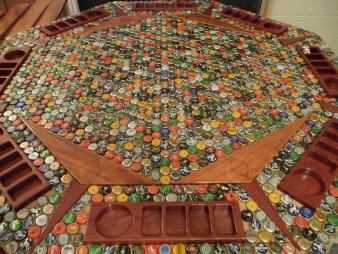
jc bottlecap table

Joe Clarey
- Townsville, QLD, Australia

----
Ed. note May 17, 2010: Joe has completed his table and posted a great youtube video of the construction.


November 11, 2009

Q. Hi this is what I am trying to do: can those of you that have made these awesome tables please chime in....

I want to make a portable (either by hinging it or just having it two separate pieces) poker table out of 3/4" plywood w/ bottle caps and then coat it with klear kote epoxy.
I have a few questions
-will 3/4" plywood be thick enough?
-would you recommend have it be pourable - will I have to worry about the clearcoat cracking because of the plywood twisting or being carried on its side?
Also I and looking for wooden chip racks/cup holders if any ones knows a good place to get them let me know

Thank you
Cole

cole Davis
- New Jersey


November 11, 2009

Hi, Cole. I haven't made a bottle cap table myself, but I've used 3/4" plywood for a plain bar top, and I've done a lot of ceramic tiling (equally brittle) on it; in one case as a stand for a 300+ pound wood stove, where the span was too great and some tiles and grout cracked over time. If you use it for playing poker or beer pong, it will be fine.

But don't make it flimsy, or one day you'll be really really mad at yourself
when there's heavy drinking & fun, and the girls are dancing on the tables
and you have to tell them they can't dance on yours :-)

Regards,

17560-5
pic of Ted Mooney Teds signature
Ted Mooney, P.E. RET
finishing.com
Brick, New Jersey

November 12, 2009

thumbsup2haha
Well I guess that will all depend on the strength of the table I put it on :-) since it will just be a table top.

Thanks again
Cole

cole Davis
- New Jersey


November 6, 2009

Q. I just poured the Epoxy Resin on my beer pong table but I don't think I mixed it very well. It's been three days and it is kinda getting harder but still really sticky but there are a couple of spots where it is still just gooey! What can I do to fix this?

Kristine Nelson
- Bradenton, Florida


November 18, 2009

Q. Hello,

I am in charge of our 5th grade class school auction project where we decided to do a bottle cap coffee table. We found a coffee table at a goodwill store that used to have glass in the center which is now missing. We thought this would be a perfect place to put the bottle caps if we attached plywood underneath the table where the glass used to be. In the meantime we wanted to order plain caps on-line, have the kids paint them, glue them to the plywood (which will have been painted by then) and then pour the epoxy-resin over the caps as the directions call for. I want to know if the epoxy will have an adverse effect on the paint the kids put on the caps. We were going to have them use paint pens, or even perhaps Sharpie markers to save money. I am getting worried about too many different elements getting into the mix, as we would be stripping the coffee table and painting it black, painting the plywood black; applying the caps and seal coats of the epoxy as I have been researching in all of your directions, I just wasn't sure about the paint on the caps, and if there was a certain paint I should use?

Beth Walker
- Nashville, Tennessee


December 9, 2009

A. Kristine,
This may be a little late to help with your predicament. The gooey/sticky undried epoxy is a result of incomplete mixing. I had this happen with one of my prototypes. I was able to scrape off most of the undried stuff and put on a new well mixed flood coat to solve the problem.

Beth,
I didn't see any reaction between any of the painted caps I used and the epoxy. The best way to be sure is to make a small test case using your desired paints and see what happens.

Good luck!
Ron

Ron Steele
- Northampton, Pennsylvania

rs bottlecap table t


December 16, 2009

i. Ron,

I used a small wooden tray and painted it black since that is the color that our coffee table will be. It turns out that paint pens are the best medium of paint to use on our caps. Since our caps were not previously covered with primer or acrylic paint, the acrylic decorative paint the kids applied just peeled right off. The sharpie markers that the art teacher recommended, blurred and ran together after the epoxy was poured on. The paint pens went on easily, were durable and showed up well after the epoxy was applied. Thanks so much for the reply. We will see how the master project goes.

Beth Walker
- Nashville, Tennessee


December 27, 2009

Q. Hello,

All of the responses on this thread have been extremely helpful so far, so thank you! I completed covering a 36" round wood table with bottle caps a little while back, and have since been debating how to cover it. Friends originally suggested a plexiglass table top, but now I am leaning toward using the epoxy because I love the way it looks.

My question is about the edges...since this is a round table with no edges that would stop the epoxy from dripping, I was planning on using removable fences. I'm just worried that the removable fences will get stuck to the epoxy as it dries, or that when I pull them off it won't be even. Does anyone know if this will happen? And if so, how can I prevent this?

Thank you so much, and the tables shown are all fantastic! I only hope mine will look half as good!

Jordan Lloyd
- Austin, Texas


December 31, 2009

Q. Hey there,
All of these projects look amazing! I'm trying to build my own beer-cap shuffle board and was wondering how smooth the kleer koat table epoxy was? A lot of shuffleboard tables I've seen use a clear gloss oil based polyurethane. Would I be able to maybe coat this on top of the epoxy covered caps/table? or is that a no go?

Ben Hintz
student - Chico, California


January 4, 2010

A. Hi Jordan,
I can't comment from personal experience regarding using a removable fence. The klear kote instructions offer some guidance on page three under advanced techniques. I have heard of others who used a temporary edge to build up the epoxy thickness followed by a final coat without the edge to allow the epoxy to run over for a better looking edge. The best advice I can offer is make a small prototype to see if the removable edge you plan to use will be successful.

http://www.shopmaninc.com/pdf/kkote.pdf

Hi Ben,
My bar top is super smooth thanks to the epoxy self leveling while still liquid. There is only a tiny upward curve within 1/8" of the edges where the surface tension of the epoxy crept up the wood edges a little bit. I would guess the extra polyurethane coat will be unnecessary.

Good luck with your projects!
Ron
Ron Steele
- Northampton, Pennsylvania

rs bottlecap table t


January 21, 2010

Q. I am planning on building an 8 x 4 ft beer pong table using a layer of bottle caps on top of plywood. My question is what do you guys recommend I use to glue the caps down and also cover the tops with. Please keep in mind the cover surface has to be hard enough for a good bounce with a ping pong ball. I started planning with plexiglass, but that'll cost me $90 and would prefer a cheaper solution.

Cole juelfs
- Kearney, Nebraska


January 21, 2010

A. Hi, Cole. Cost is always an object, but these bottle cap epoxy tables will unfortunately cost you more than $90 in epoxy.

Regards,

pic of Ted Mooney Teds signature
Ted Mooney, P.E. RET
finishing.com
Brick, New Jersey

January 28, 2010

! Your site is amazing. We're down in Southern Italy and have made a mosaic table for outdoors but have been trawling the internet for ages to work out what to seal it with to ensure protection and a flat surface. Kleer Kote will hopefully be the answer. Now the problem is how to get it to Italy! Thanks for all your input.
Chris

Chris Brunnock
- Ostuni, Bari. Italy

----
Ed. note: Thanks for the compliment, Chris, but the only thing this website did was post what people submitted. Thanks, all, for the wonderful photos and postings!


February 1, 2010

Q. Ok, so I have a 4' x 8' table covered in caps currently not glued down. Ordering the kleer epoxy shortly. I'm wondering how necessary it is to glue the caps down.

If it is, is there anything you would recommend that wouldn't require me to pick up the caps to glue them back down? Every time we pick one up it tends to mess up many other spots.

Thanks!

Emily Hoffman
- Bethlehem, Pennsylvania, USA


February 11, 2010

! Hello everyone, I am currently in the planning stages of my own folding beer cap table with a epoxy top coat. I hope it turns out as good as the ones I have seen on here. You have all given me plenty of information to work from. My table will be regulation sized as you would see in the World Series of Beer Pong. 8' x 2' x 27.5" I will report back and post my pictures when I'm done, wish me luck!

Erick Baumberger
Hobbyist - Springfield, Illinois


zr bottlecap table

February 13, 2010

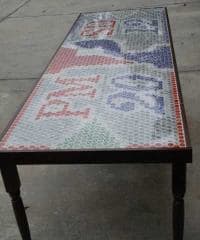
i. My roommates and I have collected about 2,500 beer bottle caps and came up with this design. There's a mario with a 1 up mushroom in a speech bubble, along with 2 triangles for a game of 10 cup beer pong. we still have to pour the epoxy though... just gotta save up some money first.

[The picture is at left].

Zach Repphun
hobbyist - Kent, Ohio


February 17, 2010

Q. Just bought a 7.5' x 2' sheet of plywood, official beer pong table size. My roommates and I have saved metal beer bottle caps for over 2 years. Our goal is to make a custom beer pong table by arranging the beer caps around the wood to make a design.

1. We sanded down the plywood until it was free of anything. Next we nailed the trim around the outside, about 1/4 inch raised off the tabletop. Then took a paper towel and cleaned up any sawdust or residue. We have clear polyurethane and just applied the first coat to the wood tonight.

Our plan is to apply 3 coats of the polyurethane. On the 4th coat, we will apply it very thick, almost globbing it on, and sticking in the bottle caps as we go.

Will this plan work?

Does anyone have a way to make it better?

What do you think will be the best way to finish this project off?

Dave Browne
- Buffalo, New York, USA


March 1, 2010

Q. When pouring the epoxy is there any chance for bubbles to form due to air pushed out from beneath the bottle caps or is this generally not a concern. How should I go about sealing the bottle caps to the base of the table prior to applying the seal coat and ensuing epoxy layers. Thanks.... This is a great thread.

David Burke
amateur builder - Chattanooga, Tennessee


sb license plate table March 8, 2010

This page has provided a lot of great information regarding poured epoxy resin tables. We decided to go with license plates instead of bottle caps and just finished a test pour of a 2' by 2' table. We screwed the plates down and applied the resin slowly and it doesn't appear that any large pockets of air were trapped beneath the plates. We just had small bubbles from mixing.

(The photo is at left)

Our next step is to do a 2 ft by 12 ft counter top that is more similar in size to the Pong tables.

Scott Burnett
- Boise, Idaho


March 15, 2010

i. I'm making a table with Kleer Koat and have had problems with bubbles using a hair dryer like the directions say you can. I wouldn't recommend this and went and got a propane torch, it works easy and fast. Has anyone else had success with other means of bubble popping?

Byron Strother
Hobbyist - Denver, Colorado


March 29, 2010

A. Hi David,

Sorry for the late reply. I haven't checked this page in a while. Yes, bubbles from under the caps is a concern. In a couple of my prototypes, I had issues with bubbles emerging from under the caps after the epoxy was too hard to pop them. One explanation I read is the air under the caps expands and escapes as the epoxy temperature increases during curing. I solved this problem by using tile grout to seal around the caps. Another solution is to fill the caps with something to eliminate the air pocket.

Hi Scott,

The license plates look great. Well done!

Ron Steele
- Northampton, Pennsylvania

rs bottlecap table t


April 6, 2010

Q. I am new at the bottle cap tables and have come across a few questions. Once the caps are glued down, how do I put borders or fences around the table's edges where they are removable? Then what is the best color and type of epoxy to put on top of the caps? So that you can clearly read the caps...

Mathew Anderson
hobbyist - Auburn, Alabama


April 14, 2010

! I am making a table of my own. These postings have provided further inspiration to my idea of building a pong table. I must say that my techniques will vary slightly as I will be using ordered blank caps to achieve my design and I am going to use an acrylic sheet top (unfortunately I really can't afford the epoxy and I got a good price on the acrylic sheet). I plan to have it done within a month and will post pictures for everyone to compare.

Eric Miller
- Allentown, Pennsylvania


April 23, 2010

! I have been collecting bottle caps for two years with the intention to build a bottle cap table. I finally finished it this month after countless hours of labor building, sanding, finishing, arranging, cleaning, sealing, and tweaking. It was such a fun project. I can't cut the habit of collecting so I'm already thinking-up ideas for another one. This one is a beerpong table. The legs fold-up and it has removable shorter legs so it can drop-down to coffee table height when we're not playing.

bb bottlecap table

Brent Bulger
- Austin, Texas


May 3, 2010

Q. I already put a 3/16" coat of epoxy resin down and I wanted to pour a second coat along the front of my bar. I called the manufacture and they said to sand it with 220 grit and then use acetone to remove loose particles. I am a little stumped by this seems like to much grit. Does anyone have any suggestions on what to do before I pour a second coat. Thank you very much.

Jason Anderegg
- Plano,Texas


May 17, 2010

! Hi, I just finished a bottle cap coffee table. I ended up painting the table black with a "fence" around the edge for the resin. I found a cheap way to seal up the bottoms of the bottle caps. I used black silicone at Home Depot and used a caulk gun to spread it generously over the surface and press the caps into it. The silicone sealed up the bottom of the caps and filled in the spaces between caps. This saved on me having to spend extra money on the resin. Unless you look really close, the silicone is barely visible against the rest of the black table. Thanks you to the rest of you who posted great hints and tips.

Chris Mias
- New York, New York


May 17, 2010

i. Hi all,

Finally finished our table.

We shipped the Kleer Kote all the way from the US.

Instead of a pic, check out this video. If you're only interested in the epoxy bits, you can skip to test pour at 2:37 , and final set-up/pouring starts at 2:54. We did 3 layers of epoxy, seal coat is tough with the bottle caps packed in tight. Used a heat gun to pop bubbles, works much better than a hair dryer and worth the $15. Pouring the epoxy is a bit of a pain, most challenges have already been mentioned here. A few additions:

1) Don't do it at night. At least if you live somewhere that tiny bugs are attracted to bright lights. Yep, we were left with a few tiny fruit flies in the surface on the final pour.

2) Don't overdo it with the heat gun. I got a little overzealous in one area, and the air under the bottle caps expanded and escaped en masse. I had also set the surface layer by overheating it, so the bubbles couldn't get out. Its not too noticeable, but it bugs me.

3) Using the removable barrier method was interesting. Make sure you pull that plastic sheeting really tight. Any bubbles or creases you leave there will result in weird patterns in the side of epoxy layer, making attaching the final sides more difficult.

4) Even after sealing the base of the table and all the gaps with copious amounts of silicon, we still had about 6 leaks. Wasn't a major problem, just make sure you lay something down underneath where you pour.

Feel free to throw questions at me now, feel I've a bit of experience with this stuff.

Cheers,
Joe

Joseph Clarey
- Townsville, QLD, Australia


June 9, 2010

! Awesome forum, this really helps people a lot, I was wondering if anyone has tried placing epoxy resin over vinyl, or in my case a vinyl banner. I designed an 8 ft x 3 ft vinyl banner that I want on my table with some sort of epoxy resin placed on top for display/protection. Any ideas?

Ray Calitri
- Upstate New York USA


June 16, 2010

i. Here it is. Took a lot of work. I would really appreciate you publishing this photo.

em bottlecap table

Thanks,

Eric Miller
- Allentown, Pennsylvania

----
Ed. note: Nice "nittany lion", Eric!


June 25, 2010

A. Hi Eric, just wanted to say that table looks great. Is that with the acrylic sheet on top? Gives a nice result if so.

Ray - Have no experience with using vinyl, but I don't see it being a problem. The epoxy doesn't seem to react with any materials, though water based paints and dyes may run a little? It also warms up a little in the curing process, but probably not enough to damage the vinyl. I'd still suggest doing a test pour to sort out any problems. The epoxy works well, but I guess you could also look into glass or acrylic options to protect the banner. Hope it all works out, post some pics when you're done!

Joseph Clarey
- Townsville, Australia


July 28, 2010

A. I spent two years collecting bottle caps. Ended up collecting far more than needed, so I have a lot extra. I decided on a Texas themed table with red v. blue. I decided on a 2X8 table that would be stationary and not portable. I built the table itself with a 1X2 edge around the top that is about 1/4" high off the table top. The height is the same as a ping pong table. It took a total of about 1900 caps to complete the table. I ordered my epoxy from US Composites. The only problems I really encountered was a fly landing in the epoxy causing me to have to repair the spot which in turn left a higher area on the epoxy because I didn't put a full new layer down. But it doesn't look bad because the rest of the table came out flawless. The costs of the table including lumber, paint, and epoxy came out to about $220. I plan to eventually add red and blue lights under the table too.

tp bottlecap table

Travis Peterson
- San Marcos, Texas


August 4, 2010

! Thanks to everyone for all the tips and advice. My roommates and I finished our bar a while back and I'm just now getting around to submitting a picture.

dw bottlecap table

Let me know if you have any questions!

Danny Warner
- Pensacola, Florida


September 25, 2010

Q. I'm about to start laying my caps down for an 8' by 3' table, I was wondering how strong the epoxy is, and how well it will resist cracking and splitting like a windshield when the table is moved around. Should I divide my cap basin into 2 or 3 areas? or Go with glass top? Thanks!

Donnie R
military - Pensacola, Florida

October 31, 2010

Q. Hello,

I constructed an 8' by 4' bottle cap table but have not laid down any type of resin yet. After we constructed it, we realized that we made the border height too tall because right now, if we were to fill in the area with resin to the brim of the border (which is how we want it), it would take around 10 gallons of resin, and we do not want t, or need to, spend that much money. The caps and the border are glued down really well, so we thought of a scenario that we could try to fix it, but I wanted to run it by this forum first. Here it is...we pour 6 gallons of resin down (a little bit at a time, going through the process) right now and then, once the resin dries and hardens, we would trim down the border to the point of the border and resin being at the same level with a hand planar or something similar. Any problems that you foresee? Would the resin crack? We originally wanted to pry up the border pieces but with it being glued down by wood glue, we figure it would simply rip the weaker wood, being the plywood.

John Shoar
- Dayton, Ohio

November 2, 2010

Q. Hey everyone,

What is the best way to glue down the bottle caps onto your table? Would using hot glue around the perimeter of the caps work, or should I fill the insides of the cap? Or can I put down a thin layer of epoxy and while its still sticky lay my caps?

Nick Keller
- Columbus, Ohio, United States

December 12, 2010

Q. I am about to build my table and have a question about gluing down the caps. There has been a lot of talk about this and I was wondering if anyone has used rubber cement for this since it can be applied easily and is cheap. Would anyone recommend using clear elmer's glue instead? Thanks in advance for any answers! On Wisconsin!

Kody Habeck
- Madison, Wisconsin

December 13, 2010

A. Kody: I didn't glue my caps down at all. I slowly pored the first layer of epoxy over the caps and kept an eye of them for 30 minutes, then periodically checked them for the next few hours. If I caught any caps floating up, I'd push them down slowly, and blow the bubbles out. I had maybe 20-30 that tried to float up, which is relatively low, considering.

Travis Peterson
- San Marcos, Texas, united states

January 10, 2011

Q. I spread out a thin layer of Elmers glue using a sponge brush and set the caps on top. The caps do not move or raise.

I have a question about the Kleer Kote. My bar is going to be in an unheated area off of my detached garage. It is enclosed but it gets below 0 around here in the winter. The bar will not be used in the winter but I was wondering if the Kleer Kote will crack? Anyone have a bar in an area like this?

Jack Bonnett
- N Ridgeville, Ohio USA

January 11, 2011

Q. I am working on a project as a gift for my boyfriend. I want to adhere bottle caps to a piece of wood to make a plaque like display of bottle caps in the shape of a 4 leaf clover. I want to layer the bottle caps to make the clover 3D. I am stumped at how to attach the bottle caps to the wood and to the other bottle caps. Does anyone have any ideas? I would like to seal the entire completed piece as well, and I have no idea how to go about sealing it without a frame around it.

Crystal Graham
- Raleigh, North Carolina, USA

April 8, 2011

Q. Going to be doing a Kleer Kote epoxy top to my bar about 3-6 weeks from now, sealing bottle caps in the process. All the advice here has been very helpful, but has anyone tried to drill through it? I need a spot for the beer line to come up into the draft tower and would prefer to drill after finishing the epoxy, if possible. I don't want it to crack, though.

Rick Mahone
- Buffalo, New York, United States

July 29, 2011

Q. Wondering if Rick Mahone drilled for his beer tap? Please post the procedure you followed for this. I'm in my biggest cap table to date that will eventually include a beer tap from a keg underneath. Need to know how wide the diameter of the hole - I'm planning on drilling prior to pouring...

Dan Gasteazoro
- Apple Valley, Minnesota USA

June 20, 2011

Q. Hey, I was was going to spray paint the wood underneath the bottle caps, but I was wondering if the Kleer Koat would do anything to the paint? anybody know/ would it even look good/ do I need to treat the plywood first?

Thanks guys!

Jack Knobloch
- Greenwich, Connecticut, USA

July 17, 2011

! Planning on doing some similar projects using the Kleer Kote Resin, my first will be encasing and enshrining seashells my 6 year old daughter collected from our vacation onto a board and making sort of a plaque that can be hung or stand like a picture. I will of course thoroughly clean (bleach) and rinse and dry them first. For the seal coat I planned to coat the board that will be used for the base and dip the shells prior to lying them onto the board in the desired arrangement. I am hoping this will reduce the issue of bubbles with subsequent flood coats. Thanks to all for the great info. and pics. After this I am beginning to get inspired to do a poker table.

Bill Wilson
- Pittsburgh, Pennsylvania

July 22, 2011

! Just wrapping up my first project. My dam around the circular table produced some issues that I'm reasonably confident I didn't come across a solution for in this awesome thread...so here goes - I intended to pull the dam off from the outer circular edge (and inner for for a beer bucket) and found that the tyvek flexible "wood" piece I used for the dam left a white coating on the epoxy (used US Composites Kleer Koat, awesome btw). What is best to use to remove this film? Second question...my dam left sharp edges. I am brainstorming the best way to "grind" these down. A sharp blade, sandpaper? I want to be able to see within epoxy finish without clouding the clarity.

Thanks for the info from years past and (hopefully) for answer to come!

Dan Gasteazoro
- Apple Valley, Minnesota, USA

July 25, 2011

i. First try at beer cap table, I'm gonna do it again

pz1 bottlecap table pz2 bottlecap table

Peter Zuzelski
Hobbyist - Walden, Colorado

August 9, 2011

i. Here is a photo of my bar which I created based on the posts in this forum. Thanks to everyone for your help and go Phillies!

jm bottlecap table

FYI, I used hot glue to secure the caps and U.S. Composites Kleer Kote Table Top Epoxy as the pourable surface. It turned out great!

Here is a little website I created with step by step instructions and pictures of how I created my bar: mirasphillybottlecapbar.webs.com/

Jim Mira
- Pennsylvania

August 15, 2011

Q. Hi all, I am a crafter making tables out of beer caps and other things. My problem is when I use the Kleer Kote on a black table I often get a dusty look in the epoxy. Any idea what I am doing wrong. Looks like tons of microscopic bubbles. Does it make a difference what type of container you mix the Kleer Kote in? Very frustrating when sometimes they look great and the next they don't. Can't seem to figure out what is different on the pours.

Linda Oertwich
crafter - Pilger, Nebraska, USA

August 18, 2011

A. I had the same problem in some parts and I think it's a result of stirring too fast. It causes tiny air bubbles that you can't really pop with a torch. On my next project I'm going to stir really slowly and hang a bed sheet or something over it to prevent any dust.

Jim Mira
- Scranton, Pennsylvania

August 28, 2011

! I found this site while me and my buddy were deciding to make a bottle cap table. All the posts have helped us a great deal. We just finished it. I will try to get photos of it soon.

Zach Alix
- New London, Connecticut

September 16, 2011

i. Thanks everyone for their suggestions on this site. I used it as my guide in creating this amazing coffee table. I am currently undergoing my undergraduate degree at The University of Cincinnati and have loved Bearcat football, so I made a tribute table. The final design used 544 plastic coke bottle caps. The table measures approx. 22.5" x 40.5"

jf bottlecap table

Thanks again to all for the great suggestions/advice!!

Josh Fuerst
- Cincinnati, Ohio, United States

November 14, 2011

Q. My friend and I have started a bar but it is on a hollow door. This was a couple years ago but we used vinyl tile glue to put the bottle caps on but we didn't seal the wood in any way. Do you see there being a problem with this in any way? And should I put a seal-coat over the caps before I do my flood coat?

Andrew DeVries
- Kalamazoo, Michigan, USA

February 5, 2012

! This website is exactly what I need to get my project started. I am starting out with a tile top coffee table. I am going to leave the tile on one side of the table top and put bottle caps on the opposite side so depending on the event we can flip the top of the table. I have already started the project and will be posting photos soon.

Thanks for the help on this forum.

Martin McCloud
- North Carolina


dm bottlecap table April 24, 2012

This is the table I made, just need to add epoxy, going with the Kleer Kote. I was originally going to do a beer pong table or bar top but I found this table outside my our apartments dumpster and just went with it (on of the legs was "broken" just needed a 4 inch piece of 1x4 to fix it, their loss) The caps that are turned upside down between the designs are from rainier and actually contain rebus puzzles on them. I remember growing up with them and helping my dad solve them.

Anyway, I'm going to build a barrier around it somehow so it will be flat out to the lowest edge. Might fill in more caps on the edges when I do that.

Drew McCarson
- Winlock, Washington, USA


April 29, 2012

Q. Has anyone ever used kleer koat on cardboard boxes?
How did it turn out?

I've had the idea of using beer and pizza boxes to make a coffee table and book shelf for a while but never used it before not sure how it would work out.

Thanks

eric green
- colorado springs colorado usa


May 3, 2012

Q. I have an outdoor "tiki" type bar with a mahogany bar top. I would like to embed sea glass and sea shells in an epoxy finish on top. Can I stain and urethane the top before applying the epoxy?

Frank Silva
- Truro, Massachusetts, USA

June 4, 2012

Q. Very informative thread everyone. I don't believe I have really seen an answer for this question yet. I am wondering if it would be beneficial to fill the bottle caps with something like hot glue or plaster, before applying the epoxy, to help keep any bubbles from leaking out. Would this work and/or even be worth the time to do it?

Josh Barta
- Lincoln, Nebraska, USA


August 7, 2012

Just wanted to send a big thank you to this thread, as it helped me plan a bottlecap bartop project that turned out really great. All the tips were fabulous.

One huge tip that I'd like to offer: Do not take too much time pouring out your mix, because it will start to smoke, harden up quickly, and you'll end up pouring a big blob into the middle of your project. This happened to me. Luckily I was able to get most of it off, and cut a line with a utility knife before it really screwed things up too bad.

For my edge, I decided to cut wine corks in half long ways, and hot glue them end to end around the edge - this was really nice since I had a rounded part to my top. I then used about 5 coats of polyurethane on the corks and especially inside the area where the caps would be so that it was completely water tight. I know the epoxy instructions say to do a thin coat like this, but I recommend just doing it with polyurethane which is a lot cheaper and also not as messy.

ts1 bottlecap table ts2  bottlecap table

To do the mixing, I used simple red solo cups - filled a cup up twice with hardener and dumped into a trick-or-treat style halloween bucket, then used a separate solo cup and filled with resin (thick!) twice and dumped in. Stirred slowly per the instructions. Made sure it was 75-80° where I was doing it - needed a space heater and had to shut the AC off in my house for a day (boo). Left the epoxy warming in my garage in the days before the pour.

I'm really glad we didn't waste our time trying to glue down the bottle caps before the flood coat - we had like 900 caps, so that would've taken forever. Once we had our patterns all laid out, basically just slowly pour your mix over the caps and have somebody else there helping you if possible. We found that using the end of a clean paint stirrer was very helpful with the "floaters". You'll see when you do yours, about 5-10 seconds after a cap is covered it will begin to float. Just push each one down over & over with the paint stirrer until every one has "sank" - and your rubber gloves stay clean. I was also using a paint stirrer to "drip-fill" the harder to reach areas on my top - but don't take too much time because your bucket will get HOT and you'll end up with a mess - seriously - have it poured within like 10 minutes after stirring's complete or you'll regret it. We didn't need to use any heat gun or anything - the bubbles just rose to the top and we popped them with the end of the paint stirrer.

My bartop is 24" wide by 80" long (with a curve in it) and 2 gallons was the perfect amount of resin. Cost me about $100-110 delivered off Ebay.

Already thinking about what we can do next!

Tom Staszak
- Pittsburgh, Pennsylvania, USA

----
Ed. note: The cork edge was a nice looking and practical idea!


August 22, 2012

Q. Can I use a marine grade epoxy resin kit, or will that yield a completely different result?

Jesse Frederickson
- Port Townsend, Washington, USA


August , 2012

Hi Jesse. If you have spare marine epoxy and a small unimportant project to try it on, please do and then tell us what happened.

But if we need to guess, my guess is that it will be quite unsatisfactory because coating materials are optimized for their purpose and marine epoxy might overheat if that thick, or it might acquire unremovable bubbles, or it might not level without brushing, or it might harden before you can get it all smoothly poured, etc.

Regards,

pic of Ted Mooney Teds signature
Ted Mooney, P.E. RET
finishing.com
Brick, New Jersey

August 24, 2012

Q. I really am lost. I'm trying to make a beer pong table for my husband's man cave. He's deployed and I wanted to surprise him. I don't know where to find the caps at. Also, how do you attach them to the table after its made? Thanks.

Jordyn Delossantos
- Tacoma, Washington, USA


August 25, 2012

Hi Jordyn.

I think the main source of caps is beer bottles that you have opened. If that is not applicable, it's possible to buy plain bottle caps in a wide variety of colors from Amazon =>

3 postings above yours, Tom S. tells you how to do the project without attaching the caps, just pushing them down when they float. So you can either glue them or not. I'm not suggesting that the project is easy, because I haven't done it, but I think there is enough info on this page if you read slowly and carefully. Good luck.

Regards,

pic of Ted Mooney Teds signature
Ted Mooney, P.E. RET
finishing.com
Brick, New Jersey

Bottle Caps


October 2, 2012

Q. Hi all,
I've been looking at various sites and this appears to be the most informative. I have a painted plywood hexagon shape with a wood trim border. The table is just going to be inside a garage/basement.

I plan to glue my caps down with a clear acrylic latex caulk, is that a bit overkill?

I saw a lot of resin products to seal it, is one of the products better to use than others? (My dad suggested an FRP fiberglass resin) Has that been used before?

Any other suggestions would be appreciated, and I'll be sure to post a picture after I'm done!

Jackie Schmit
- Chicago, Illinois


December 12, 2012

Q. For those of you who have done folding beer pong tables... Did you just use 2 fences in the middle to create the barrier? If not how did you separate the 2 sides so the table was still able to fold without having a lip/bump in the center of the table? What material would you suggest to use for a removable fence? And in general about how much does the finished beer pong table weigh? Lastly how did everyone keep dust and bugs and anything else unwanted from sealing into the final surfaces? Thank you everyone for all your shares! This will be my first project and it's a pretty big one but I think my son will appreciate his birthday gift. Thank you all again!

Crystal Garcia
- APO, AE (US Army, stationed in Europe)


May 12, 2013

Q. Hey Everyone,
I see this forum is a little old but hopefully someone can help me. I am building a mini bar, and I put my first coat down of resin tonight. After reading the instructions more thoroughly I see that we made our coat about three times as thick as recommended. Does anyone know what I should expect? Will it even set? Help!

Sara Roloff
- Fond du Lac, Wisconsin, US


May , 2013

A. Hi Sara. The forum is well established, durable, and enduring -- not old :-)

If you added the right amount of curing agent (hardener), it will harden. These chemical hardening reactions generate a lot of heat and I think that one concern with a coating that is too thick is it may gas or bubble from overheating. But if it worked it should be fine.

Regards,

pic of Ted Mooney Teds signature
Ted Mooney, P.E. RET
finishing.com
Brick, New Jersey

June 15

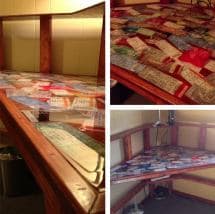
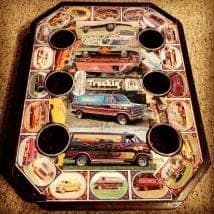
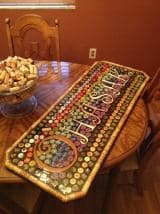
A. Hey - Tom S here again - same guy that did the bar [a few postings above]. I'm back to report we've done 3 more epoxy projects since the bar.

First is a desk I made for my wife (from scratch) who works in the music business - we covered the top in concert ticket stubs. Second is a table I made for my 70's custom van with 1975 Donruss "Truckin" trading cards & vintage van magazine cutouts. Third is a wall-hanging barcap sign with cork edge & lettering for a game room that we made as a gift for friends for their wedding.

ticket stub table  truck theme table  ohasak

Advice in addition to what I said back when I submitted my bar pics: If using paper/cardboard like two of these projects: FIRST - use clear spray paint on the front & backs of each piece of paper. This is tedious - however it'll prevent wicking during your pour. I found that spray painting thin layers were best so that the actual spray paint didn't wick the paper as well. SECOND: Glue down every nook & cranny of paper including corners - they will float and annoy the heck out of you. THIRD: If you use wooden letters like in the sign we made, cover the letters (or anything wooden) with polyurethane first - otherwise you'll get air bubbles.

We poured all 3 of these at room temperatures around 70-72 degrees and they all turned out pretty good. Keep some shims on hand wherever you're doing your pour so that you can adjust the levelness on the fly. I used Elmer's glue as "caulking" around all the edges & nooks & crannies - it's key to make sure there's nowhere for the epoxy to escape. It's best to have at least 2 people on hand during the pour -- we used clean paint stirrers to push our bottlecaps back down (over & over & over) as well as a hair dryer. Once you feel it starting to firm up, stop trying to pop every last bubble because you're likely to screw it up more than you're helping it.

As you can see -- I have cup holders inside the van table. The way i did this was I shoved solo cups in the holes extremely tight and glued them in with Elmer's -- they held tight for the pour. Then after the epoxy hardens, you can pull them out and hit the sharp edges with some sandpaper.

Everybody has loved all of our projects, and I'm sure there will be more! Good luck if you're reading this and trying this for your first time.

Tom S
- Pittsburgh, Pennsylvania, USA

----
Ed. note: Incredible work, Tom. Thanks for sharing it with us!


1     2

ANSWER, or ASK a related Q. POST an unrelated Q.See HOT Topics


disclaim

 seek

JobshopsCapital Equip. & Install'nChemicals & Consumables Consult'g, Train'g, SoftwareEnvironmental ComplianceTesting Svcs. & DevicesUsed & Surplus


©1995-2013 finishing.com     -    Privacy    -    Search