
| Search our quarter-million Q&As |
Home of the finishing HOTLINE since 1989
-----:What to use as anodize remover/stripper
Quickstart:
In the anodizing of aluminum the components are immersed into a tank of acidic solution and connected to the anodic (+) positive pole of a power supply. The current separates some of the water in the solution into positively charged hydrogen and negatively charged oxygen. The oxygen is attracted to the positively charged components and converts the skin of the aluminum to aluminum oxides.
Readers new to anodizing of aluminum may wish to view our "Intro to Aluminum Anodizing".
It will sometimes be necessary to remove an anodize coating. The anodized surface is very hard, and the underlying aluminum is very soft, so mechanical removal generally isn't usually practical and chemicals must be used.
Caustic soda (sodium hydroxide / lye / NaOH) is the most commonly used stripper, but chromic-phosphoric acid has the advantage that it only dissolves anodizing, unlike caustic soda which can also attack the aluminum.
Remember that stripping anodizing is different than stripping plating or paint because even if the stripper consumes no aluminum, the anodizing itself did, so the part will be smaller after stripping than it was before anodizing. An anodized coating of 0.002" thickness consumes about 0.001" of aluminum to create the aluminum oxide, and you don't get that back.
Read on, join in ...
Q. What is the best way to remove an anodized coating and prep the part for a new one. I would VERY MUCH like to use anything other than nitric acid, due to its availability and toxicity.
Chris Francis- Hampton Virginia
2000
Aluminum How-To
"Chromating - Anodizing - Hardcoating"
by Robert Probert
You'll love this book. Finishing.com has sold a thousand copies without a return request 🙂
A. Whoever anodizes your parts will strip them before they anodize. A warm bicarbonate of soda at about 1 lb per gal will strip it slowly. If you want it to go faster, you can add one teaspoon of lye per gal until you find one that works best for you. Guts ball, use Easy Off oven cleaner ⇦ on eBay or Amazon [affil link] . Very aggressive.
James Watts- Navarre, Florida
Q. How long does it take with the bicarbonate formulation? I am seeking to experiment in order to contribute more information about amatuer/hobbyists friendly finishing methods, avoiding as far as practicable difficult to obtain or hazardous substances.
Sorry for poor english, ESL.
- NSW state, wollongong city
May 3, 2026
This is a meeting place for camaraderie & sharing, not a free consultancy. So some readers don't engage with anonymous posters.
A. Hi Harry.
James was a prolific responder here, but has not been around for some years.
A sodium bicarbonate solution is going to be about pH 8.5, and I think it would take the better part of forever to strip anodizing with it. Sodium carbonate, washing soda however has a pH of 10 to 12 depending on concentration, and can probably strip anodizing (depending on its thickness) in something like a half hour (guessing here because of no actual experience with stripping anodize in washing soda).
The problem with this and and with most strippers is that it will probably also attack the aluminum if not watched.
Luck & Regards,

Ted Mooney, P.E. RET
Striving to live Aloha
finishing.com - Pine Beach, New Jersey
Need quick confidential answers? $25
Need project assistance? $100/hr.
A. Caustic soda ⇦liquid caustic soda in bulk on Amazon [affil link] , 50% mixture is a common anodizing stripper and etching solution that would not only remove previous anodize, it would etch and clean the surface and the surface would be ready for a new fresh coat of anodize.
If you're thinking industrial sized solution and not something for yourself personally then I would suggest either using straight caustic soda with an addition agent that keeps the caustic bead or flake from gathering on your tank and heating coils and what not, or you could buy a premixed solution from a vendor with the addition agents already available in the solution mixed with the caustic (I use the latter for its plain ease of use).
Matthew Stiltner- Toledo, Ohio
Q. Won't the caustic soda mixture damage the aluminum, that is destroy the machined finish and possibly pit it?
chris francis [returning]- HAMPTON Virginia
A. Chris, You just listed good reasons why you should have a professional do it. It is a series of tradeoffs. Time, temperature, chemicals, concentrations and thickness of the anodizing to be removed. Excess of any one of them will remove an excess of aluminum and possibly pit your part.
James Watts- Navarre, Florida
A. Hi Chris, James is right, but from my experience, to pit a part with a caustic solution, takes an extended period of time. Granted, it depends a lot of the condition of the material in question. But I can never remember pitting a part with a caustic soda ⇦liquid caustic soda in bulk on Amazon [affil link] , maybe I'm just fortunate but it's never happened to me. I'd say the maximum time to leave a part in any caustic soda solution should never exceed 1 minute to be safe. 15-30 seconds is a reasonable amount of time to prep a surface that is bare. To strip an anodize I generally etch around 45 sec - 1 min and it works fairly well 99% of the time.
The surface comes out with a semi-matte finish, but nothing so extreme as to dull the surface of the aluminum. There is a mixture of chromic acid + phosphoric acid that strips anodize only and limits the attack on the base material, but it's got to be used in excess of 150 °F, so it's probably too much out of range for average user needs such as yours. Not to mention the definite danger of these two chemicals mixed together and boiled can be very high.
Matthew Stiltner- Toledo, Ohio
A. I have ran anodize line on type 2 for 30 years, and have removed the anodize coating on thousands of parts. Use a 10% solution of caustic soda ⇦liquid caustic soda in bulk on Amazon [affil link] at 110 °F for 40 seconds to a minute, rinse parts.
Raymond Hendrix Troy, Tennessee

|
! I believe we should take a step back here and look a little closer at this question. I don't know Chris' background from his brief letter, but with all due respect to him, if he is concerned about handling nitric acid (which won't strip anodize anyway) he obviously is not a person used to handling chemicals, as nitric acid is only one of many nasty chemicals in any typical metal finisher's shop. Hot caustic, even at 10%, is not something an inexperienced person would want to handle any more than he would want to handle nitric. To me, telling Chris to use caustic for stripping is like telling an Indy race car driver who was just in a bad accident to switch to NASCAR- the odds are good that he can still get hurt. The first sentence of Jim Watts' second letter expresses my advice to Chris- leave the stripping and refinishing to an experienced anodizer. If you are in a position where you must do this yourself, learn the proper handling procedures for hazardous chemicals. One reason that anodizing is done in the first place is because it is a relatively inert, chemically-resistant oxide. This means that removing it when necessary is not an easy task, and is almost impossible without handling something hazardous.
"The Surface
Treatment & Finishing of Aluminium and Its Alloys" by Wernick, Pinner & Sheasby  on Amazon or eBay or AbeBooks (affil link)
Regards,  Ted Mooney, P.E. Striving to live Aloha finishing.com - Pine Beach, New Jersey Need quick confidential answers? $25 Need project assistance? $100/hr. |

 Hi Phil. Thanks for the very important warnings, Phil!
A. CHRIS,
I BOUGHT SOME ANODIZE REMOVER AT A CAR SHOW A COUPLE OF WEEKS AGO, IT IS CALLED SIMPLY ANODIZE REMOVER. THIS PRODUCT WORKS VERY WELL BUT PRECAUTIONS NEED TO BE TAKEN AS WITH ANY CHEMICAL. I USED IT ON ALUMINUM TRIM ON A 1960 CHEVY AND WAS AMAZED AT THE RESULTS. YOU SHOULD BE ABLE TO FIND IT AT ANY CAR SHOW WHERE VENDORS ARE PRESENT.
Brian Allison- Shelby, North Carolina
A. Anodize coatings can be stripped using a dilute aqueous solution of phosphoric and chromic acid. There will be no etching of the parent metal. See MIL-A-8625 / MIL-PRF-8625 [⇦ this spec on DLA], especially the section on measuring the coating weight. The solution used for stripping the test panels can be used for production parts. Be sure to consider the dimensional change (hard anodize can be in excess of 0.002"). Don't mess with either chemical without proper safety precautions.
Sodium Hydroxide will strip the anodize coating (aluminum oxide) but will strip the aluminum even faster. I wouldn't do this in a production setting. I strongly recommend you don't do this, but Drano ⇦ on eBay or Amazon [affil link] (the plumbing cleaner) is a relatively strong NaOH solution. I know for a fact it etches aluminum in a hurry. As always, the resulting gas with Al and NaOH is hydrogen, which is highly explosive.
William Beeson- Phoenix, Arizona, USA
2003
Q. I tried stripping a clear anodize with KOH (I didn't heat the water though?). It seemed to strip it okay but left a dark film on the part which would not rinse off with water but would wipe off with a rag. The problem is there's a lot of engraving I can't clean the residue out of. How can I clean these parts so they can be re-anodized? Is the problem the KOH?
Thanks for your time.
- Rochester, New York
October 1, 2008

Never use HF anywhere unless trained!
If you do, you MUST have the antidote gel on hand for instant use!
Calcium Gluconate
for HF acid burns
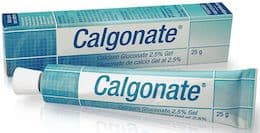
on Amazon or eBay
(affil link)
A. Hi, Jeff. The principle here is that KOH will dissolve aluminum but it does not dissolve the copper, silicon, and other alloying materials that are usually present to varying degrees in aluminum alloy parts. They remain behind, and become concentrated, and turn the part gray or black. An anodizer removes them with desmutting compounds which can dissolve copper and silicon, often including quite dangerous nitric acid and horribly dangerous hydrofluoric acid.
It might help to explain your situation in greater detail; we don't know the alloy, and whether it's a casting or extrusion. It would be good to be completely clear on whether this one particular part was a fluke that you encountered after previously stripping hundreds of parts, or whether this wa a one-off and you had little idea what to expect.
If you are not an anodizing shop it might be best to just let the anodizing shop do the desmutting. It may not be a big deal with the proper acids. Best of luck!
Regards,
Ted Mooney, P.E.
Striving to live Aloha
finishing.com - Pine Beach, New Jersey
Need quick confidential answers? $25
Need project assistance? $100/hr.
A. caustic soda will attack any aluminium based product and destroy it [dependent on dilution]. If it touches Al it will turn it black. This is my experience of using a caustic soda & water based paint stripper bath.
Peter Robb- Dunedin, Otago, New Zealand
February 21, 2015
A. You will need a deoxidizer; what you are seeing is what most anodizers would call "smut'. Hope this helps.
KJE Estoque- Angeles City/Pampanga, Philippines
October 13, 2022
Q. Stripping Nickel Acetate only.
How can I strip off the nickel acetate sealer from some Type III anodized parts.
We did some secondary machining on the parts after anodize, and then used Branson MC-3 in an ultrasonic tank to clean the parts, and it damaged the Nickel Acetate sealer. Preferably we cannot attack the Anodizing.
- wilton California
March 18, 2016
A. Hi Clay. Sorry, but I don't think that can be done, although I'd like to hear from other readers. When we hear the term "sealer" we tend to envision some sort of "clear coat / top coat", but sealing in anodizing doesn't involve an additional coating, rather it involves clogging the pores with nickel compounds but also hydrating the aluminum oxide to cause it to convert to a more voluminous form that seals them.
Type III coatings are usually only sealed if identification is required, i.e. live ammunition rounds vs. dummies; are you sure they were sealed?
Regards,
Ted Mooney, P.E. RET
Striving to live Aloha
finishing.com - Pine Beach, New Jersey
Need quick confidential answers? $25
Need project assistance? $100/hr.
Q. I am planning to start a business of de-anodizing aluminium (hard coated). As far as I know there is always risk of damaging aluminium in using caustic as de-anodizing agent. Are there any other options for this process that can keep the un-anodized part safe?
Pradee Papnai- New Delhi, India
November 11, 2016
Ed. note: This question is answered in the posting from William Beeson above, Pradee, chromic-phosphoric acid.
How to remove 12µm Aluminum oxide on Aluminium alloy
Q. Hi. I would like to repair a damaged aluminum alloy anodized surface. I need to remove the 12µm Aluminum oxide on the surface first. I saw on the web that many suggest different methods. Actually is 10% HNO3 good enough to remove Al2O3 without attacking the Al surface? 10% NaOH at room temperature also gets the job done? I would like to try to keep the chemical concentration not too high as the waste treatment may have some problems.
Andrew Wong- Hong Kong
December 16, 2016
A. Hi Andrew. Please slow down and read carefully. No one suggested HNO3 (nitric acid)! You could try the NaOH (caustic soda) at room temperature, and see whether it works, and whether it harms your parts.
But Raymond Hendrix has told us that over the course of 30 years he's successfully stripped thousands of parts with:
10% NaOH
at 110 °F.
in 40 seconds to 1 minute
It's understandable to want to skip the heating, but when a procedure is already clear, simple, & straight-forward, remember the Vaudeville aphorism: "Don't tinker with a good line" 🙂
Regards,
Ted Mooney, P.E. RET
Striving to live Aloha
finishing.com - Pine Beach, New Jersey
Need quick confidential answers? $25
Need project assistance? $100/hr.
Q. Hi my name is Jim Atherley, I am needing to find out the mixture of 50% caustic soda ⇦liquid caustic soda in bulk on Amazon [affil link] and the other agent for stripping Aluminum after it's already been anodized. Also a distributor of where to buy a pre mix.
Jim AtherleyAnodizing business owner - Orem utah
July 22, 2021
A. Hi Jim. Raymond Hendrix very confidently says on this page that 10% at 110 °F for 40 seconds to 1 minute does it.
We can't suggest distributors (huh? why?) I don't believe you need any other ingredients, nor a pre-mix, but don't forget that this chemical can also attack the underlying aluminum, so watch the time. The chromic-sulphuric doesn't attack the aluminum; sorry, I don't know if anyone offers a premix.
If dimensions are critical, remember that you lose some aluminum from each anodizing/stripping cycle because the anodized film was made from the aluminum of the substrate.
Luck & Regards,
Ted Mooney, P.E. RET
Striving to live Aloha
finishing.com - Pine Beach, New Jersey
Need quick confidential answers? $25
Need project assistance? $100/hr.
Sorry! Finishing.com is temporarily Read-Only.
Ted Mooney is retiring but I have several offers to take it over.
We're working hard to make sure we find it the best new home.