

Metal finishing Q&As since 1989
-----
Use of Pickling VS Passivation in removing rust in Stainless Steel
2007
The following passage is shown in a number of website on Stainless Steel:
"Pickling is an acid treatment to remove high temperature scale produced in welding, heat treatment or hot working. It also removes red rust from corrosion of the steel or from corrosion of contaminant iron or steel particles. Note that passivation is not sufficiently aggressive to remove this corrosion product after the free iron has begun to rust."
Does this mean pickling instead of passivation must be used to remove rust on Stainless Steel?
architect - Hong Kong, China
2007
Yes, pickling is used to remove rust and may be required as a pretreatment for passivation.
If formal documentation is needed, ASTM A967, 'Standard Specification for Chemical Passivation Treatments for Stainless Steel Parts' refers to ASTM A380
, 'Cleaning, Descaling and Passivation of Stainless Steel Parts, Equipment, and Systems.' The latter describes and gives solutions for acidic descaling (pickling).
- Goleta, California
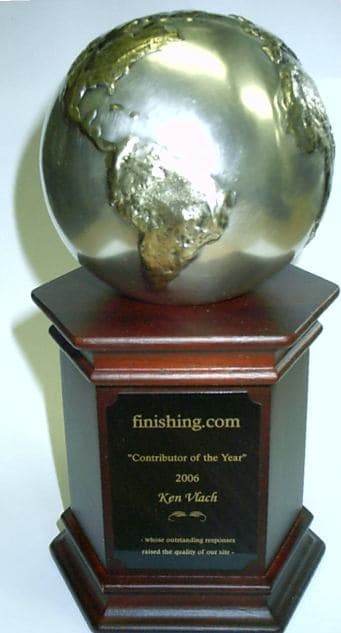 Finishing.com honored Ken for his countless carefully researched responses. He passed away May 14, 2015.
Rest in peace, Ken. Thank you for your hard work which the finishing world, and we at finishing.com, continue to benefit from.
You mention several distinctly different operations here. Pickling can remove rust from the surface and also removes the heat treat of weld discoloration.
Passivation after pickling will improve the surface to improve the corrosion resistance.
If it is JUST rust removal that you want to do, there are a lot of treatments that can do this without using harsh mineral acids.
If you want to remove red rust AND re-passivate you can use citric acid based products to do this effectively.


Lee Kremer
Stellar Solutions, Inc.

McHenry, Illinois
2007
2007
Hi there, I have a question to ask.
I need to know the difference between
ASTM A380
compared to ASTM A967
- Malaysia
July , 2007
You need to get a copy of each if you intend to reference them, Adrian, but perhaps the biggest difference is that they were written by different committees :-)
Milt Stevenson explains some of this in letter 37219.

Ted Mooney, P.E.
Striving to live Aloha
finishing.com - Pine Beach, New Jersey

this text gets replaced with bannerText

Q, A, or Comment on THIS thread -or- Start a NEW Thread