

Metal finishing Q&As since 1989
-----
Test for ethanoic acid
Hello :)
I am an AS Chemistry Student, and Have a planning exercise. I have to identify 6 liquids. I've almost completed the exercise but have become stuck! Ahh!
I've been looking for a positive test for ETHANOIC Acid. My original plan was to add a sample of Iron (3) chloride to all liquids, and identify by colour change! But I cannot find a suitable equation to show this!
Does anyone know of the reaction between ethanoic acid and Iron (3) Chloride, or of a another positive test for Ethanoic acid?!
Thanks for your times, guys!
A- Level Chemistry Student - Swansea, Wales, UK
2007
2007
The easiest method is smell - ethanoic acid (known as acetic acid
[on
eBay or
Amazon] in the USA) has a characteristic sharp vinegar
[in bulk on
eBay or
Amazon] smell.
The Yahoo answer re ferric chloride [on
eBay or
Amazon] as indicator may be wrong: The method works for the salts of the acid, but the color disappears in the acidic solution itself.
If you have access to an IR spectrophotometer, acetic acid has a well-known spectrum. The C=O bond gives an absorption peak at 1680-1750 cm(-1) and the O-H bond gives a broad trough in the range 2500-3300 cm(-1). http://www.chemguide.co.uk/analysis/ir/interpret.html
Reaction of acetic acid with an alcohol will produce an ester (typically, sweet smelling). E.g., reaction with ethyl alcohol (with sulfuric acid present as catalyst and a desiccant to remove water produced) produces ethyl acetate, which is commonly found in nail polish remover and has a fruity smell.
As a weak acid, its solution conductivity is lower & pH is higher than a strong acid of equal concentration. Titration with 1.0N NaOH [1N NaOH on
Amazon]
solution should produce a characteristic curve (pH vs. volume titrant).
Reaction with Mg metal will produce H2 gas, and reaction with baking soda will give CO2 gas [true for most acids]. Wikipedia gives many properties which may be useful.
https://en.wikipedia.org/wiki/Acetic_acid#Detection
- Goleta, California
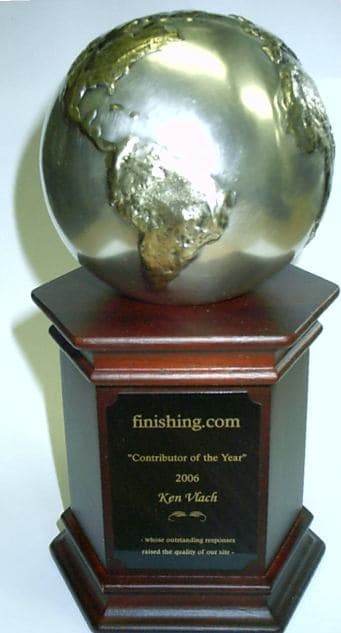 Finishing.com honored Ken for his countless carefully researched responses. He passed away May 14, 2015.
Rest in peace, Ken. Thank you for your hard work which the finishing world, and we at finishing.com, continue to benefit from.
Q, A, or Comment on THIS thread -or- Start a NEW Thread