

Metal finishing Q&As since 1989
-----
DI Water Standard
Is there a standard to define what "good quality" DI water is. What is the maximum conductivity that should be allowed? less than 5 micromhos/cm, less than 10? All thoughts and opinions will be appreciated.
Kurt Sammonshigh performance conductors - Inman, South Carolina
2007
I think you're going to get lots of opinions on this, here's mine for what it's worth, I'll let my tank go to 100 ppm, but no higher. I've been in clean rooms that run their tanks at 5ppm. Most of the system suppliers guarantee <5ppm coming out of the resin tanks. It's really up to you to set your own standard based on testing you're own product(salt spray, various adhesion test, etc,...)

Sheldon Taylor
supply chain electronics
Wake Forest, North Carolina
2007
2007
"There's nothing either good nor bad but thinking makes it so."
--- Hamlet.
Think about the sensitivity of your application to contamination.
'Good quality DI water' is perhaps 18 Meg(a)ohm-cm water from mixed bed polishing. See Type I Reagent Water requirements in ASTM D1193. Maximum conductivity of 0.056 microSiemens/cm,* max. chloride 1 ppb, max. silica 3 ppb, max. organics 50 ppb.
*Siemen (S) = mho = 1/ohm
For most natural waters, conductivity in microSiemens/cm x 0.55 to 0.70 = ppm TDS.
- Goleta, California
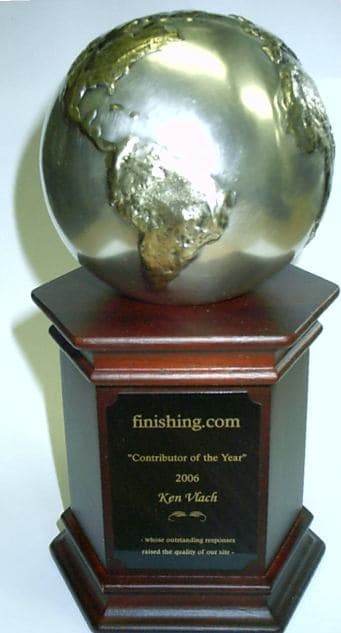 Finishing.com honored Ken for his countless carefully researched responses. He passed away May 14, 2015.
Rest in peace, Ken. Thank you for your hard work which the finishing world, and we at finishing.com, continue to benefit from.
There are actually four grades of DI water in the ASTM standards literature: Types I, II, III and IV. These are actually pretty good benchmarks.
A water handbook should list these and other standards, but there seems to be little consensus in industry over a quantitative definition of "deionized water".
Many customers specify the resistivity or conductivity of the water used for final rinsing, and many process chemistry suppliers also have specifications for water used in their processes. For example, it is not unusual to see specifications for water with a resistivity of > 2 Meg-Ohm-cm in the mirror manufacturing industry, and > 3 Meg-Ohm-cm in the electronics plating industry.
consultant - Cleveland Heights, Ohio
2007
Q, A, or Comment on THIS thread -or- Start a NEW Thread