
| Search our quarter-million Q&As |
Home of the finishing HOTLINE since 1989
-----Find the copper content in the British penny
Q. I am a sixth year school pupil doing an advanced higher chemistry project, find the copper content in the british penny. If I dissolve the coin in nitric acid and electrolyse the solution to remove the copper will I then be able to determine the copper content in the penny? If anyone could help me with this question it would be appreciated
Thank You
Student - Coatbridge North Lanarkshire Scotland
2006
A. It will not work well because whatever the alloy metal is will also plate out.
You really need to know what the alloy metals are and since you do not have sophisticated equipment, you might be able to dissolve it in sulfuric acid (probably 50%) to get copper sulphate
⇦ on
eBay or
Amazon [affil link] and then use an EDTA or sodium thiosulphate
⇦ on
eBay
or
Amazon [affil link]
titration to find the amount of copper. You will find this in a college analytical chemistry book at the library.
- Navarre, Florida
2006
2006
A. I have to disagree with James on this one.
Find a chemistry book on Quantitative Analysis, and it should have a procedure for electrolytic determination of alloys. The usual procedure is to selectively plate out the copper from a 1 M sulfuric acid solution onto a pre-weighed platinum cathode at a controlled voltage (lower than that at which the other metal(s) plate out. Check the emf series). After plating out all the copper, weigh the electrode. Additional metals in the alloy can be then plated out stepwise, at controlled voltages.
- Goleta, California
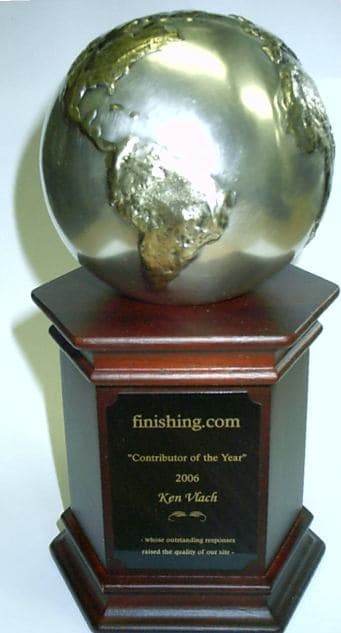 Finishing.com honored Ken for his countless carefully researched responses. He passed away May 14, 2015.
Rest in peace, Ken. Thank you for your hard work which the finishing world, and we at finishing.com, continue to benefit from.
2006
Hi Ken,
I made an assumption and that can be dangerous. The assumption was that his school would not have a power supply with a fine enough control to selectively plate out the copper. It also assumes that there is no other metal that could plate out first from the sulfuric solution. It requires an insoluble anode, which I doubt that he would have. The pH will drop like a rock if he is going to plate out all of the copper which will also cause problems. He would very probably require using an aliquot sample which requires more equipment and calculations.
Yes, it is doable, but does he have the toys to do it?
The high schools here certainly do not.
- Navarre, Florida
A. Hi Sam,
Why don't you cheat and ask the British Mint for the copper content?
But would they reply to a country North of Hadrian's wall?
Good question !
Freeman Newton [deceased]
(It is our sad duty to advise that Freeman passed away
April 21, 2012. R.I.P. old friend).
2006

|
2006 "Why don't you cheat and ask the British Mint for the copper content?" As the British mint is situated in Wales and both Wales and Scotland (good celtic countries) are part of Britain any reason why they wouldn't? Incidentally, England (which is not Britain) is also part of it. John Martin- Wales Bleedin' 'ell, Freeman Newton [deceased] (It is our sad duty to advise that Freeman passed away April 21, 2012. R.I.P. old friend). 2006 2006 Save a little bit of that moonshine for the New Year Freeman! It's causing you to slur your speech. Who would put a "U" in the word "favor" anyway?  Sheldon Taylor supply chain electronics Wake Forest, North Carolina You spell favour with a 'u' this side of the pond. May not be fashionable but that's the way we do it. John R Walker- Co Derry, N Ireland 2006 |
A. Quoted from "History of the British penny"-95.5% Cu, 3% Sn, 1.5% Zn alloy, or, depending on what year the penny was struck-97% copper, 0.5% tin, 2.5% zinc alloy. This obviously isn't the answer so stay off my case, the answer is how to do the experiment that will prove the website is correct.:-)
Sheldon Taylor
supply chain electronics
Wake Forest, North Carolina
2006
A. Before we get too carried away with the historical copper content, I suggest that you try the effect of a magnet on a current British penny. Wow-magnetic copper!
For a long time now, copper has been too expensive to make pennies. They are now made of copper plated steel.
I believe that the coating is pure copper, so a practical experiment would be to weigh the coin, dissolve the copper and weigh again.
The trick is to dissolve the copper and not the steel. The easiest solution would probably be concentrated nitric acid (in a fume cupboard and don't let the environmentalists catch you) A better idea is to use a solution of sodium or ammonium persulphate. Ammonia/hydrogen peroxide or sulfuric acid/hydrogen peroxide are also possibilities.

Geoff Smith
Hampshire, England
2007
|
|
Hmmm, - Cleveland, Ohio 2007 2007 Thanks for the procedure, results and discussion, Will! But tooth decay from soft drinks is more closely related to their sugar content, and the support this gives to plaques, than to dissolution by acid. If you put the cut up pennies in vinegar ⇦ in bulk on eBay or Amazon [affil link] or lemon juice they dissolve much faster than in Coke (I couldn't get those penny wedges to dissolve in Coke in two weeks). Should vinegar and lemons be avoided by children as worse for teeth than Coke because they are more acidic? Or should Coke be avoided because it is more sugary than vinegar or lemon juice?  Ted Mooney, P.E. Striving to live Aloha finishing.com - Pine Beach, New Jersey Need quick confidential answers? $25 Need project assistance? $100/hr. May 28, 2008 "Hmmm Thought the penny in coca-cola "trick" had been disproved, it was on Myth Busters (quite educational), and another program on The Discovery Channel that I forget. The acid in Coke is too weak to be effective, or have they started producing super strength coke?. And the teeth problem is more to do with the sugar content. For the penny experiment I suggest using one of the acids mentioned by other posters, unless you want to wait several years. In my humble opinion. Philip Harrison- Nottingham |
Q. I'm doing the exact same project, but as I'm doing it with a recent coin, I had to find out the content of iron as well. I've completed all the experimenting, and now I just need to write it up.
But I've lost my "daybook" thing :(
So I'm gonna do all the calculations backwards, so I need to know the copper and iron content of a recent (after 1993) one pence coin.
Anyone have it?
- Glasgow, Scotland
April 16, 2008
Shoot that darn dog, Daniel, he's ate the homework one time too many.
Ted Mooney, P.E.
Striving to live Aloha
finishing.com - Pine Beach, New Jersey
Need quick confidential answers? $25
Need project assistance? $100/hr.
April 19, 2008
Sorry! Finishing.com is temporarily Read-Only.
Ted Mooney is retiring but I have several offers to take it over.
We're working hard to make sure we find it the best new home.