
| Search our quarter-million Q&As |
Home of the finishing HOTLINE since 1989
-----Science project on the effect of water, saltwater, vinegar, and bleach on steel wool
Quickstart: Steel wool is great for corrosion studies of different liquids because its huge surface area makes reactions proceed quickly. But nails are better for experiments with coatings like nail polish or oil because it's very hard to cover every strand of steel wool with these.
Clorox was the most corrosive liquid, followed by vinegar.
Never mix bleach (Clorox) with acids like vinegar!
Q. Does a clear nail polish ⇦ on eBay or Amazon [affil link] or oil coated on a steel wool pad prevent it to rust better when dipped in water? checked after every 12 hour.
Hellena S [last name of minor deleted by Editor]- Vancouver, Canada
February 4, 2021
A. Hi Hellena. I think there are two issues here: first, your question of how effective the nail polish and the oil are at discouraging rust; but secondly, how well you will be able to coat steel wool with nail polish vs. oil. I think a thin oil like machinery oil or WD-40 ⇦ on eBay or Amazon [affil link] has a fair chance of saturating (wetting) all the surfaces of the steel wool, but nail polish won't -- there will be steel exposed.
I think a great experiment would be to try both coatings on a steel nail (which you will be able to fully coat) to see which is better at resisting rust, before trying it on the steel wool to see if the same result still holds.
Luck & Regards,

Ted Mooney, P.E. RET
Striving to live Aloha
finishing.com - Pine Beach, New Jersey
Need quick confidential answers? $25
Need project assistance? $100/hr.
⇩ Similar, related, Q&As -- oldest first ⇩
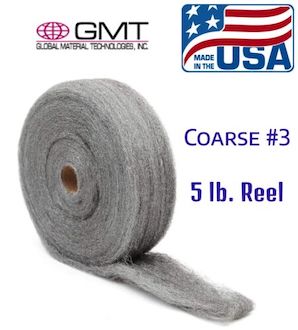
Q. Here is the situation: I notice you have a lot of inquiries regarding nails and rust but, I am a student and am doing a science project trying to compare the way steel wool rusts in different types of water. I am using distilled water, tap water (unfiltered), spring water and reclaimed water from one of our local ponds and squares of extra coarse steel wool ⇨
Each piece of wool is in a separate container with only a thin layer of water across the bottom. I notice not only rust in the water after a couple of hours but also small dark specks in the pond water, and the way in which each piece of wool is coated in rust varies from one water type to the next. (i.e. the wool in the spring water is rusting from the middle rather than the top or bottom. I can't seem to find information on why this may be happening for example are the black specks results of the minerals in the pond water reacting to the wool? Do you know where I may be able to locate this type of information or a resource which may aid my problem?
student at Western Governors University - Glendale, Arizona, USA
2005
A. Maybe more questions than answers.
I would expect algae in pond water. Examine the specks with a microscope. Another possibility is FeS formation in sulfur-containing water.
Was the steel wool completely cleaned prior to testing? If not, I suggest ultrasonic cleaning in warm, alkaline detergent, followed by rinsing (final rinse DI water in the ultrasonic bath), & 125 °C oven drying.
Are you monitoring the pH, TDS (total dissolved solids -- can use a conductivity/resistivity tester), dissolved oxygen (or at least ORP)?
The solubility of iron varies with pH; see "a graph of pH vs. Metal Concentration in wastewater" at www.finishing.com/library/metalpH.html
Are the containers covered or open? Light will grow algae, water can absorb CO2, O2 (to replace any consumed in oxidation of Fe), etc.
ASTM has publications on corrosion in natural waters,
STP 1086 Corrosion in Natural Waters, and
STP 1300 Corrosion Testing in Natural Waters: 2nd Volume,
with Tables of Contents available at www.astm.org,
but perhaps not applicable, as the exposures are in situ.
- Goleta, California
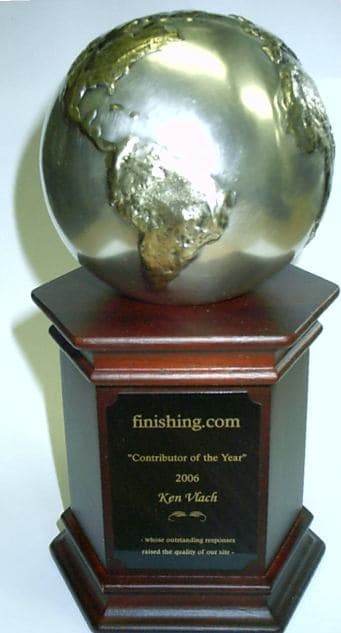 Finishing.com honored Ken for his countless carefully researched responses. He passed away May 14, 2015.
Rest in peace, Ken. Thank you for your hard work which the finishing world, and we at finishing.com, continue to benefit from.
Q. I am conducting a science fair experiment and I am looking for sources of information on the affect of salt if the water amount stays constant on a piece of steel wool. Should I use a different metal for my experiment than steel wool? How can I find information on the affect of salt as I plan to add 1 tablespoon , 2 tablespoon and 3 tablespoons and 4 tablespoons and watch the effects over a 20 day period of time. Lastly, I will measure the weight of each piece of steel wool before the experiment and after to show the measurement of change.
Margaret M. [last name of minor deleted by Editor]student science fair - Lakeland, Florida
2006
A. Hi,
There are some problems with your experiment design that you might want to look at. First, most steel wool has a trace amount of an oil like material on it to keep it from rusting in the package. You should remove it before you start. I would soak it in a glass or ceramic pan/bowl with distilled water and an industrial strength soap or possibly some trisodium phosphate
⇦ on
eBay
or
Amazon [affil link]
(TSP). I would boil it for several minutes and then rinse it in more of the distilled water. Shake off the excess water and put it in the oven at about 180 °F for several minutes to completely dry. As soon as it is fairly cool, put it in the smallest tupperware dish that it will fit in. When it is cold and you are ready, weigh it on the best balance that you can come up with. At that, it is probably not going to be sensitive enough for a rational result.
Use the coarsest steel wool that you can get
⇦ on
eBay or
Amazon [affil link] or you will lose weight (fine pieces of steel)in the handling.
After your exposure time is up, again dry the steel wool in the oven, cool and weigh. It will pick up some weight just standing in open air.
Now the big problem- Part of the steel wool is going to dissolve in the salt solution, which will produce a large lie in your results, i.e., you have a rust weight gain, but you also have a weight loss of the steel. There is no way to run a blank or a control. You would have to analyze the salt solution for iron which is beyond high school capabilities unless you have access to a real lab. You should run triplicate samples and compare weight gains per weight of steel. Use some easy statistical methods on it to present your results.
- Navarre, Florida
A. Hi Margaret.
I think you'll need to be careful that you have enough water to see the difference because of the issue of 'solubility'. At normal room temperature you can only dissolve about 360 grams of salt (about 20 tablespoons) per liter of water . So if your container is small you may not be able to dissolve 4 tablespoons of salt into it. Any sludge/syrup sitting undissolved at the bottom of your container doesn't add corrosion it just distorts your graph -- so maybe you could try 1 through 4 teaspoons instead of tablespoons?
Luck & Regards,

Ted Mooney, P.E.
Striving to live Aloha
finishing.com - Pine Beach, New Jersey
Need quick confidential answers? $25
Need project assistance? $100/hr.
Q. Hello,
Great site! My Uncle and I have just completed the majority of my 8th grade science fair project experiment. We wanted to know what rusted steel wool the quickest: water, sugar water, salt water, vinegar
⇦ in bulk on
eBay
or
Amazon [affil link] or Clorox
⇦ in bulk on
eBay
or
Amazon [affil link]
. I know you have received inquiries on this type of experiment many times and we have benefited from it greatly. I have some additional questions on the subject that I cannot find answers to however. First, our procedure: We cleaned the steel thoroughly (thanks to tips from this site-- it will be heavily mentioned in our report/bibliography!) and partially submerged them in a 10 ounce clear plastic cup containing 8 oz of the liquids mentioned above. To limit spillage, we taped another cup, with a 1/4" hole in it, on top of the other cups. The hole was there to allow moisture in. In a week, here are the results from least to most rusty:
1) Sugar water
2) Water
3) Salt water
4) Vinegar
5) Clorox
Note: Water was NOT out of the tap and therefore was not aerated nor contained chlorine.
The difference between the first three was minimal. The difference between vinegar and the first three was very significant as was the difference between the Clorox and the other four (the entire biscuit of steel wool was nearly converted into rust!).
Here are my questions:
Early in the experiment, we noticed that the cups containing the vinegar and Clorox were dripping with condensation. Did the Clorox and vinegar know that this was a rust experiment and that we would need water? Also, after a week, there was absolutely no scent of Clorox or in the cups at all. They smelled and looked like water!
Furthermore, the rusting was still occurring in the cups containing and Clorox but the rate had decreased to that of the other cups. I think that water replaced the Clorox but don't know why. Your input is greatly appreciated.
Student - Columbus, Georgia, USA
2006
A. Vinegar
⇦ in bulk on
eBay
or
Amazon [affil link] and Clorox are both acidic. The acid reacted with the steel. Acetic acid plus iron will yield an iron acetate. Clorox is a 5% solution of sodium hypochlorite, NaOCl. This is a moderately strong oxidizing agent. Rust is iron oxide, so you would expect it to form the most rust.
Rust is formed by iron plus oxygen plus moisture. It takes all three. temperature is a factor on the rate of reaction within certain limits. The reaction will proceed faster when you have material that increases conductivity. Sugar is a very poor conductor.
Hit google for rust and then oxidation. Wikipedia should have some layman's language on both.
The smell went away because you used up the free acetate and free OCl.
- Navarre, Florida
A. Hi,
Jim has explained that you consume the vinegar and bleach by running the experiment; but in addition, bleach is actually chlorine gas dissolved in alkaline water and, over time, the chlorine dissipates into the air. The reason you smell it is because it is dissipating :-)
I think Jim suffered a small mind slip though; although bleach is very corrosive to steel because of the OCl he mentions, bleach is alkaline not acidic.
Luck & Regards,
Ted Mooney, P.E.
Striving to live Aloha
finishing.com - Pine Beach, New Jersey
Need quick confidential answers? $25
Need project assistance? $100/hr.
Sorry! Finishing.com is temporarily Read-Only.
Ted Mooney is retiring but I have several offers to take it over.
We're working hard to make sure we find it the best new home.