
| Search our quarter-million Q&As |
Home of the finishing HOTLINE since 1989
-----Passivation of Titanium Medical Implants Q&A [ASTM F86]
Q. 1) Is it recommended to copper sulphate
⇦ on
eBay or
Amazon [affil link] test titanium (I would argue that "passivation" of titanium isn't required per ASTM B600).
2) if any part (implantable or instrument) is copper sulphate tested, do you have to throw away the parts? We AQL our copper sulphate test (sometimes 47 parts) and it would be a big cost to discard them per ASTM F1089. Can you demonstrate removal of copper sulphate as part of cleaning validation instead and thus not discard the parts?
Technical Services Director - South Bend, Indiana
October 26, 2021
A. Deana,
Though the term "passivation" is applied to several different processes and materials, usually with titanium we are talking about the stainless steel version of passivation, i.e. removal of surface iron. In the case of titanium there is no iron in the alloy, so the concern is solely for contaminant iron, and if you're confident there was no opportunity for iron contamination to occur, then there is no need for a passivation treatment.
The copper sulphate test is just an iron indicator, and can be used on a wide variety of substrates to check for the presence of iron (I'm sure some other metals might cause a "positive" test result also, but it's used in cases where iron is the main concern.)
When working on ASTM F1089 (corrosion testing for surgical instruments), I tried to remove the requirement to discard parts after copper sulphate testing, and was told that even though we know a negative/passing test result isn't leaving any copper on the surface, it's not easy to PROVE that not even the smallest amount of copper remains, and some parts of the body that surgical instruments are used on are extremely sensitive to damage from copper. It does seem odd to run a test that means throwing away an expensive medical tool, but the attitude was this would be used by people that have bought them in bulk and the sacrifice of one to ensure the compliance of the rest is acceptable. Personally I wonder if people just avoid calling out F1089 because of this, much as some people specify ASTM A380
for stainless passivation when they want to avoid the per-lot testing requirement in ASTM A967.
Other standards, such as the aerospace AMS2700spec or the general industry ASTM A967 and ASTM A380
, regard copper sulphate as a non-destructive test, if it's a pass you rinse off the solution and move on. The old MIL-STD-753C (used by QQ-P-35C) and older versions of A967 said to not use copper sulphate on food equipment, but the possible copper contamination from a drop or two of this stuff is really too minor to be of genuine concern there. ASTM F86 for implants doesn't mention copper sulphate at all, and really is intended to just point out the NEED for passivation or other relevant surface treatment, it leaves the appropriate method and testing procedures up to the user to determine, since the standard covers implants of any metal or alloy. ASTM B600 imports the ASTM A967 treatments for use on titanium, but did not carry over copper sulphate or any other test method.
In the end, yes, if you are required to follow ASTM F1089, then you must discard instruments test with copper sulphate. However, if we are sticking to a strict reading of F1089, it is for stainless steel only. Titanium is not mentioned at all, nor do I recall any kind of provision for use on non-ferrous alloys in general (such as is found in the appendix of ASTM A967).
I would say in your case, you should be within your rights to decide whether or not to use copper sulphate for per-lot testing in the first place, and whether or not paranoia over the smallest bit of residual copper is applicable for the end use of the piece.

Ray Kremer
Stellar Solutions, Inc.

McHenry, Illinois
October 28, 2021
November 1, 2021
A. Deana,
Titanium alloy, especially 1-4 grade, is soft and always incorporates some iron from cutting instruments. The best way to completely remove any iron enclosures is to briefly electropolish parts. The surface becomes "surgically clean" after electropolishing.

Anna Berkovich
(ed. update July, 2025: sorry, Anna has retired)
 Anna,
Anna,
Thanks so much for your response. We do EP titanium, but we often follow it with passivation. To your point, our main customer has requested that we just EP.
Q. I have one more question. F86 and one of my customers implies that it is only exogenous iron that is concerning. I'm wondering if any iron from the material itself is freed during processing? In other words, if a stainless steel has more iron content in its alloy composition, would it be somewhat "worst-case" regarding passivation validation. This assumes the processes expose all metals to the same (unquantifiable) exogenous iron? Does that make sense? I'm trying to rationalize a "worst case" approach to the validation. Again, super helpful is this website and thanks for your participation.
Technical Services Director - South Bend, Indiana
November 4, 2021
A. Deana,
The ASTM standards regarding passivation of stainless steel currently really only talk about this exogenous iron (alternatively, free iron or iron contamination), as a problem, and mostly ignore the iron that is innate to the alloy. Of course, yes, iron contamination when present is a much greater problem than the innate iron, but also we still generally passivate stainless when iron contamination has not occurred, because removing that innate iron at the surface is still a non-zero boost to the corrosion resistance. Definitely all manufacturing operations on stainless steel (machining, bending, grinding, blasting, etc.) potentially returns you to a surface that has an iron content matching that of the bulk alloy itself (65% even in 316!). Naturally, this is why passivation is saved for the final stage in manufacturing.
However, the standards do admit that an entire category of grades is not likely to ever pass the copper sulphate or potassium ferricyanide tests due to the lower chromium (e.g. higher iron) content!
ASTM F86 is much more vague on these points, because it is not really intended to be primarily about stainless steel, even though stainless does ultimately get most of the attention. (By the way, we just finished up a new revision of F86 earlier this year. Not much was changed technically, but a lot of things should be explained a little better now.) In fact the word "exogenous" did not even appear in F86 until this year's revision, in a paragraph borrowed from ASTM A967.
"Worst-case" can mean a lot of things. Stainless with iron contamination is worse than stainless without it. 420 is worse than 316. 316 is worse than a non-ferrous metal. A weld or laser mark on stainless is worse than the areas not affected by extra heat.
Ray Kremer
Stellar Solutions, Inc.
McHenry, Illinois
November 9, 2021
A. Diana,
The term "passivation" means two completely different processes with different results obtained:
1. Removal of chromium-depleted (less than 7% Cr) structural components or surface contaminants;
2. Thickening and compaction of the natural oxide film that passivates the "normal" SS surface.
The first process is carried out with nitric or citric passivation. The second process does not resemble citric passivation and only very weakly occurs with nitric passivation.
Anna Berkovich
(ed. update July, 2025: sorry, Anna has retired)
November 9, 2021
⇩ Similar, related, Q&As -- oldest first ⇩
Q. Can you supply a procedure for passivating Titanium that complies with Mil Spec QQ-P-35C [from DLA] ? We do passivation on stainless steel but have not had a requirement for Titanium.We have an urgent requirement from our Customer. A prompt reply would be greatly appreciated.
Thanks,
Clayton Hinman- Chantilly, Virginia
2002
A. QQ-P-35 is specific to stainless, and titanium isn't covered. In general, titanium is so "passive" a separate treatment is not called out, however, it is for the medical industry and usually ASTM B600 is cited for cleaning and descaling of titanium. It is referenced in ASTM F86 which describes practice for prepping "metallic surgical implants." Our firm does a lot of titanium related finishing including that for the medical industry and would be willing to look at this for you.

Milt Stevenson, Jr.
Plating shop technical manager - Syracuse, New York
2002
Citric vs. Nitric passivation for implants
by Zhentao Yu
on Amazon or eBay
or AbeBooks
(affil link)
Q. We currently utilize nitric passivation to burn away any ferrous inclusions & provide the TiO2 layer on our finished titanium products. Are there any publications regarding the equivalency of citric passivation? Also, are there any studies comparing the biocompatibility of titanium implants processed with the different acids?
would appreciate any help in this area!
Daryl BrownManufacturer of Medical Implants & Instrumentation - Addison, Texas, USA
2003
A. ASTM B600 Standard Guide for Descaling and Cleaning Titanium and Titanium Alloy Surfaces is the standard reference on this subject. All of the ASTM F-series standards for implants reference this document. citric acid is not discussed as a suitable pickling acid. Caustic (alkaline) based cleaning compounds and salts are discussed, as is sulfuric acid for cleaning molten salt-treated components. Final pickling is always in nitric-hydrofluoric acid.
Toby PadfieldAutomotive module supplier - Michigan
2003
A. Toby's response is correct. You need to refer to the ASTM specifications for the cleaning.
citric acid formulations are very good for removing iron from the surface of Titanium (sometimes called passivation) faster and better than nitric solutions, but it will not remove the alpha layer that can be on the Titanium after heat treating. You need HNO3/HF to do that normally.
It is critical to use an alkaline process for implants not only to clean the surface of oils, dirt, etc, but also for removal of endotoxins that might be on the surface. HNO3 solutions CAN remove endotoxins under the right conditions, but nitric acid passivation should not be used as a process for endotoxin removal. Further study of this is in process.


Lee Kremer
Stellar Solutions, Inc.
McHenry, Illinois
2003
Q. We have recently passivated parts for a medical prototype, made mostly of titanium, to be used in a surgical setting. Some of these have been laser etched with details and logos. The titanium parts that were not laser etched blackened, whereas the laser etched parts remained a shiny silver. Why is this?
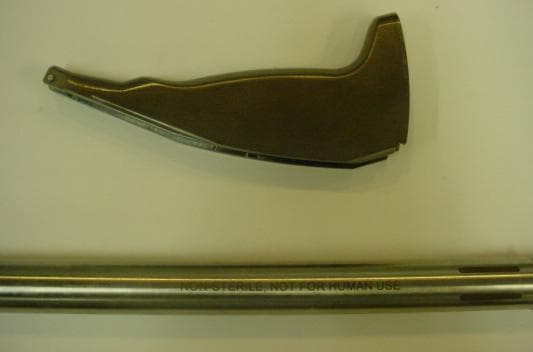
The two parts in the photo are titanium and were passivated. The shaft on the bottom had details laser etched and the trigger did not. Yet the colors are different. The trigger (the dark piece) was darker, but turned a lighter color when touched, maybe a reaction with oils from the hand.
Matthew Sweeneymedical prototypes - Clifton, New Jersey
2003
? What passivation type? What alloy of titanium. Define "darken" This is most unusual. We do lots of titanium, while I see it darken a lot from machining and tumbling, (We have means to address this) Passivation is a dumb bunny for the most part. Please respond I am interested.
Jon Quirt- Minneapolis, Minnesota
2003
Q. I have heard there is a process for passivating titanium using a citric acid bath. Can anyone tell me the particulars of this process and if it meets the requirements of ASTM F86?
Tony SpasianoDirector of Manufacturing - Stratford, Connecticut, USA
2004
A. No, will not meet ASTM F86 at this time. Lee Kremer of Stellar Solutions [a finishing.com supporting advertiser] is working to resolve that.
Jon Quirt- Minneapolis, Minnesota
2004
Passivation and Testing
Q. I am in the process of developing a passivation system for a small medical device company in the Midwest. I have experience with passivation and testing of stainless steels. I am looking for information on passivation and testing for Titanium, especially testing after the passivation process. I have acquired most of the ASTM and other industry standard on passivation and testing, but none mention Titanium. Any suggestions?
Ed RedmonMedical Device Manufacturer - Indiana
2005
A. Titanium is naturally passive and the reason you cannot find a specification for the passivation of titanium is probably that there isn't one.
If you are worried about iron contamination after machining or shot blasting then you could try using a 50% nitric acid dip for 15 minutes.
Aerospace - Yeovil, Somerset, UK
2005
2005
A. Ed,
Brian is right, so-called passivation of titanium is normally just the removal of iron contamination. citric acid formulations can be used for this as well. Let us know if we can help.
Ray Kremer
Stellar Solutions, Inc.
McHenry, Illinois
Q. I am a manufacturer of medical implants and instruments. Our customer would like us to use citric passivation as opposed to nitric. From my research I find it to be a better way of passivating, but can't find the certification or spec to back it up. I have found ASTM A967 to allow for citric passivation of stainless, but not titanium. Anyone out there using citric passivation to passivate titanium implant? If so, what spec are you using?
Steven J. HicksThorn Industries, medical manufacturer - Springfield, Massachusetts, USA
2006
A. Why do you need to passivate titanium anyway?
Ti implant are usually used without passivation.
- Montreal, Quebec, Canada
2006
A. Passivation occurs naturally on titanium when exposed to and oxygen atmosphere. This layer of oxide can be enhanced through the passivation methods discussed in ASTM A967, or possibly ASTM A380
as for stainless steels, using this spec should be ok. Anodizing titanium will drastically improve the alloys ability to oxide rather than just pickling.
Good luck!
- Kelowna BC Canada
2006
Multiple threads merged: please forgive chronology errors and repetition 🙂
Q. One of our customers asked us to quote price on passivating ASTM F136 titanium TI-6AL-4V-ELI per ASTM F86. They would like citric passivation. Can we do it in Citric or Nitric Acid?
Nancy ZapataElectropolishing shop - Brooklyn, New York
May 8, 2008
on Amazon or eBay
or AbeBooks
(affil link)
A. Take a look at topic 6885 Passivation of Titanium on the site here for a variety of opinions regarding this subject.
Without trying to appropriate their information, what I get is that the "passivation" of Ti is something of a misnomer; it is a very different material from stainless steel, and the purpose of treatment via citric or nitric acid is very different.
I did some reading on this subject. Although I cannot pretend to be an expert on the subject, most of what I found is in accord with what Mr. Kremer said in the thread referenced above.
In the ASM Handbook, there is a tabulation of corrosion rates of titanium in a variety of chemicals, including citric acid at a number of concentrations. The corrosion rates in all the solutions tested were close to nil, except one; this was a supersaturated citric acid solution at 150+ °C. Calling it a "solution" is a bit of a stretch, because it was only about 30% water. This liquid attacked the Ti vigorously. Cautions regarding pitting, crevice corrosion, etc., mainly mentioned reducing acids, such as hydriodic and phosphorus acids, and, of course, chlorides.
It also seems to me that Ti spontaneously forms a passive oxide layer as long as oxygen is available, and that no additional chemistry is required. In fact, I found few references to the "passivation" of titanium; mainly the processes described in ASTM F86, and ASTM B600 are referred to as "cleaning", "acid pickling" or "descaling." The purpose of all of these is generally given as the removal of foreign substances and iron inclusions.
One caveat: all of this data applies to pure Ti, not the alloy that Ms. Zapata is working with. Alloying elements may affect the corrosion chemistry in a number of unpredictable ways.

Dave Wichern
Consultant - The Bronx, New York
May 12, 2008
A. I am in agreement with Dave. The term "passivation" is generally misused by the industry, even with stainless steel the true passivation occurs when the iron-free chromium enriched surface reacts with oxygen in the air (though a bath containing oxidizing chemicals can put a jump start on the process). The purpose of the so-called passivation bath, nitric or citric, is only to remove the surface iron in order to allow the actual passivation to occur.
The same holds true for several other alloys, merely substitute the appropriate metal for chromium, and with the iron coming only from surface contamination and not also from the alloy itself. Nonferrous alloy parts that are not in danger of surface iron contamination shouldn't need an acid bath "passivation" treatment at all.
I hadn't heard that an oversaturated citric bath does indeed damage titanium, but a standard citric passivation bath is only 4-10% citric so there is no problem.
Ray Kremer
Stellar Solutions, Inc.
McHenry, Illinois
June 3, 2008
A. We also agree with Dave, however we believe that the passivation of titanium to improve its corrosion resistance IS POSSIBLE. We are talking about possibility of formation of less defective and thicker oxide film on the surface of titanium. Such passivating film can better protect titanium from corrosion. By improving structure, composition and thickness of passivating film, we can improve corrosion resistance of titanium alloys. Improved and thick passivating film can be obtained chemically or electrochemically in solutions that slowly dissolve titanium oxide.
Anna Berkovich
(ed. update July, 2025: sorry, Anna has retired)
June 17, 2008
Treat titanium (Ti-6Al-4V) for use in liquid oxygen
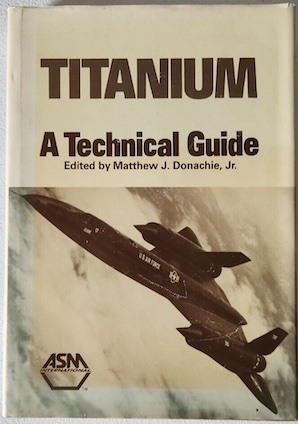
Q. I am looking for how to keep the titanium products in liquid oxygen. From MNL36-2ND "Safe use of oxygen and oxygen systems", Titanium alloy was restricted because of flammability and ignition characteristics.
I thought I'd do surface treatment to titanium. But I find it difficult in doing that.
Plating, Passivation, Paint, Coating ... ?
Please advise if you have the solution applicable to titanium. A paper or the results of the experiment are better.
engineer - Daejeon, South Korea
March 12, 2014
Sorry! Finishing.com is temporarily Read-Only.
Ted Mooney is retiring but I have several offers to take it over.
We're working hard to make sure we find it the best new home.