

Metal finishing Q&As since 1989
-----
Copper plating from hydrochloric acid
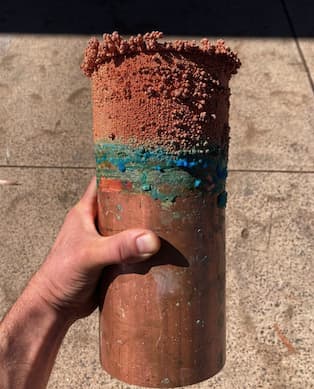
Q. Tom, I try to achieve the finish as in this picture for an art project. The size of the bath is about one liter. I understand that hydrochloric acid would create this in conjunction with high current and a long time. Any guidance would very much appreciated.
- Glen Innes
April 13, 2024
A. Hi Lori,
Unfortunately, Tom hasn't been back for years; but yes, high current density does lead to nodular plating like this. However, copper sulfate and sulfuric acid would work as well.
Luck & Regards,

Ted Mooney, P.E. RET
Striving to live Aloha
finishing.com - Pine Beach, New Jersey
A. Excellent article on acid copper plating, with extensive troubleshooting list:
http://www.plateworld.com/editorial12.htm
Hope it helps and good luck!
- Cerovski vrh Croatia
Q. Thank you so much. How would you define "high current"? I am trying right now with 5 Volts 20 Amps
Lori Lorenz [returning]- Glen Innes
April 14, 2024
A. Hi again,
You'll have to calculate the surface area you are plating, but 20 Amps per square foot is a typical value for conventional copper plating. Anything slightly above should encourage nodularity. And, of course, no brighteners because one of their functions is to discourage it.
Luck & Regards,
Ted Mooney, P.E. RET
Striving to live Aloha
finishing.com - Pine Beach, New Jersey
⇩ Related postings, oldest first ⇩
Q. Hello,
Could anyone recommend a source for paper / publication on plating metals in Hydrochloric acid? There seems to be precious little available on this topic.
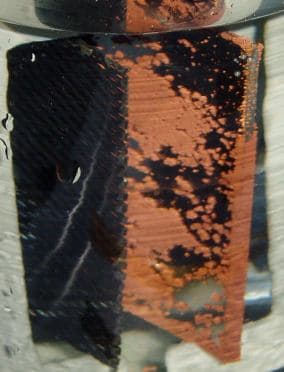
As you can see from the above I am a plating noob.
Edouard Gerardwaste acid recycling - Singapore
2005
A. If I am looking at your picture correctly, do I see a 2 expanded mesh electrodes (they look like they have DSA coating on them?!?) in a glass beaker [beakers on eBay or Amazon]?
Well, let's start off with the simple things:
1. You can plate copper out of an HCl solution, but it takes one heck of a lot of current. Since your business claims to be in spent acid recycling, do I take it you're looking at removing copper from a copper chloride (cupric) etch bath? If so - then good luck.
2. The chloride background of the bath is so strong and stresses the deposit so much that what you will see happen is really just a bunch of dendritic deposits forming. Copper electrodeposited from a chloride bath forms an elongated, columnar metal crystal - ripe for making dendrites (or tree's). These will grow much faster than any deposit that you may get on a flat surface of a cathode.
3. High surface area cathodes will etch off the conductive copper foli surface long before you can actually get anything to plate on them. In most cases, the cathode foam becomes useless. You also cannot get a high enough current density to overcome the etch rate of the solution on a HSA type electrode without it typically catching on fire (it does make pretty blue flames, however, when it does!)
4. The typical current density that you will have to use is actually well over 100 asf. This can be brought down if the concentration is more dilute, but that might not be feasible in your application. Also, if the solution is heated in any fashion (either intentionally or due to the inefficiency of the reaction itself), the current density will need to go even higher.
I'd be happy to discuss my experience with you further - I have done many years of R&D on this very application, and there are ways to get around some of these issues, but if your looking for a quick and dirty plate it out type system, your not going to be very happy with what you have. We do have other types of acid recovery technologies, however, that might be more useful to you to evaluate, but would need more specifics.

Tom Baker
wastewater treatment specialist - Warminster, Pennsylvania
 Mr Baker,
Thanks for your response.
The picture is of a single DSA mesh anode with a Ti cathode.
The current density was quite high indeed, and quite a lot of chlorine was being evolved.
The aim of the exercise was to see what kind of solution would remain after plating out the copper to the limit of what is expedient, and the kinds of likely treatment solutions that would be required there after.
Edouard Gerard [returning]- Singapore
2005
Q, A, or Comment on THIS thread -or- Start a NEW Thread