
| Search our quarter-million Q&As |
Home of the finishing HOTLINE since 1989
-----:Blue water & Copper in residential water
Quickstart:
Copper ions are blue. Blue water indicates dissolved copper in the water.
One theory for its cause is poor water chemistry; another is that it is an electrical phenomena like improper grounding. Smarter people than us are highly confident in their theories, but we believe each cause is common.
Read on, join in ...
Q. I am a civil engineer trying to figure out the following problem for a high-end home builder. After just finishing this exclusive house, the owner started complaining about blue water in their domestic water system. The local water authority was contacted and confirmed through water sample analysis that it was copper corrosion, and happening only at the referenced house. Suspecting potential electrolysis due to improper grounding of the electric wiring, an independent electrician was hired and confirmed that grounding was correct. Further inspection revealed that the copper piping from the hot water heater was connected to galvanized steel reducers and the connection was corroding and starting to leak. Does that explain the blue/green water in the system? Both the hot and cold water had the coloring, with the cold water having more pronounced evidence of the bluish tint! Due to the size of the house, the hot water heater is part of a forced hot water system to ensure hot water is available instantly at any location in the house. Any explanation for the copper corrosion? Is it electrolysis due to improper electric grounding even though no evidence was found? Is it due to the galvanic corrosion from the water heater? Any ideas?
Tony Warrickcivil engineer - Bethlehem, Pennsylvania
2004

A. This sounds to me like it is related to improper grounding of electrical service causing electrolytic dissolution of copper. Can you turn the power off at the main, and run the cold water, to see if it clears up?
Both galvanizing (zinc) and the pipe underlying the galvanized surface (steel) are anodic to copper. These materials go into solution preferentially to copper. Remember the high school chemistry experiment of putting a nail in copper sulphate: the copper deposits on the nail because iron goes into solution to pull the copper out, not vice versa. The very rapid failure of the galvanized joint may well also be due to the electrolytic action from the electrical system.

Ted Mooney, P.E.
Striving to live Aloha
finishing.com - Pine Beach, New Jersey
A. Another possibility: Maybe the electrical system is grounded OK, but there is an appliance with a small earth leakage - not a full-blown earth fault that would trip a protection device - and the small earth leakage is causing the corrosion. Certainly sounds as though SOMEWHERE there is a source of electric current through the water pipework.

Bill Reynolds [deceased]
consultant metallurgist - Ballarat, Victoria, Australia
We sadly relate the news that Bill passed away on Jan. 29, 2010.
A. If you can find someone with a clamp-on Ammeter large enough and sensitive enough, you can check the water supply-pipe for current flow. Sounds like an interesting problem, please let us know what you find.
Tom Gallant- Long Beach, California
A. Blue Water:
I am a retired electrical inspector of 25 years an electrician for 45 years. When I was an Electrical Inspector I was called to a 48 unit condo that was complaining of blue water staining sinks and tubs. One woman complained of getting blue hair. What I found was an 600 amp service grounded by a 3/0 wire to a 1.5" water line that ran through the building to two cu ground rods outside.
Everything looked good but on further inspection I found a water softener was installed with a plastic manifold cutting off the ground path. The grounding current was showing on water lines everywhere except ground rods. A 3/0 jumper at the water softener corrected the blue water.
I have been retired for 23 years and have recently moved into a condo and was told they have blue water. When checking grounding there was a fluctuating current Up to 4 amps. With an electrical contractor we discovered the original contractor cheated on ground rods; they were only 18" long and just went through concrete protruding 3" two" into the ground ... 10' copper rods were installed.
For single family homes with blue water. It could be the bonding to water lines that are copper from the street. The building ground (ground rods) are not connected. If a water softener was installed with a plastic header (cutting off grounding) ground current can run through water but it causes electrolysis which will produce blue water.
Retired Elec Inspector. - Regina Sask.
November 18, 2024
Ed. note: Readers -- Harold's posting is pretty convincing, but please also see response from Steven W of Santa Ana, who feels that this is a water chemistry issue
Q. I have a 10 year old home, that has had 5 leaks in the copper water pipes. Always the cold water lines. To make matters worse, the plumbing is run under a concrete slab. 5 different plumbers think there is some sort of electrolysis causing the corrosion of the cold water lines. But, none have any idea how to stop the problem. Evidently, this can be a problem with electric hot water heaters, but ours is gas. You can even feel an electric tingle if you touch a cold water pipe. Any ideas on how to fix this?
Shirley Canfieldhomeowner - Alpine, Texas
2004
A. Hi Shirley Canfield..
I had the same problem. The earth on your house should read less than 1 ohm from any power socket to ground. The earth connection should be made via a dedicated earth cable from your consumer unit to ground via a buried metal spike. If you can feel a tingle (it's safer to use a multimeter tester) when you touch your water pipes, this is due to the voltage leak going to earth via your pipes rather than the correct route through the earth wire. Try switching off each mains fuse trip one at a time until you locate the circuit that is responsible for the voltage leak (tingle should disappear).Once you have located the offending circuit, unplug each appliance on that circuit until the leaky appliance is identified and have it repaired ot bin it. You should then have your earth connection checked out.
Good Luck.
Keith (UK).
Note this sort of earth leak will pepper your copper pipe with pinholes wherever it comes into contact with moist earth, (the higher the voltage, the quicker the holes).
Keith Cooper- England
Q. I have a similar problem in that I have a .75 inch cold water copper pipe under my slab approx. 20 feet long and there have been 5 separate pin hold leaks in this section over a 6 year period. To my knowledge, there have not been any leaks in the other sections of the house or the hot water pipe. The house is 30 yrs. old. Any suggestions ? ⇦ Answer?
Thanks
William Hutt- Dallas, Texas
Q. 2 years ago I was called to investigate water in a 1st floor ceiling. The house is approx. 25 years old with copper piping. There is a 2nd floor bathroom above the wet ceiling. I investigated and saw no evidence of a fixture leak. We took the ceiling apart and found pin holes in a few locations with green stains nowhere near the sweated joints. The house has city water. My first thought was low pH and would have pursued this if it were a well system. We had a plumbing contractor in to repair the pipes and analyze the situation. They stated it was caused by electrolysis. They proceeded and repaired the pipes that were visible. I explained to the homeowner ( not fully understanding electrolysis) the situation and said we should get an electrician in to look at the bonding, they did so and he said everything was ok. @ years later the customer called me back and said the leak reappeared in the same area. I visited the site and found in the basement near the service panel more pin holes. I have our electrical contractor meeting me next Monday. I need any info on this including possible causes, testing and solutions.
Thank You,
ART CICCARELLOcontractor/designer/builder - NEW HARTFORD, Connecticut
2004
NOM = natural organic matter
A. What is occurring in your plumbing system is refer to as "Blue Water Syndrome". It is not an electrolysis problem but a water chemistry issue. All new copper piping dissolves at a rate of .001-.003 per inch, per year during the first few years of installation. Blue water occurs many times in homes which are larger and only a few occupants or if a soft water conditioner was installed before the piping was ever used and is over softening the water. There are a few other reasons why you can have an accelerated rate of copper dissolving as well. Some of which is if the pH is below 6.5 copper solvency occurs. In addition the changes made as part of the EPA Safe Water Act of 1991 removing of NOM's from the water has caused a lack of the protective patina which occurs as the copper is dissolving.
Steven Wann- Santa Ana, California
2005
Q. PROBLEM: Corroding pipes and copper precipitate in sink basins (and maybe in the bodies of my family as well).
I live in an old house, built in about 1940. All the pipes were galvanized, but I have been changing them to copper and have isolated the galvanized sections with dielectric unions. We are on a domestic well and our water has pH values that range between 6.1 and 6.9, depending on time of year. I'm not sure what is causing the pH change, but it seems that the lower pH values occur during the summer.
The pump intake is PVC. The piping between the pump and pressure tank is PVC. And, the outlet between the water conditioning tank and the main copper water pipes is PVC.
I installed a water conditioning system to manage the pH. The tank is filled with aluminum hydroxide and calcium carbonate. The water has become harder, but the pH doesn't seem to be raised to normal (i.e., 6.9 to 7.1) as advertised. The thinking was (by the salesman, that is) that I had a low pH problem and that the copper was dissolving in this low pH environment. Measurements of pH in my well and on the downstream side of the pressure tank and water conditioner are about the same, suggesting that there may be electrolysis occurring further downstream somewhere.
The pipes are corroding on the inside. My plumber (who suggested that I contact an electrical or chemical engineer about this problem) said he rarely sees copper pipes that have become so "eaten away".
QUESTION: What can I do to stop the electrolysis and high copper concentrations in my drinking water?
1) Is there a non-toxic sacrificial metal that could be installed in the plumbing system?
2) Could I connect all plumbing components (pipes, hot water tank, well pump, recirculating pump, Jacuzzi pump, water conditioners, etc.) in the house with a copper wire and ground it to one of the electrical service grounding rods?
3) Is it possible that electrolysis is occurring because of the type of solder that was used in the copper pipes? Some of the copper pipes were installed long before I purchased the home. Is there a different electro-potential between copper and silver solder versus lead solder?
I need help and would sure appreciate any ideas and suggestions.
Bill Shiels- Woodinville, Washington, USA
2005
A. I think your plumber's advice is basically good and that you need to contact an electrician or electrical engineer who is experienced in this. My presumption is that an electric current, possibly a ground loop, is causing this corrosion.
Ted Mooney, P.E.
Striving to live Aloha
finishing.com - Pine Beach, New Jersey
A. Another factor to consider could be microbiological action. This is normally characterized by separate nodules on the inside of the pipe. There are a number of organizations that can test for it. Check out MIC - microbially influenced corrosion. Good luck!
Karl Nitsch- Toronto Ontario Canada
A. Domestic copper pitting occurs randomly with well water and only rarely on municipal water. Low pH, below 6.4 dissolves copper piping, generally through uniform wall loss and pipes last 5-10 years.The serious cause is carbon dioxide. The exact way of corroding is not readily explainable with carbon dioxide.
Domestic well waters usually are treated with calcite mineral installed in a water softener tank. This method adds hardness to the water and elevates the pH. It is low maintenance and is used frequently. Another method is to install a soda ash liquid feed system and add as needed to get to 6.8-7.2 pH range.
More recently many pits are blamed on poor quality copper metal supplied from all over the world.
Best bet is to maintain clean pipes and neutralized water.
Galvanic corrosion protection is talked about in old farm houses where wiring may be questionable.
- Downingtown, Pennsylvania
2006
Q. I have a newly constructed home that is just over a year old and has excessive blue-green staining of sinks, tubs, tile etc. I had the water tested and it is municipal water that tests OK. I have been told by the chemist as well as a water treatment specialist that my water is corrosive and the problem has to be electrolysis. My electrical system has been tested and has been found to lose amperage to grounds (e.g.copper pipes, etc.) instead of the neutral ground. However thus far the source has not been isolated. I'm trying to find out the places or areas within the house that people have had experience with this occurring. Can it only be in the electrical system? Can it be in the plumbing system? Can it have to with the electrical utility company or the water company outside my house? Can it have anything to do with the audio-visual wiring or phone or computer network wiring somehow creating a ground loop within the house? I am desperate to hear from anybody who has encountered a similar problem and what the possible causes and solutions are. ⇦ Answer?
Thank you.
Stephen Galhomeowner - Wyckoff, New Jersey
2005
This page welcomes Q&As, photos, history, anecdotes, relevant jokes ...
We're happy to provide the space & mechanism, but only the readers can build a community.
Please try to ENGAGE
• When people show interest in each other's problems, it's a fun & informative mutual learning experience !
• If they ignore other readers' postings, it becomes a dull string of unanswered questions 🙂
Q. We have a new construction home that is 2 years old. We are on a private well and the water is extremely hard. The first year we dealt with hard water deposits and staining, and then we installed a water softening system. That helped reduce that problem, and now a year later we have blue water stains indicating copper corrosion.
We have not done any testing to discover the underlying reason for this problem (we are still gathering info). My question is: Assuming the reason is discovered and addressed; is there a way to stop the corrosion or are we destined to have leaky pipes with the likelihood of having to replace them? ⇦ Answer?
- Rochester, Washington
Q. I have an artesian well and the pH was low a while back so it tinted my bath tub and my hair a greenish color. Not so fun. The pH has been normal for a while now but the water is still turning my hair a funny greenish tinted color. If anyone knows how to make it so the corroded copper stops turning things green it would be so awesome. please help! ⇦ Answer?
Christine C [surname deleted for privacy by Editor]student - Concord, New Hampshire
Q. I have .3 to .9 volts a/c on my external water faucets, what could cause this? I am experiencing pin holes in copper water pipes in a nine year old home. From the looks of the pipe, it appears to be electrolysis. The first leak appeared 2 years ago and the latest one week ago. I have a water well with excellent water and live in rural central Texas. The electric company came out and removed the meter and we disconnected the breaker at the well. With no electricity possible to the house, I still measured the .3 to .9 volts at the faucet. ⇦ Answer?
Any ideas? Help.
rancher - Mullin, Texas
2005
Q. In my 45 year old house we noticed blue water in our bathtub recently when filled to 8-10 in. The city and province ( state) have all tested and declare the water OK to drink. Then ran a hose from the fire hydrant into my white bathtub, by passing my system, and the water was still blue. tests for copper all indicate level OK for drinking water. my neighbor has the same problem. Extensive testing for organic and non organic and metals all show normal levels for drinking water.
Any thoughts?
Any help would be welcome!

on Amazon or eBay
or AbeBooks
(affil link)
- Toronto, Ontario, Canada
2005
A. Too many earths could explain most of these problems. I am an electrician turned science technician. Electrolysis is caused by DC current only. I found pin hole leaks under an earth clamp. My explanation is that a DC current is flowing from one earth on the water system to a second earth also connected to the water system. A DC voltage often exists between distant earths. Examples of separate earths are:
The electricity substation earth rod.
A supply pole earth wire.
A buried water or drain pipe.
A buried cable sheath.
The steel frame of a building.
A machine,pump or boiler standing in water or on the ground.
Telephone or other communication system earths.
Electricity will flow through the water as well as the copper. Modern regulations mean that the water system is earthed by several of these sources of varying potential at various points. Now can someone suggest a solution?
- St. Briavels, Gloucestershire, UK
Q. I am facing a similar problem. There is a tingling sensation when we try to open the taps in the house - kitchen, bathroom … but it lasts only a few seconds - 10-20 sec. Then it's gone for a few hours. The electrician checked the electrical wiring but seems fine. still struggling with the problem. ⇦ Answer?
If anyone can suggest I would be happy . If I find a solution, I will post it to you.
- Delhi, India
2005
This page welcomes Q&As, photos, history, anecdotes, relevant jokes ...
We're happy to provide the space & mechanism, but only the readers can build a community.
Please try to ENGAGE
• When people show interest in each other's problems, it's a fun & informative mutual learning experience !
• If they ignore other readers' postings, it becomes a dull string of unanswered questions 🙂
Q. I am curious about the forming up of the 'Blue/green' water in copper pipelines, just wondering if these pipes are soak in water before a huge tank to allow these pipe to be oxidised will it help?
Basing on my understanding, these phenomena is only subjected to NEW copper pipelines.
My prime concern is to get an answer not by purging the pipelines or flushing the pipes with chemicals. ⇦ Answer?
- Singapore
Q. My problem is also with copper pipe failing, my Question is will a strong radio signal promote electrolysis in copper pipes? If it can does anyone have any suggestions? ⇦ Answer?
Miles Berry- Meridian, Idaho
Q. I'm not seeing many answers here, but I will post what I'm seeing and see if it helps anyone.
My house is 6 months old and it gets used only every few weeks. Every time we have returned the water will flow bluish and you can find blue crystals in the aerators and showerheads after running the water. The crystals look much like copper sulphate.
The water supply comes through black Polyethylene piping and connects to the copper system in the house. The electrical system is not connected to the copper pipe at all, but is grounded via grounding rod outside. There is a DC potential of ~0.5 volts between the metal spikes embedded in my foundation and the copper piping in the house. When the main circuit breaker is turned off, the potential remains.
Add to all this that my foundation is insulated on the outside using pink styrofoam insulation, but is attached using special nails with 2" diameter heads. I measured the potential between the nails and the electrical ground rod to be about 0.3 volts (the measured points were only 12" apart). This may be the multiple grounds that Eric referred to above.
My big problem is that my shower heads are clogging and it appears that I will have failing pipes in the near future if this is not resolved.
Local water quality is excellent with a PH around 7.0. Neighbors and local plumbers do not have/have not seen this problem.
So if I have a distant earth problem, will providing a better ground than the foundation be the solution? or will I just create new problems by grounding the pipes to a new ground rod.
I'm going to get to the bottom of this so any leads from here are greatly appreciated. A solution is even better. ⇦ Answer?
- Limerick, Maine
Ed. note: Thanks William. This is a public forum not a paid consultancy, and human nature dictates more Q's than A's, and more people concerned with solving their own problem than someone else's.
Still, there are many generous & helpful answers above and there will surely be more below 🙂
Q. Following Steven Wann's answer, I have another question.
We have a new vacation home in NH, and are experiencing the blue water problem. I called the town water person (we town water not a well), and he said they keep their pH at about 8, so that should not cause the copper corrosion.
Our electrical system is properly grounded, as far as I am told.
Is there another answer to this blue water thing? We are going to have the state lab test our water for potability.
The toilet tanks show blue tinted water, and the toilet bowls of the lesser used bathrooms have a blue stain that is difficult to remove. This does not occur in the bathrooms that have been used more regularly, say once or twice a month.
Any suggestions?
Thank you.
- Lexington, Massachusetts
2006

A. I do have a solution although it is costly. Replace the copper pipe system with a PEX system. If you are on a slab, run the pipes down from the ceiling. PEX has been used in Scotland for 30 years very successfully. It is being used in new developments in the local area. I am a homeowner and live in a 100 unit duplex/triplex set of condominiums. Built mainly in the 1976 to 1985 era. We have had 5 major pinhole leaks in copper pipes in last two years. Three of the leaks were under cement slabs. I have been trying to find the cause with no success. I have talked with water analysis engineers, had lab work done on the water and the pipes and I still have no answers about cause and repair. I have discussed the problem with people from Alaska to Florida. No solutions. After two years of research I have come to the conclusion that copper pipes and water don't work together and nobody knows why.
Donald H Leo- Lacey, Washington
Q. I have been living in the same house for 26 years using the same artesian well and copper water pipe system without any significant problem. Over the past three years we have been getting a bluish-green stain on our white bathroom fixtures. It has gotten worse and worse to the point of frequent cleanings and I'm worrying about the safety of the water.
I recently had the water tested and it was normal except for the pH level which was 5.8; however, 26 years ago it was 5.6 and I had no staining problems then. The only thing I done to the system recently was about four years ago the submersible pump was professionally replaced.
Any ideas?
- Westford, Massachusetts
2006
A. I'm an electrician, I can only say what a properly grounded system should consist of, according to the NEC. The neutral (in the main panel or first main disconnect) should be grounded to the Copper water main before the water meter(the water meter should also have a jumper around it,to provide continuity if the meter is replaced).This is one method other methods are a copper wire embedded in the footing and bonded to the rebar(UFER GROUND), or if a steel building, using a steel beam as the main ground. The code then requires an additional(supplementary) grounding rod(actually two unless the electrician can prove that the one rod is 25 ohms or less to ground). So usually two 8' ground rods are driven and connected to the water pipe as well.
Now a jumper of #6 copper wire can be placed from the cold water pipe to the hot water pipe above the water heater. Any other systems should all be bonded back to the same point(before the water meter)this is the crucial step that eliminates any potential ground loops. Any piping system which you believe could become energized is permitted to be grounded back to the water main. The NEC gives specific wire sizes for telephone(Communication) and Cable(CATV) grounding.
There's also a line of research in which childhood leukemia is being investigated in which small electric currents flowing from the supply to the drain piping via a person touching the faucet handles while in the tub. EC&M magazine published this article in about Sept 2006 -- they're on the web as well.
Finally, electricity wants to get back to the source(the transformer which it comes from)and the ground(earth) is not a very good path, the copper wire which is the neutral usually covers 90% of this, it's the other 10% we're worried about. However if lightning were to strike you'll be very glad to have a well grounded system.
- Denville, New Jersey
Q. My copper pipes are underneath my house, Katrina flooded my house with 4 feet of water, should I change them.
SHANYE PETERSSOCIAL WORKER - NEW ORLEANS, LA, U.S.A.
2006
A. I don't think so. If they are exposed, you might rinse them with fresh water though. It is very common to use copper water pipes even for direct burial in the ground.
Ted Mooney, P.E.
Striving to live Aloha
finishing.com - Pine Beach, New Jersey
Q. YES I AM A DO IT MY SELF PERSON AND I NEED TO INSTALL A NEW HOT WATER HEATER MY PIPES ARE COPPER AND I WAS WONDERING SO THAT IT WILL BE EASIER THAN USING A TORCH CAN I CHANGE THE ENDS OVER TO PVC?
BARBARA MACKEYHOBBYIST - LANCASTER, South Carolina
2007

A. PVC is a nice material in many ways but has a very low temperature limit making it unacceptable for hot water piping in general, let alone connections right at the water heater. Get a handyman book on the subject of soldering copper pipes, Barbara; it's relatively easy. These days you can buy copper fittings with the solder already applied, and it makes it even easier. Good luck.
Ted Mooney, P.E.
Striving to live Aloha
finishing.com - Pine Beach, New Jersey
Ed. update: A technology we hadn't heard of in 2007 has become very popular now, and should at least be considered: SharkBite fittings. There are now simple solder-free connection kits for water heaters ⇨
Q. My husband and I recently bought what we thought was our dream home until we found blue granules in our toilet tank and toilets and then started noticing a blue spot in one of our sinks. Our community is about 1 year old and several homes are having the same issue. The water has been tested at the hydrant and tests normally(so our H20 supplier says)and the homes have been tested and are properly grounded. What else could be the problem? Also, how hard would it be to reinstall plumbing for an entire home, if it is even possible? I have children and a newborn and have read that it is toxic to ingest a certain amount. Does anybody have any other solutions for me to try?
Sarah Bowermannew home owner - Hutto, Texas
2007
A. While proper grounding is important one thing that I have noticed in my area involves the water chemistry. I have a handful of customers in a new housing development that are seeing this staining. Some have water softeners and some don't. The problem comes from the incoming water. People hear that the pH is around 7.2 (pretty neutral) and assume it has to be the electrical system. I disagree. You need to have a water analysis done and look for a few important things. What is the copper level at? What is the Dissolved Oxygen level? The oxygen will start the corrosion process of the copper that is in solution and in some cases from the plumbing itself. You are left with a Blue-Green stain or build up and in some cases pin holes in your plumbing.
Chris Ray- Omaha, Nebraska
! I investigated a blue water issue in a town home community my company built several years ago. Several homes in the community (but not all) had the blue granules and staining. We also found evidence of the same phenomenon in a neighboring single family community. We used the same materials and contractors in several Villages, but only had the issue in one. We tested the water, and while the copper content was higher than normal it tested well within the EPA's standards. We had State plumbing and electrical inspectors check the community and all was found to be done correctly (no grounding issues and proper materials and installation). Nothing we did alleviated the problem. I called a chemist at a neighboring Village's water department and was told that some Villages use a chemical to seal their pipes periodically if high levels of lead are found. This chemist said that her Village did not use this chemical because it causes copper to corrode. When I mentioned this to the water department of the Village we had the issue in, they ceased to request any more exploration into the issue by my company. I believe it is still an issue in that community to this day (7 years later), but we have not been involved in it for the last five years.
John Yanezwarranty manager - South Elgin, Illinois
A. I came across the following information from the Washington Suburban Sanitary Commission. It may help explain some of the copper pipe problems in new housing:
Formation of a uniform, protective film on copper also depends upon proper flushing of the system to remove construction debris from the inside of the tubing. Clean inside surfaces are essential to the development of protective films. If debris is allowed to remain in place on the inside surface for an extended period of time early in the life of the system, two to three months for example, corrosion can develop beneath the deposits [6,14]. Once started, this type of under deposit corrosion@ will likely continue resulting eventually in a leak failure.
A related cause of copper corrosion can occur when a completed plumbing system is allowed to remain stagnant with residual water for an extended period of time following flushing and testing. This problem has been discovered and identified most often in tract homes and apartment complexes that are often constructed, but not occupied, for a period of time [13]. The initial stages of protective film formation on a clean copper tube surface depend upon a frequent flow of water through the system to promote uniform film growth. Stagnant conditions for extended periods of time, especially when the system is partially filled, can cause non-uniform film development and corrosion depending upon the source of water.
An example of stagnant water induced corrosion is shown in Figure 6. The copper tube sample shown is from a horizontal section of 3/4 inch Type M cold water tube removed from an apartment complex that had been tested for leaks, but remained unused for several months. After two years, leaks began to develop in the plumbing. The upper half of the tube is positioned at the top in the photograph. A residual amount of water remained in the tube following testing, resulting in the growth of a non-uniform corrosion film in the bottom half of the tube. The yellow arrow indicates pitting corrosion that occurred at the water line under the stagnant conditions. This is another example of under deposit corrosion."
Brian Crawford
- Tupper Lake, New York
Q. Our house in Edinburg, Texas was built in 1996 and we bought it in 2000. I never dreamed a less than 5 year old house would have problems with the water pipes. We put in a water softener at that time, too, but it does not to appear to have helped. We recently went away for the Thanksgiving holiday and returned to a flooded kitchen, DR & LR.
The insurance company will help with the damaged drywall, cabinets, etc, and I paid for the water line repair. However, I am now trying to decide whether to change out all of the water lines.
What are your recommendations?
student - Edinburg, Texas
2007
A. I have seen on the internet Oscillating Rings that take care of rust, lime scale, bio film and various other problems in the water system. I am sure these are an answer to your problems. I have one in my house and it has cleaned all the pipes of calcium build up, including the recurring problems in my showers holes that got clogged regularly.
Rishi Dwivedi- Flushing/NY/Queens, New York
August 5, 2008
Ed. note: Please note that it was a reader, not the editor, who recommended these "Oscillating Rings". I'm not familiar with them, but the explanation on their web page struck me as quite silly.
A. After finding some copper flakes (!) coming out of our bathtub faucet, my wife (with knowledge in metallurgy) suggested we needed to do something, so I read up on corrosion enough to understand there were many possibilities. Also, reading this thread it's striking how very complex the combination of possible factors is for each house. I count 6 possible factors to consider in deciding what to do: ordinary galvanic corrosion (this is common), electrically driven corrosion, pH driven corrosion, oxygen driven corrosion, considerations of grounding pipes (advantages vs disadvantages), and of course the effects of changes in standards of water supply by cities and in grounding, all contributing to possible complex situations.
Consider for instance that even copper tubes are thought to have some impurities that could lead to local galvanic corrosion.
I wonder if using a "sacrificial anode" (a standard part of every water heater) might help in many instances …
For example, your hot water heater anode may be worn out, contributing to increased corrosion not only in the water heater itself, but elsewhere also. One possibility.
Many water heater anodes can be easily replaced, and it's worth a look for a do-it-yourselver that takes simple precautions such as turning off the water at the outside meter after having turned off the water heater and run the hot water out of it, etc. etc.
- Austin, Texas
A. I have found many of the comments of great value and there are many good insights. I have done some recent research on this subject and would like to share my 2 cents worth. My initial question of anyone calling with blue/green staining is, "are they noticing staining connected with both the hot and cold water". If the problem seems more prevalent on the hot side, I have suggested checking the temperature on the hot water heater. If it is above 120 °Fahrenheit, I suggest that the temperature be reduced to that level. Also with the square footage of homes increasing many homes are equipped with a recirculation loop to provide instant hot water at every hot water location. These systems can contribute to erosion corrosion is some situations and reducing the pumps velocity or turning them off altogether has eliminated the problem.
High levels of Dissolved Oxygen and Carbon Dioxide are other issues that can cause copper corrosion and should be checked. I will not go into electrical cells that are set up in the plumbing because that has been covered in this thread by folks more knowledgeable than myself.
I would just like to mention that in some cases, we have used poly phosphate feed to form a coating on pipes to protect them from corrosion. This naturally occurs when the copper is exposed to hard water but where water softeners are installed on new plumbing or the water is naturally low in total dissolved solids and hardness using poly phosphate can be an option.
Lastly, it is important to realize that once corrosion begins it can be very difficult to stop. Within the corrosion pocket a mini environment is established which can be much more corrosive than the surrounding water. In these situations encouraging the copper piping to establish a protective coating may be the only solution.
engineer - Manitowoc, Wisconsin
A. The problem of corrosion and pin hole on the water pipe caused by the water pipe being used as the neutral-to-ground bonding jumper in the electrical panel in your house. You have not electrical ground in your main service per NEC250.
Benjamin Du- Torrance, California
March 26, 2009
A. An entire housing tract in Danville, California had or has this same problem. Bill Watenburg, electrical/mechanical engineering professor at UC Berkeley and radio host, suggested a fix by providing a constant source DC voltage power supply, presumably low voltage, applied between the copper pipes and earth ground. Power supply voltage and connection points were a variable depending on measured results. I don't recall all the particulars. However, the "blue water" situation seems to have stopped shortly thereafter.
Jerry Ringtadt- San Diego, California
Q. My wife highlighted her hair and her hair is changing to green,what causes this. my cold water heater is grounded to the electrical system at the hot water heater, I also extended the grounding to the incoming water piping at the water softer, also there is a ground rod with # 6 ground wire.
And my wife is mad about her hair turning green.
- Indianapolis, Indiana
September 29, 2009
A. I recommend that for a complete explanation of all of the above problems you search on: "stop-pinhole-leaks" and read the information. This is NOT a recommendation of the company but the theory is good and has been used for lots of years in the petroleum industry protecting tanks and lines. That information should end your speculation.
Lee Griffithretired engineer - San Diego, California
Ed. update: Carefully crafted search terms like that used to work, but these days that search term pulls up dozens of sites and we don't any are the one Lee was suggesting.
Q. My home is about 16 years old and I have just had to correct my third pin hole leak in one year. The third since the house was built. It has copper water lines.
I have been told that; 1) bad pipe was used, 2) the lines were not shield correctly and they are touching metal some where, 3) extra hard water causing corrosion, 4) electrolysis due to improperly grounded electrical.
I have not had "blue water". I have a water softener.
So far my possible suggestions for correcting the problem have been:
1) repiping the house -very costly,
2) Having my water pipes coated with epoxy from the inside - maybe not as costly as repiping, but expensive,
3) grounding the water system with a ground wire from the cold input pipe to the hot water heater,
4) Re-grounding the electrical.
Needless to say, I am confused, but I need to correct the problem. It is costly to repair the leaks and damage.
The previous answers don't directly address my issues. Any help will be greatly appreciated.
Thanks,
Home owner - San Antonio, Texas
December 12, 2009
A. I stumbled on to your site looking for something else but I'll throw in my two cents. I'm an electrician. I was working for a Country Club and members complained of "tingling" sensation while showering. Sure enough there was about 5 volts AC on the plumbing lines to Earth. I checked all grounding and found nothing wrong. We tried turning off different circuits with no luck and finally shut down the entire building. The voltage was still there. We thought it might be coming from the phone lines or cable and eliminated those sources and the voltage was still there. I called the power company and they sent out a tech. I duplicated what I did with him and he was as baffled as I was. A few days later the power company sent out an engineer and he told me he had seen this before. He called out some linemen to check the connections on several transformers in the area (mounted on the ground with underground services - not on poles). He found one about 250 yards from the building with a bad neutral connection. They corrected it and problem solved. No more stray voltage and no more tingling. Who would have thought a transformer a couple hundred yards away could induce stray voltage into the copper plumbing lines because of a bad neutral connection?
Wesley Burchardt- Lutz, Florida
February 14, 2010
Q. I too stumbled in here looking for an answer. I am renting a business location which was built about 18 months ago. We have been doing some work and had not moved in yet. The water meter on the ground floor (interior wall, room heated to 60)had the bottom cracked open and sprayed the room with water 3 inches deep. The water was full of teal green precipitate. The copper pipes did not freeze as it was not that cold outdoors, and other people in the adjoining spaces were using water without a problem.
The DEP said the meter had to have frozen, but I know that did not happen on a heated interior wall. I am concerned because of the damage and do not want this to ever happen again. Could there have been too much pressure in the line or was this a defective meter? or could the copper precipitate in the water every where indicate some major failing? ⇦ Answer?
- Staten Island New York
February 18, 2010
Q. Hi my name is Sheila Winters. My husband and I built our house 8 years ago and we have our own private well. We have a serious problem in our hot water system but only on the bathroom circuit only. The problem started about 7 months after we moved into the house we noticed that particularly in the winter months when the water is being heated there is a terrible blue staining coming through onto the bathroom appliances i.e., the shower and bath but not the toilet and only occasionally on the sink.We have asked 3 or 4 various people about this and nobody knows. It is also interesting to note that the kitchen hot water is on the same circuit but to date has not caused a problem. My husband and I are baffled as to what this is and why it only happens on the hot water system and particularly in the winter months. The hot water storage tank is clear on the inside. we are worried that there may be a health risk in using the water and are keen to resolve the issue Please help.
regards
home owner - Ireland
March 15, 2010
A. Plumbers and electricians often confuse or call Galvanic Corrosion "Electrolysis". Any internal corrosion of a pipe will not be caused by stray currents occurring on the exterior of a pipe. Blue water is a water chemistry issue. Remove your water softeners so that your copper piping can oxidize and develop its patina and a nice shield of calcium carbonate. Using pre-oxidized pipes, not a bad idea. External corrosion of your copper pipes may be due to SOIL CORROSIVITY or because a HOT water pipe is in close proximity to a COLD water pipe. Copper is susceptible to thermo-galvanic corrosion. ammonia ⇦ on eBay or Amazon [affil link] and nitrates are also bad for copper so if your copper piping is in soil, you should have your soil tested.
Eduardo Hernandez- Temecula, California
A. Hi Eduardo.
I accept that water chemistry is often the cause of corrosion, and that galvanic incompatibility is unlikely a cause of corrosion of the copper since it's more noble than the other metals it might be connected to. But I cannot agree with you about stray currents not being a possible cause -- if there is a difference in potential between two sections of a pipe, metal will attempt to ionize into the water so that positively charged metal ions can flow towards the more negative section to balance the charges.
Luck & Regards,
Ted Mooney, P.E.
Striving to live Aloha
finishing.com - Pine Beach, New Jersey
A. Wow, lots of issues with copper piping, nary one answer for all, and some are close but none more informative than the copperinstitute.org. I've been plumbing for 30 years, and have seen, heard and read a significant amount of information about this subject. I'm a plumbing contractor, IAPMO, ICC plumbing inspector, and a certified Cross connection specialist (water contamination specialist).
First things first, any change in the color of your water is considered turbidity, which could be caused from organic and inorganic dissolved solids. To be safe, I would have the piping system professionally cleaned as specified in the Uniform Plumbing Code with a mixture of sodium bicarbonate, this will neutralize any acidic issues, and give you a fresh start.
Second, the pH of the water is essential to a healthy copper plumbing system, therefore a municipal water system should be used, not well water.
Third some copper piping was found to contain steel coming from Mexico, which will cause holes.
Fourth, copper piping will expand and contract with temperature, and if uninsulated will rub on rocks, etc. and cause pin holes.
Fifth, Soft underground copper tubing may be deformed or pinched during initial installation which may cause water velocities to wear at the deformed areas of piping causing leaks.
Sixth, Non water soluble flux, or acidic flux (now banned) may also cause corrosion, as most fluxes were heat activated, this also may affect hot water lines.
Seventh, dissimilar metals, will also cause corrosion, as will acidic pipe dope compounds.
Eighth, Soil composition, is also an issue and is referred to as "Hot Soil", and may have a pH issue, or is high in salinity.
Nine, any electrical current found in a copper piping system is of great concern, as this is the most under-reported cause of death of plumbers who work on water systems, and is NEVER OKAY, the water pipe should have at least 5' of direct burial water main giving the system a proper ground, and should never be dependent upon a grounding rod that may not extend 9' down, or is only tied to the rebar in the foundation.
Tenth, there are chemical treatments available for caustic water, and you should contact your county health department for the appropriate approved treatment should you need it.
Pex is very durable, and has been around Europe for some time. The fittings are not copper or brass, and should provide years of trouble free service for anyone with well water or issues unresolved concerning a dependable and potable water supply.
- Temecula, California, U.S.A.
Ed. update: Times are always changing, and some people are concerned about microplastics and leaching of plasticiizers from PEX.
Q. I have home built in 1998 and had many pinhole leaks in copper pipe mostly around water heater in mechanical room. We are on well water which is acidic and has many "particles" along with nitrate in it. Did lots of reading as our lines are grounded as recommended. Have the blueish water, pinhole leaks and sometimes rotten egg smell. So after much reading began to suspect its a water issue. Discovered many water companies sell units designed to take out the particles such as iron, magnesium and sulfur ⇦ on eBay or Amazon [affil link] and then the water goes through water softener and by time it hits pipe water is less able to cause an electrical charge in pipe. These units are becoming very popular as people learn about them and I am on the verge of getting one. The are called iron and magnesium reduction tanks for use with well water. My water tests positive for nitrates so it is a way to get our water as healthy as possible. I have a water softener that has reduced the amount of pinhole leaks greatly and feel this may help to further reduce them even more and maybe even stop them. Spoke with well specialist and he agrees the well water is an issue. I have replaced as much copper pipe as I can. I really believe the water is the cause. Copper pipe has been around for a long time and just recently more and more people having problems? Either the copper is made much weaker or our water has changed or both?
Karen W [surname deleted for privacy by Editor]- Twin Falls ,Idaho USA
January 26, 2011
Q. Questions regarding blue water.. Attention please, Steven Wann.
We are a high end residential builder and recently encountered the Blue Water Syndrome for the first time in over 30 years. The home is very large, almost 30,000 sq ft, and occupied by a couple and their two children. Now, a year and a half after occupancy, the homeowner has noticed blue rings at the water line of the master tub, blue staining of the marble floor directly below the shower heads, and a blue ring at the water line in the toilet water reservoirs. All the staining, other then in the toilet reservoirs, is extremely light. The residence has a very sophisticated water purification system with Water Softening equipment, Reverse Osmosis, Charcoal Filter, etc. (Interestingly, two bathrooms, one in the Gate House and an exterior bath, that are located BEFORE the filter system do not have any signs of blue water staining). We have our electrician checking all the copper piping for any electrical charge, to confirm the grounding is sound, and we have our plumber checking all the filters for contamination and visually inspecting to be sure there are no electrical conduit or metal bracing, etc., touching the copper.(Although the mechanical areas had been checked very thoroughly during construction to be sure that this condition did not exist).
These are my questions:
1. Does misc. light contact between different metals really create that much deterioration of the copper?
2. If there is electrolytic dissolution, how quickly does the water clear once it is resolved?
3.Are there agents used to flush the system to accelerate the clearing of the pipes?
4.Why would this blue staining appear a year and a half after occupancy.
5.I was told by someone that they had encountered similar blue staining, only in one bath that HAD NOT had water run through the piping before the Water Softening System was operational. The problem was resolved by shutting off the Water Softening System for approximately a week and running untreated water though the plumbing. Does this make sense?
Please, I'd appreciate any advice anyone might have regarding this situation.. Thank you.
Construction - Los Angeles, California
April 19, 2011
A. Moved into a house that is 6 years old and water on mains fine. However after switching to tank water (tanks a couple of years old) we have the blue residue. Have been told possibly the pH of the tank water is affecting the copper piping. Don't yet know the solution but will update this if we find one. Meanwhile I am switching back to mains water.
Andrea Excell- Regional Victoria, Australia.
A. I run a small water testing laboratory and have been involved in many such cases over the last 15 years.
I see 3 different types of corrosion.
1. The water is aggressive (low pH, iron, nitrate present or calcium and magnesium absent i.e., soft water). Hard water is often not the cause of corrosion as it tends to leave a protective calcium coating on the inside of the pipe. It does leave a deposit in the jug.
2. There is a mixture of metals in the plumbing system. typically iron, zinc (from galvanizing) and copper.Recently I have been involved with a coastal location with under floor aluminium foil which was in contacted with the copper plumbing. In this case the problem was only measurable during an easterly storm when the sea spray aluminium insulation and iron nails were creating a battery cell.
This type of corrosion is galvanic and generates a DC current. This can be measured. Reverse polarity of probes reading should also change polarity. If it doesn't, then there could be and AC component to the current leakage.
3. An electrical device, this includes the power meter, maybe leaking a small amount of AC into the electrical system. Dishwashers, water pumps, waste masters, washing machines etc, can all be responsible. Modern devices often have switch mode power supplies which can leak current. Unplugging items from the electric sockets.
Checking for electrical leakage is not easy and requires methodical recording of MV readings as you go through the plumbing system.
I usually start with a water test. Two sample are collected first thing in the morning (before toilets are flushed and showers are used). Run the tap in the area showing blue or green staining wait till hot water comes through from cylinder and collect 50 ml. Run the cold till for a few seconds and collect a sample. The hot sample represents what has come from the hot water cylinder. The cold sample represents what is in the cold plumbing.
Because chemical reaction occur faster at higher temps (generalisation) The hot sample will be higher in copper than the low sample if it is a chemically aggressive water.
If the cold side has a higher copper content than the hot then there is current leaking into the system. My theory is that the current supplies the energy for the increased corrosion. Cu -2 electrons = Cu2+ This is the conversion from metal pipe to dissolve copper. The process produces current when active.
The copper in the hot and cold can be the same and this can indicate a problem before the water enters the house/dwelling
Shallow bores tend to be soft, have an acidic pH and be low in minerals. Rain water has a naturally acidic pH. If stored in a concrete tank they are often OK (no corrosion due to the concrete hardening the water).
When stored in a plastic or metal tank the corrosion occurs.
If an acid neutralising chemical is added to the storage tank the problem will cease. Re dose when the green/blue reappears.
Points to note: The corrosion is at it worst closest to the problem. (check current leakage around the site of the water leakage)
Solar water heating and gas heated water frequently have problems.
- Whangarei, New Zealand
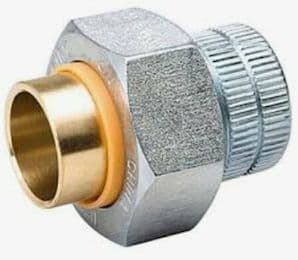
A. What you are describing sounds like a galvanic reaction. Make sure that dielectrics are installed (they look like a gnarled union) and if they are make sure that the rubber gaskets are good not allowing for contact between the copper and galvanized steel.
J. Kirk- Genoa, Illinois, USA
Q. Our home was built in 2005 and installed a mega tek geo system. In 2009 we started getting pin hole leaks inside the furnace. By 2010 we had five pinhole leaks inside the furnace. Just recently we got one pinhole outside the furnace just a few feet away. All these pinholes are on the hot water lines. Just this week noticed the first sign of blue staining in one bathroom. Have not had blue water in any other parts of the house. Had electrical system professionally tested and all okay. Well water was tested and ph level was in normal range. We do have a water softener treating for calcium. Any suggestions what is causing these leaks and what else we can investigate.?
Knowing that water does carry current but would plastic insulators between the copper lines prevent any further corrosion? ⇦ Answer?
mike veon- new castle, Pennsylvania
August 15, 2011
? What has been the copper content of the water in some of these cases in parts per million. The EPA acceptable level is 1.3 ppm. ⇦ Answer?
John LaurensonSalt water reef tank hobbyist - St. Augustine, Florida
October 27, 2011
Q. I have had blue stain in my sinks for several years now. Have read all responses posted here and don't see any easy solution. I've found one commercial product out there that claims results. Does anyone have any comments on the sacrificial anode made by Copper Knight?
James Haberberger- Leavenworth, Washington
November 7, 2011
A. I am a registered corrosion engineer in California and have worked on several copper corrosion issues including a very famous blue water problem in Northern CA.
Internal corrosion of copper pipes, which causes blue water, has nothing to do with electrical grounding. If stray currents will be involved in copper corrosion (very rare) it will be external corrosion of the copper pipes not internal.
My experience is that internal corrosion is generally caused by bacterial corrosion (generally stagnant water or water with inadequate residual chlorine), leftover flux during pipe installation, erosion corrosion due to high water velocity such as in recirculating water in hot water systems.
Not knowing all the details, I can suggest the following:
Install dielectric unions between the water heater and the copper pipes.
Turn off the recirculating water pump and see if the problem goes away in the hot water pipes.
Check the residual chlorine at the taps and see if it conforms to the water District standards (greater than 1-2 ppm comes to mind)
If the problem still persists, call a local corrosion engineer. Good Luck
- Danville, California
A. FYI:
In 4/2006 installed a Paloma tankless water heater for whole house-love it. In 1/2007 installed Kinetico whole house salt exchange water softener.
Within about a year green stains gradually built up in both bathroom tubs/shower areas. City water tested as normal. Copper bypasses were placed outside where the softener was installed with no improvement.
Company finally checked household water which confirmed higher copper levels. More copper wire bypasses were placed around water heater which led to some improvement.
Several (4-6) months ago we noticed cold water input copper pipe abutted the metal tank housing where we then stuffed insulation.
So far it appears we corrected the problem-fingers crossed!
- Metairie, Louisiana
March 5, 2012
Q. I have purchased a home in cape coral Florida. I have gutted the home and am told while it is gutted I should replace the plumbing. It now has copper water lines in the slab. The house was built in in 1972. There have not been any issues but I am told that in time these pipes will beginning springing leaks and I should run new pipes from the attic down to the faucets. Does anyone know if there is truth to this? I do not not have any blue green rings in my sinks as others had reported. Any assistance will be appreciated. ⇦ Answer?
Thanks
- Cape Coral, Florida
March 11, 2012
Q. I own an old house with copper piping; we also have well water and have been told we have hard water. We have several leaks a year with blue corrosion at the leak site, and the area will be so thin that it just breaks and crumbles. Would a water softener correct this problem? ⇦ Answer?
TERESA A HORROX- RINGTOWN, Pennsylvania
March 26, 2012
A. In 1969 or 70 after Christmas vacation I was getting ready for a morning meeting getting a big drink at a water cooler and then before I filled a soda pop can full of water, I allowed my boss behind me in line to get a drink. 20 minutes later I excused myself from the meeting to go to health service, noting I feel sick from that drink of water. My boss joined me. I declined an offer to pump my stomach; I shouldn't have! My boss left; I later learned he had gone to men's room and vomited. He felt better; I didn't; I felt rotten all day. When I poured the soda pop can contents into a glass, the mush was too opaque to see thru, a mix of green, mint green, and blue-green.
The investigation of the problematic water cooler found:
* In piping the water line to the cooler, the plumber used one plastic fitting in what was otherwise an all copper line
* That to provide a ground connection to d c [direct current] signaling function of a tie trunk circuit of a PBX switcher in the lab at this Bell Telephone Labs location, the design people had run a wire from the PBX to this nearby water cooler. And
* The 4 day weekend was long enough for a lot of nasty electrolysis across that plastic fitting.
I recall in electrolysis experiments I did, using ac didn't do much but using dc much more happened!
One can get DC out of AC by using a rectifier; crystal [radio] sets used a crystal to rectify radio frequency AC into varying [at audio frequencies] DC. Some of these crystal sets used the crystalline structure of steel razor blades. It seems possible to me that nearby radio transmitters [like home electronics or cel phones] or high voltage transmission lines can induce signals into metal water pipes with some flow thru the water at dielectric junctions to copper sulfate/sulfite crystals in contact with inside surface of metal pipe, thus resulting in rectified [dc] flow.
Another chemical involved in some municipal water is phosphoric acid which is added to the "finished" water to keep lead piping from dissolving into the potable water. Detroit Water & Sewerage Department is one that does this but refuses to say so in their Water Quality Reports. This acid in the water may increase its conductivity, causing increased electrolysis effect.
- Detroit Michigan you s of a
Q. I have a home built in 1998. In the last 3 months we have had 4 "Pinhole" leaks in our copper pipes in unrelated areas of the house. Investigating online I see this is becoming an increasingly common problem in homes across the nation, and that the latest research leans towards water chemistry as the problem although no one yet has a definitive answer. My question related to the above topic is: What experiences have folks had with PEX piping. I see many folks are going this route, and I read that PEX has been the piping of choice in Scotland for more than 30 years, but I can find no reliable information about the long term history of PEX. I need to repipe my whole house, but I don't want to use copper again if I'm going to have the same problem in another 10 years.
Please help if you can! ⇦ Answer?
Joe in NY
- Pound Ridge, New York, USA
August 20, 2012
Brass finish sink has a white film on it … electrolysis?
Q. I have a Hooker bathroom vanity and sink. The bowl is a baked on brass finish. It was installed during construction and has been in our powder room and used for 8 years. Then two days before New Years Eve this year, we noticed that water that sits in it leaves a white film which we cannot get off. The manufacturer said we can use regular toothpaste or Soft Scrub on this bowl. Nothing works. I did fill it partway with vinegar ⇦ in bulk on eBay or Amazon [affil link] and let it stand and some of it seemed to come off but not a lot. Two things have changed that may/may not be the cause. We installed a hot water recirculating pump in October. Then the first week in December we installed a non-electric Kinetico water softening system with a Chloramine Reduction System which has a large carbon filter. Since installing this we have noticed a green residue accumulate under my electric toothbrush and last week we noticed our bar sink (not used much) had a green residue, like calcium deposits only green, on the outside of the aerator. Kinetico has been out to look over the problem and claims it is not their system but thought maybe we have a electrolysis situation. He feels it is in our plumbing or that maybe the recirculating system is causing it. My thought is, why is it only showing up now? I hope someone has an answer before any damage is done.
E A McCoy- Omaha
March 28, 2013
Hi E A.
A. Anything is possible and your sink may be suffering from the chemical or electrical issues discussed here, but I tend to doubt it.
The "baked on" finish on your brass sink is almost surely a lacquer or clearcoat of some sort, and it would not seem strange that after 8 years of use, or an incident of abuse (some sort of chemical like turpentine rags in the sink), for the clearcoat to "whiten". If that were the case, you would not be able to clean it off with anything because it wouldn't be a stain on the surface but discoloration of the clearcoat itself -- and that seems to match your situation as well. It's probably possible, but perhaps impractical, to strip the clearcoating and re-apply it (you obviously couldn't use an oven-bake clearcoat). Maybe if you include a photo people will be better able to advise if it looks like failure of the clearcoat. Good luck.
Regards,
Ted Mooney, P.E.
Striving to live Aloha
finishing.com - Pine Beach, New Jersey

Q. The powder room gets very little use and certainly has had no chemical in or around it as the countertop is marble. I have filled the sink to different levels 3 times, each one higher than the one before with plain water. It leaves a white coating each time. Is there something in the softened water that would dissolve the clearcoat?
E A McCoy [returning]- Nebraska USA
April 1, 2013
A. That does look like something in your tap water interacting with the clear coat.
Get your tap water tested.
Also get some pH test strips and see if your water is swinging too far towards acid or base (pH of 7 is neutral).
Blacksmith - Boone, North Carolina, USA
April 8, 2013
Q. We had a new solar water heating system and on-demand water heater installed last November. Coincidentally, the town had just repaired water saddles on our street before redoing the road surface. Also, we had just upgraded to FibreOp on our tv/ internet. When we started to experience blue water from our taps, both hot and cold, we contacted the solar installers to see if there would be any system or electrical cause and they told us there shouldn't be. But here we are, almost a year later with the same problem and no idea how to go about fixing it. We don't remember the blue before this but had had a recent discolouration (brownish/greyish) in our water from the hot water tank that we had only had in operation for 8 years.
All the above information is very interesting but we are unclear as to the order of steps we should follow. City? Electrician? Plumber? Etc.
Thank you for any feedback or advice you may have.
- Wolfville, Nova Scotia, Canada
October 9, 2013

A. Sounds like your house is somehow reproducing a earth battery effect two dissimilar metals, such as iron and copper lie in damp soil they can tap telluric currents creating a current leading to electrolysis and pin holes A earth type battery set up was used to power telegraphs in the early days.
Jamie Robb- Dartmouth, Nova Scotia, Canada
May 2, 2014
 If you all stayed in Scotland you could replace all your copper supply pipes in barrier pipe (plastic) which gets a 25-year guarantee and copper only gets 15 years in Scotland.
plumbing and heating - Glasgow,scotland
!! Hi, we had light blue water when we had a dysfunctional water softener installed in our house. I had professional water analysis done on our household softened & unsoftened drinking (tap) water.
The softened (tap) drinking water had copper level of 15 mg/L (EPA safe level is 1.3 mg/L), and also contained acetone. Unsoftened household water copper level was .05 mg/L. and did not contain acetone.
Our family had physical symptoms consistent with high copper ingestion including gastroenteritis, bloody diarrhea, nausea, vomiting, headaches, tachycardia, dermatitis, cognitive impairment. Symptoms started within weeks of the softener being installed and continued for the 7-month period that the softener was in our home. The water softener company failed to install a pressure regulator valve, which apparently caused the unit to become damaged and not function properly. After 7 months of having this dysfunctional unit in our home, the company took out the broken unit & replaced it with a new unit. After 2 weeks of the new unit softening our water, water analysis showed that softened water copper levels were at .06 mg/L. Our symptoms improved. My daughter now has IBD (Ulcer. Colitis) and I have cognitive impairment.
Later we discovered that the company who installed and maintained the water softener system, installed it without required permits (which if permits were pulled, the incorrect install would've been noticed by inspector). They also installed a system which is illegal in our city (it drains brine waste into the sink/sewer, which is illegal). If anyone has a water treatment system in their house and has noticed blue water, and physical symptoms described here, please let me know.
Tawny s [surname deleted for privacy by Editor]- Los Angeles, California, USA
August 16, 2014
A. Sorry for your troubles Tawny. If you are considering legal actionh, please contact a lawyer and let him/her handle it; s/he may explain that public posts can weaken your case :-(
My limited understanding of this is that if your lawyer receives opinions contrary to your view, s/he doesn't have to reveal it to the other side because it's "work product"; but if you're asked, you must truthfully answer. Good luck, and speedy recovery.
Regards,
Ted Mooney, P.E.
Striving to live Aloha
finishing.com - Pine Beach, New Jersey

A. A water softener is not made for drinking water. It prevents scale build up. It does not stop things that dissolve copper. Drinking water is made from a reverse osmosis unit which will make it drinkable . Water softeners soften the water … if the water is soft then it's not the softener causing blue water. High TDS dissolves brass fittings. Best pipe to use is PEX with plastic fittings. If you have copper, check grounds and use poly(?) to coat your lines to help slow down the corrosion while trying to figure out the answer.
Chris smith- el reno Oklahoma usa
July 23, 2015
Ed. note: Some of the electricians above have claimed that water softeners can be a problem -- not due to the water chemistry but because the water main was previously a ground and installing the water softener can interrupt that metallic grounding path, so it must be cabled around.
Q. Hi, I live in a rental and there is a blue tinge to the cold water. I boil the water as I like to keep a jug of cold in the fridge; when it gets near the bottom of the jug there are blueish granules, residue. I have been in the property about three months. If I continue to drink this water is it likely to make me ill or do me damage. I am getting a bit worried about this; hopefully someone can reassure me that I will be okay. Many thanks, Gerry.
Gerry mcveigh- Hamilton New Zealand
September 5, 2015
A. Hi Gerry. Sorry, I wouldn't drink it. Buy bottled water or contact the county health department or wherever monitors public water supplies.
Regards,

Ted Mooney, P.E. RET
Striving to live Aloha
finishing.com - Pine Beach, New Jersey
Q. We just purchased our house 6 months ago. It was a custom built home in 2005. My husband loved the master bath, it came with a steam vent, lg ceiling fixture, & 3 side wall mount fixtures.
I'm blonde and have highlighted hair. After 6 weeks I have green tint to my hair. The salon said it must be chlorine, we have a whole house water purification system, charcoal tank kind. We have it serviced & checked. We have an on-demand hot water heater for the house. The salon got the green out of my hair and 3 weeks later it is green again! I noticed green residue on the ceiling shower head. Also there is substantial green corrosion on the copper pipe to the steam value. We are not on a well. The problem is the plumber doesn't think it is a corrosion problem because we are not on a well. The pH level is good and no chlorine was found. No one seems to be able to answer or willing to look. Is there a plumber in the area who can find a solution? Thanks.
Patrick Coleman- Fallbrook, California
December 14, 2015
A. Hi. I'd bet that the county health department will analyze your water for free. It may still turn your hair green, but at least you'd know whether it's safe to drink :-)
Regards,
Ted Mooney, P.E. RET
Striving to live Aloha
finishing.com - Pine Beach, New Jersey

A. I had a new electric water heater installed, a new gas heater and new plastic piping. The contractor (on his own) after a utility company inspection, put in a new copper water pipe to the new water heater. The water heater is grounded. The person who installed the water heater did not run a new line as I specified but used the line for a basement light. He was paid to upgrade all the lines including well pump but did not so they are from 1951. I found this out in 2015. Without knowing I had a copper pipe, my bath water was blue so I checked to see the pipes in the basement and found the copper pipe with corrosion around all of the welds. Neighbor came in and said it was new pipe. Meanwhile, the water heater is running brown and in a real mess. It was only 5 months old. This house was bought in 2001 and had good water. When that copper pipe was installed the mess began. ⇦ Answer?
barbara brandt- Ewing, New Jersey, USA
February 21, 2016
Q. My house was built in 1928 and I hired electricians and plumbers to bring it to code after 4 years. No problem with corrosion or blue water. Changed to PEX for all basement plumbing. Gutted bathroom but not tub. Porcelain over cast iron. New Heating system also used PEX. Bought new electric water heater to replace gas (vented into chimney was not good). Found green and blue water after utility company visited and discovered copper pipe from well to water heater. Sense here is for years no blue and green water or corrosion even with well. Now with copper pipe supplying NEW water heater (electric) it had a life of 4 years. I also noticed installer used wiring and circuit from the light in that area rather then a new circuit and I had a 20 amp board installed but had a marginal electrician twice. Water is a little acidic.
Had all cast iron plumbing replaced. Tub shows corrosion around new chrome fixture. I am replacing water heater and will use black pex. Not sure if I should go back to endure expense of a new gas appliance with venting or try electric again without the copper pipe.
- Ewing, New Jersey USA
May 21, 2016
A. Hi Barbara. If your tub is connected to everything only with PEX it is not possible for galvanic currents to travel to it. It should be fine henceforth.
I don't think corrosion is inherent with an electric water heater; something is doubtless wrong, but I wouldn't know what.
Regards,
Ted Mooney, P.E. RET
Striving to live Aloha
finishing.com - Pine Beach, New Jersey
A. It sounds like this forced hot water is a tankless water heater? If so get rid of it and use a tank type. If not it may have an electric recirculating line, look at that.
Also look at type of copper and solder used.
No dissimilar metals should be used.
I am not an electrical expert but I disagree with using copper water pipes for grounding because there is always a current traveling through them which causes corrosion.
Compare water before the meter vs. after to locate source of problem.
LEADFREE COPPER IS THE SAFEST POTABLE WATER SYSTEM.
- Omaha Nebraska USA
August 6, 2016
Q. Blue water on the floor outside the shower every morning and/or evening. Have no idea what it is, would this be the same thing? We don't know where it's coming from.
Rebekah Foote- Perth, WA, Australia
March 21, 2016
? Hi Rebekah. Apologies but I don't understand the situation you are trying to describe. We can either hope that another reader understood, or please write a couple of paragraphs :-)
Regards,
Ted Mooney, P.E. RET
Striving to live Aloha
finishing.com - Pine Beach, New Jersey
Q. Hello. We recently (3 weeks ago now I think) had a water softener installed as we live in north London and have very hard water. We have also refitted our house with new appliances, a new combi boiler, and just had the downstairs bathroom redone. so we've invested a lot of money!
So far the water softener seems fine. But last week we went on vacation. And we have come back to find a blue stain in the bath, under the bottom of the u-bend in the shower hose.
so I can't imagine this is anything other than the water softener, maybe being set at too high a setting? the bath was redone 1 year ago, and the combi boiler was put in 1.5 years ago. no prior history of staining before the water softener. there are no other blue stains we've found. thanks very much, ⇦ Answer?
mike
- London, England
June 20, 2017
This page welcomes Q&As, photos, history, anecdotes, relevant jokes ...
We're happy to provide the space & mechanism, but only the readers can build a community.
Please try to ENGAGE
• When people show interest in each other's problems, it's a fun & informative mutual learning experience !
• If they ignore other readers' postings, it becomes a dull string of unanswered questions 🙂
Q. Hi. We have blue green staining as well. 15 year old home and one owner. Piped with copper and electric water heater and private well (330 ft deep). Replaced water heater in year 3 and year 6 and in year 15 (this year). Started noticing blue green staining shorty after second water heater install mostly on the hot water side. NO HOLES in the pipes. We paid for complete water testing -- all checked out fine including pH. Some turbidity.
We installed a triple 2.5 x 10 water filtration (sediment + GAC + Carbon Block) and swap them out every three months or so. The sediment more often. House is grounded appropriately (to well casing), but somehow copper water pipe is bonded to the neutral. Physically disconnected the water heater and pump from the electrical system, but copper pipe still bonded. Switched off each breaker individually, copper pipe still bonded. Drained water from copper pipe and disconnected pipe from pump (to see of water is carrying the charge) … copper pipe still bonded. I have replaced pieces of the copper with PEX when installing water filtration and new water heater. AND … we are still getting blue green water staining with NO pin holes/leaks in pipes. Any thoughts/solutions before I re-plumb the house with PEX. ⇦ Answer?
LR Squires- St. John's, NL
May 19, 2018
Q. Hi,
We replaced our old water softener (it was past six months old) with a new one last week. Since then the water in all the faucets is blue in color. Tried leaving the taps on for few minutes to drain out the water in the pipes, but no difference. We thought the water softener was defective so bought a new one and had a plumber replace the cartridge but the water remains blue and has a metallic taste. So definitely it's not the softener. We have copper piping in the house.
I don't know if there's a connection but at the same time when I changed the first water softener, I replaced the water filter cartridge behind my refrigerator as well.
The water was fine until I replaced the water softener filter with a new one. I am supposed to change it every six months. Have done it in the past. No idea what happened this time. ⇦ Answer?
Please help.
- Bay Area, California, USA
December 14, 2019
⇦ Tip: Readers like to learn from others' situations;
some readers skip abstract questions.
- King William, Va
March 21, 2026
Sorry! Finishing.com is temporarily Read-Only.
Please maintain your bookmarks! Although Ted Mooney is retiring, finishing.com is not!
It will have a new owner/curator very shortly!