
 Where the
world gathers for metal finishing
Q&As since 1989
-----
European directives vs. Tin Whiskers & Tin Pest
2003
Europe is pushing removal of Pb from everything come 2006. We are examining the alternatives. Pure tin (>99.5%) appears to be what the consumer industry is going with. We in the industrial market keep hearing about whiskering and "pest" We have examples of whiskers, and while we are worried, apparently the component manufacturers are, in general, not. Pest is something not even discussed.
Solders will probably be something like Sn[92]Ag[4]Cu[4]. Platings are apparently going to Sn. Will the alloying during the soldering process be sufficient to keep whiskers and pest from being an issue? Solder probably forms 90% of the bulk, but I would expect some metallurgically pure tin at the interfaces.
You folk appear to have experience with this, and so I would ask the following:
1) Anyone have alloying percentages to keep whiskering and pest under control?
2) Anyone have rates of decomposition for pest?
3) Any anecdotal information that could help?
The entire electronics industry appears to be moving this direction, and to be perfectly honest, there is a mint to be made by discussing tin related issues at electronics conferences. We have no experience with it (except some from tin plated brass hardware). We need to become instantly knowledgeable, since, with 2.5 years until implementation, there will be no time to correct for errors.
test & measurement electronic engineer - Beaverton, OR, USA
2003
The (U. S.) National Institute of Standards & Technology has conducted considerable research on lead-free solders. See "Properties of Lead-Free Solders" at http://www.boulder.nist.gov/div853/lead%20free/props01.html [Ed. note, now https://www.nist.gov/fusion-search?s=tin+whiskers]
NASA Goddard Space Flight Center has conducted a lesser amount of research on tin whiskers. Interesting website (including photos and results from other sources): http://nepp.nasa.gov/whisker/experiment/index.html. A page devoted to MIL & NASA prohibitions on the use of pure tin shows that alloying with 3% lead is specified in many cases, so anticipate changes.
A University of Maryland site, http://www.calce.umd.edu/lead-free/tin-whiskers/ offers "Mitigation Strategies for Tin Whiskers" for circuit designers and platers [Ed. note, now https://calce.umd.edu/search/google/tin%20whiskers
Search "Whiskers" with this site's Search Engine.
Other sites with considerable info on lead-free solders and tin whiskers are the National Electronics Manufacturing Initiative
(http://www.nemi.org/), www.TinTechnology.com (formerly the International Tin Research Institute) and Tin Technology Ltd.
(http://www.tintechnology.biz/soldertec/) [Ed. note: link no longer works] There is little research on Tin Pest Disease; its metallurgical cause has been known for many years. The rate of transformation from white tin to gray tin as a function of cooling temperature was determined by J. H. Becker, Journal of Applied Physics, vol. 29, p. 1110 (1958). See letters
#0740,
18849 and
25988 for more info on tin pesting. Alloying with as little as 0.26 % antimony prevents pesting. Research on preventing tin whiskers via alloying is also relevant to the prevention of Tin Pest Disease. There are numerous professional and subscription-based journal articles on these subjects. A free, online article on lead-free solders: http://www.tms.org/pubs/journals/JOM/0106/Frear-0106.html
Hope this helps,
- Goleta, California
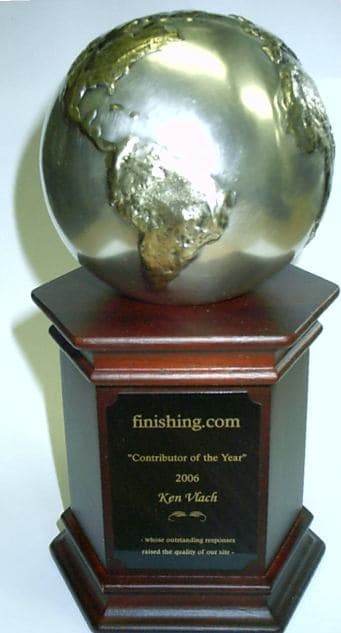 Finishing.com honored Ken for his countless carefully researched responses. He passed away May 14, 2015.
Rest in peace, Ken. Thank you for your hard work which the finishing world, and we at finishing.com, continue to benefit from.
Q. It is common to tin plate busbars and other copper parts in the Low Voltage Switchgear business.
However tin plating may lead to the presence of tin whiskers (tiny tin hairs growing on tin plating) which can lead to minor arc faults.
Is there anything one can do in the plating process to eliminate, or avoid the growth of tin whiskers.
General Manager - Ireland
August 28, 2018
A. Hi Sean. 70 years after the recognition of tin whiskers we believe that we understand some things that increase their propensity, like highly stressed deposits, and some things that largely eliminate them, like RoHS-forbidden lead content in the plating ... but as I was reminded even today by writers who have spent their life studying them, we neither actually understand them, nor can we accurately predict much that is truly useful about whiskers from pure tin coatings; they can start immediately, or never start, or spontaneously start after years, and the trigger is not understood.
Fortunately, you probably have a resolution even if it's painful: proper conformal coatings with greater cohesion than adhesion can stop them, and that seems possible for busbars.
Although Ken Vlach noted above that NASA Goddard "has conducted a lesser amount of research on tin whiskers" that appraisal seems very dated -- I wish I had a free week or so to spend at https://nepp.nasa.gov/whisker
It's a fascinating site!
Regards,

Ted Mooney, P.E. RET
Striving to live Aloha
finishing.com - Pine Beach, New Jersey
August 2018
Q, A, or Comment on THIS thread -or- Start a NEW Thread