
| Search our quarter-million Q&As |
Home of the finishing HOTLINE since 1989
-----Home anodizing
Current questions and answers:
Q. Hello total newbie here, i have successfully anodized several aluminum pieces I machined. But in the most recent batch of parts I noticed my aluminum rod I attached the part to was not usable after 2 uses due to corrosion. Previously i did not have this issue. Any ideas as to what could cause this?
Jacob Gonzales- Albuquerque NewMexico
January 17, 2021
A. Hi Jacob. Please send a pic to [email protected] for posting here. I think you're talking about a bar that bridges the top of the tank to which you are wiring your parts but that is unclear, as is the 'corrosion' that renders it unusable. Production anodizers have used aluminum work carriers for decades (although the contact areas are copper). Thanks.
Luck & Regards,

Ted Mooney, P.E. RET
Striving to live Aloha
finishing.com - Pine Beach, New Jersey
Need quick confidential answers? $25
Need project assistance? $100/hr.
January 2021
⇩ Similar, related, Q&As -- oldest first ⇩
1999
Q. I am looking into trying aluminum anodizing as a hobbyist. I have read some articles on the subject but before I dabble with different acids and solutions, I would like to find a good source for this procedure. Is there a way that I can set up a small operation in my garage or basement? I would be working with only one or two small pieces at a time. I did read one article were the author (Jim Bowes) tells to clean the part in a nitric acid solution (1-2 ounces per gallon.) Then put a combination of sulfuric acid and water (1 part water and 2 parts acid) in a bucket. Then make an aluminum "wand" and place that into the solution and attach the negative end of a battery charger ⇦ on eBay or Amazon [affil link] to it. Then, place the positive lead to the part and immerse it. He then advised to wait until it no longer conducts electricity. After rinsing with cold water, dip into a dye solution. Is this something that can be done? Is it more dangerous than it sounds? Is there somewhere that I can get more info on "Anodizing at home?"
One last question, is there a way to do anodizing without using electricity?
Thanks, Tim.
Tim Mattsson1999
A. I myself have looked for home anodizing info, specifically for my paintball gun. Yes I could send it out, but where's the fun in that? Here are some things I have found on doing it at home:
http://www.ptialaska.net/~airserv/anod.html[Ed. note: link was bad by 1/13/00]http://warpig.com/paintball/technical/paintguns/anodize.shtm[Ed. note: link was bad by 1/13/00]
There is a place on the web called [name removed at request of that company] that sells home kits for the do-it-yourselfer hobbyist. Including a cool paint-on gold plating kit. Most paintball players love shiny things;)
Ian CarlinEd. note: Please google for 'hobby anodizing'; the company that was mentioned has requested that their name not appear on this site.
A. Fun is important, just not the only issue. There is also safety and environmental responsibility. So start with goggles and gloves before doing anything else. And in addition to talking about technique, be fully aware that the chemicals involved are dangerous and can have an environmental impact, so look into that as well. Good luck.

Ted Mooney, P.E.
Striving to live Aloha
finishing.com - Pine Beach, New Jersey
Need quick confidential answers? $25
Need project assistance? $100/hr.
1999
 My applause Ted. I have worked in the metal finishing field as an engineer for over 18 years. I deal with the safety, environmental and operating aspects of different metal finishing processes, including anodizing. The first and foremost concern are the chemical hazards to the operators. Wearing the proper safety equipment is only half the story. The other half is having other people trained to help in an emergency. The solution of sulfuric acid mixed in water is no different than battery acid
⇦ on
eBay
or
Amazon [affil link]
, one drop in your eye and you are blind. Just mixing the water in the acid can cause it to blow up in your face.
My applause Ted. I have worked in the metal finishing field as an engineer for over 18 years. I deal with the safety, environmental and operating aspects of different metal finishing processes, including anodizing. The first and foremost concern are the chemical hazards to the operators. Wearing the proper safety equipment is only half the story. The other half is having other people trained to help in an emergency. The solution of sulfuric acid mixed in water is no different than battery acid
⇦ on
eBay
or
Amazon [affil link]
, one drop in your eye and you are blind. Just mixing the water in the acid can cause it to blow up in your face.
Leave these chemical processes to the professionals who can give you the results you expect in a safe way. This will allow you to continue with your hobby for many years to come.
Keep up the good work Tim!
Brian DeLucenay- Van Wert, Ohio
2001
 I disagree. Unless you have absolutely no education whatsoever, and didn't read into the process before commencing it, anodizing isn't that hard. There are hazards, but once you protect yourself from spills, contain the sulfuric acid solution in a sealed box with an adequate fume hood, anodizing isn't hard at all, especially for hobby uses.
- Mississauga, Ontario, Canada
2001
! Actually I shot battery acid ⇦ on eBay or Amazon [affil link] in my left eye when I was 12. I poked it with a nail to find out what was inside. It shot into my eye and then fell into a puddle spewing its contents throughout. My dog then drank from the puddle. I didn't go blind, neither did my dog.
Tim Mulligan- New Hudson, Michigan
2003
I've done a couple batches at home from several of the home anodizing suppliers and it is safe. Read the instructions and there will not be problems. My father had a battery blow up in his face because he was smoking while working on his car -- battery discharging while he was working on it and he suffered no long lasting problems and yes he got it in his eyes.
Russ W [surname deleted for privacy by Editor]tumbling - Livonia, Michigan
2004
Hi Russ.
If you consider lead-acid batteries exploding in your face safe because your father survived it and wasn't blinded, then right, you have no safety concerns about anodizing. But many wouldn't agree with you that battery acid and exploding batteries are no big deal :-)
Regards,
Ted Mooney, P.E.
Striving to live Aloha
finishing.com - Pine Beach, New Jersey
Need quick confidential answers? $25
Need project assistance? $100/hr.
A. I have been anodizing parts in small quantity for quite a while now, and I have found that unless you ignore all of the safety tips, you can do it without mishap. And on the issue of hazardous materials, I found that for a small fee, my local landfill would take any of my waste and dispose of it properly.
Abe Hager- Olympia, Washington
2004
A. Again, everything is relative, there is room for multiple opinions on what is relatively safe and environmentally responsible, Abe. But as operator of this site I feel the obligation to remind readers that if they move beyond anodizing their own parts, they need to see the EPA's stand on this issue in the Code of Federal Regulations at 40CFR433 (available in most libraries as well as on line).
I see no way of interpreting it but that if you sell any product that you are anodizing, or you sell an anodizing service, then the weight of federal compliance regulations and reporting regulations fall upon you. The waste is then 'categorically hazardous' regardless of how innocuous you or the landfill operator may feel it is (because it came from an anodizing shop, it is by federal law 'categorically' hazardous waste no matter what characteristics you measure. If the landfill operator knows that the waste is from an anodizing shop he would be committing a federal crime putting categorically hazardous material into a general landfill, and you remain responsible for it forever anyway.
Clearly the chance of getting into serious trouble for operating a pint-size beaker [beakers on eBay or Amazon [affil link] in your garage is remote. But there is a temptation to grow, and the number of people jailed or losing their house and life to fines for operating their garage as a plating shop is not small. A plating shop in a one-car garage attached to he owner's house in York, PA eventually landed the owner in the penitentiary when he chose illegal disposal over losing his family's home to legal disposal costs; a chromium plating operation in a two-car garage in Odessa, Texas is a Superfund site which has cost a million dollars and counting just in legal fees.
You are welcome to say that this is silly & alarmist, and I was already quick to concede that the average hobbyist isn't in serious threat of jail, but please read the law I referred you to so you can understand the overall situation.
Ted Mooney, P.E.
Striving to live Aloha
finishing.com - Pine Beach, New Jersey
Need quick confidential answers? $25
Need project assistance? $100/hr.
2003
Treatment &
Finishing of
Aluminium and
Its Alloys"
by Wernick, Pinner
& Sheasby
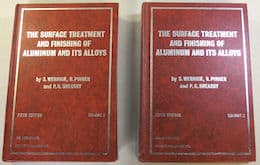
on Amazon or eBay
or AbeBooks
(affil link)
Aluminum How-To
"Chromating - Anodizing - Hardcoating"
by Robert Probert
You'll love this book. Finishing.com has sold a thousand copies without a return request 🙂
by Kushner & Kushner
(If you can't buy it, try Worldcat for a library which has it).
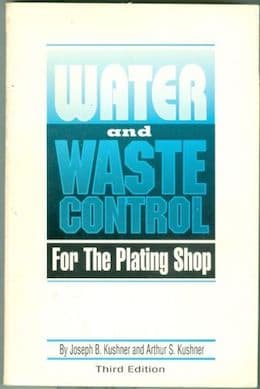
on Amazon (rarely)
or eBay (rarely)
(affil link)
Well I hope someone can help me out. I have a paintball gun not sure exactly what they are made from would like some input on that part but I want to anodize it another color and want to know what's the best way to do that.
thanks,
consumer - Southmills, North Carolina
2007
Being a regulatory compliance guy (I have my own business in product regulatory compliance) and someone who has done "home anodizing", I can also vouch for it being safe as long as you educate yourself prior to attempting it, and use some common (uncommon?) sense.
Read everything you can get your hands on and listen to those that have done it before you. That doesn't mean do everything that everyone tells you to do, you are on a *fact* finding mission before you dip your first part.
Don't go big right off the bat. Start small and increment yourself if you must do more.
Read the regs, and know that unless you start charging and/or your dumping waste haphazardly, there is nothing special there. If you start doing this for others and/or get to a level other than just a hobby...be aware that you will have quite a burden placed on you. Nothing wrong with running a hobby line done responsibly. Just like nothing wrong with prospecting responsibly or making beer or wine for personal use in a responsible manner. You don't need to apply federal regulations that are not intended to be applied to the hobbyist...having said that, dump something into a stream or sewer and you deserve to go to prison for two reasons...one for breaking the law and especially for two...being so stupid.
Happy anodizing!
Incidentally, the aerospace company I work for wants to open an anodizing line because they think we pay too much for anodizing...I am preparing a study to show them that they would be crazy to bring this burden (administrative, cost and liability) on to the company for the scant amount we pay a third party who has being doing it consistently and cost effectively since about the 40's. Since they have long since paid for their buildings and equipment, they have been exceptionally reasonable in our pricing and we have a long standing history...the owner sees a number and has absolutely no understanding that the number is peanuts compared to what it will cost him to bring this in house, he will though.
- Priest River, Idaho
2007
Q. Hi, please could someone with some experience of anodising tell me if steaming a freshly anodised part would properly seal the pores. I'm setting up a small anodising line and I have an old veg steamer that I was thinking would do the job of sealing, seems to make sense as I would save one distilled water and there is a timer.
Steven Bradleyhobby engineer. - Birmingham , England , UK.
April 10, 2012
Hi, Steven.
Steam sealing can work. Stay in the steam at least as long as in the anodizing tank.
Regards,
Ted Mooney, P.E.
Striving to live Aloha
finishing.com - Pine Beach, New Jersey
Need quick confidential answers? $25
Need project assistance? $100/hr.
April 10, 2012
Q. I am new to anodizing, but am trying it out. I've been troubleshooting my setup for a week and can't get it to work. I am using parts that were previously anodized, starting by soaking them in a lye solution until I can see the grains in the aluminum. I then rinse the part with distilled water. I have even tried sanding the part down to fully bare aluminum. I rack the part with 16 ga aluminum wire and put it in a bucket with a 1:3 ratio of distilled water and battery acid. Using a heater to keep it right at 70 degrees. I'm using 5 lead strips as my cathode, about 20 sq inches of exposed cathode. I've made sure to scrub them in between attempts to remove corrosion. I suspend my part (6061 aluminum, about 3 sq inches of surface area.


Based on this math I use the 720 rule, 6 amps/sq ft, 0.16 amps for an hour. Set to constant current, Voltage starts around 2-3 volts and drops to like 1.5-2 volts by the end of the hour. The part comes out looking a little grayer, but I can still see the grains. What could I be doing wrong? My troubleshooting so far: scrub cathodes every time, have tried using 1:1.5, 1:2, and 1:3 ratios of battery acid to water, tried different parts between 2 sq in and 27 sq inch, done the proper math, and they just don't seem to work. None of the parts will take dye, not even the aluminum wire. I've taken apart the power supply to verify proper polarity. I'm completely lost. Any help greatly appreciated
Carter Breckenridge- St. Louis Missouri
January 9, 2021
A. Hi Carter. You'll never anodize at 2-3 volts. Somewhere in the area of 12 volts is required depending on the alloy. 6 A/sq. ft is probably a bit low, but I understand that hobbyists work in that range.
If you have the polarity right (the aluminum must be connected to the positive), then I suspect that your power supply is defective. What I would suggest doing for a test is switching to voltage control, starting at 2-3 volts and over the course of five minutes slowly and gradually raising the voltage to 12 volts for the rest of the hour (check the voltage with a different meter, don't trust the one on a possibly defective power supply.
Luck & Regards,
Ted Mooney, P.E. RET
Striving to live Aloha
finishing.com - Pine Beach, New Jersey
Need quick confidential answers? $25
Need project assistance? $100/hr.
January 2021
A. Carter
At 2-3 volts, it is quite possible the electrolyte is dissolving the coating as fast as it is formed.
Unless you have really small hands, the parts looks bigger than 1" diameter. Make sure you are calculating for all surfaces.
Consider trying to anodize just the wire to see if you can get it to take the dye. Anodize @ 15 (or 12) volts for 30 minutes. Use your volt meter to cross check the power supply gauge. Also try using a 3:1 anode to cathode ratio, or something close.
With regards to the grain, the anodize will not hide or cover the grain. If you want shiny you will need to start with shiny.
- Green Mountain Falls, Colorado
January 11, 2021
Sorry! Finishing.com is temporarily Read-Only.
Ted Mooney is retiring but I have several offers to take it over.
We're working hard to make sure we find it the best new home.