

Metal finishing Q&As since 1989
-----
Best way to measure chrome plating hardness
Q. Which is the best instrument to measure hardness of hard chrome plating? Can we use Ultrasonic hardness tester for this purpose?
FINNY VARGHESEPetrochemical industry - BARODA, GUJARAT, INDIA
2003
A. I am from the old and broke school of chrome plating. The only "hardness" test that I am aware of is a microhardness test which requires a test piece or destructive testing of a part.
James Watts- Navarre, Florida
2003
A. Agree with Mr. Watts. Hardness testers used for bulk materials are unsuitable for thin coatings. A sizable investment is required for proper sample preparation and measurement, so unless you already have metallography facilities, first check for a nearby metallurgical testing laboratory.
I suggest a Knoop microhardness tester, as it can measure thinner coatings than Vickers testers. Instruments with switchable Knoop and Vickers indenters are available if you also wish to measure hardened steel. The measurement method is given in ASTM E384 Standard Test Method for Microindentation Hardness of Materials. Also ISO 14577. For sample preparation (slice and dice with a diamond wafering saw, mount in a hard plastic, polish to a near-mirror finish), see ASTM E3 Standard Practice for Preparation of Metallographic Specimens.
Use the finishing.com search engine for coating microhard Knoop vickers for additional info, e.g., letter #6561
Some technical features of Microindentation Hardness Testing are given at http://www.metallography.com/amp/micro.htm Both bulk and microhardness methods are described at http://www.leco.com/customersupport/met-tips/met_tip9.pdf
- Goleta, California
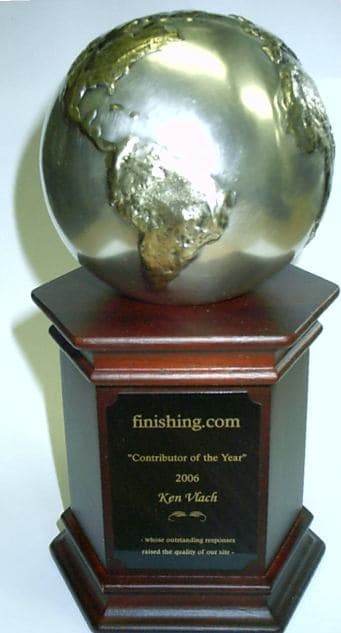 Finishing.com honored Ken for his countless carefully researched responses. He passed away May 14, 2015.
Rest in peace, Ken. Thank you for your hard work which the finishing world, and we at finishing.com, continue to benefit from.
2003
----
Ed. note Sept. 2019: That leco.com link is now broken.
A. The above procedure is partly from ASTM B578-21 Standard Test Method for Microhardness of Electroplated Coatings. This is the Knoop microhardness test required for Cr plating per ASTM B177 and also for electroless nickel per MIL-C-26074
[on DLA] and ASTM B733, Class 2. An advantage of this method is that the samples can also be used for microscopical thickness measurement per ASTM B487. A disadvantage is that the coating thickness must be at least 25 microns (1 mil) for hard metals Cr, Ni, etc. and 38 microns (1.5 mil) for soft metals Ag, Au and Cu.
I thank Toby Padfield for pointing out elsewhere that Fischer Technology makes a highly sensitive microhardness tester capable of measuring coatings only 1 micron thick. As such, it can measure a very flat plated surface (polished) directly, without the cross-sectioning procedure required by the ASTM procedure.
- Goleta, California
Finishing.com honored Ken for his countless carefully researched responses. He passed away May 14, 2015.Rest in peace, Ken. Thank you for your hard work which the finishing world, and we at finishing.com, continue to benefit from.
2003
Handy instrument for hard chrome plating hardness
Q. LOOKING FOR HARD CHROME COATING HARDNESS HANDY INSTRUMENTS. REQUIRED HANDY INSTRUMENT.
DIGISH PATELSHAFTS - AHMEDABAD, INDIA
October 7, 2009
A. For chrome, a micro hardness test is required! This is a destructive test.
If you can guarantee that the shaft underneath is always within a tight hardness range, you can do destructive microhardness tests on a series of dummy shafts and compare them to rockwell C readings. This will give you an approximation of the real hardness. The chrome has to be of identical thickness as well as the shafts being of identical hardness.
In short, the only true answer is microhardness which is not quick, cheap or easy for poorly qualified help.
- Navarre, Florida
October 12, 2009
Microhardness testing of hard chrome plating
Q. Is there any procedure available for Microhardness testing of chrome plated ram of diameter 450 mm and length 1845 mm and plating thickness of 0.075 mm. Can hardness be checked directly on such a huge piece?
George DavidA mechanical engineer - Pune, Maharashtra, India
July 22, 2010
A. George,
Microhardness should really be done on the cross-section of the plating to get a true hardness. If you were to plate a test piece along with the job it could then be tested rather than the part.
It is possible to test the part, but it will leave a small dent where the diamond indenter lands on the surface. This just means that you need to test in a non-critical area of the part.
Finally ASTM B578-21 describes microhardness testing of electroplated deposits.
Aerospace - Yeovil, Somerset, UK
July 28, 2010
Q. Sir we are the manufacturers of hydraulic cylinders and for that we used to manufacture piston rods. Now we don't have any instrument to check the plating hardness. Now the instrument require large investment so is there any traditional way to check the plating hardness?
For now we check the hardness using a mechanical file and applying certain amount of load and monitor whether plating comes out or not. is it correct way? if yes what should we keep in mind before doing that.
Warm Regards

Rushikesh Deogade
- Nagpur, Maharashtra, India
February 9, 2013
LEEB Hardness Testing Hard Chromium Coating
February 18, 2015
Q.
Is anybody have experience with Leeb Hardness testing method for measuring hardness of Hard Chrome plating layer.The substrate can be steel Stainless or soft metal like copper, aluminium, etc.

Yehuda Blau
YB Plating Engineering and Quality - Haifa Israel
----
Ed. note: Readers may also be interested in this closely related thread:
Topic 50120, "Hard chrome thickness and hardness measurement equipment"
Q, A, or Comment on THIS thread -or- Start a NEW Thread