

Metal finishing Q&As since 1989
-----
Lead Anodes

this text gets replaced with bannerText

Q. We are going to replace our anodes in our tank and are trying to figure out what is the best material to use. Right now we have half inch lead for the buss bar around the tank. Our anodes are flat anodes sheets. Our owners manual said the buss bar from the factory is aluminum and the anodes are 1/2 inch thick. My question is do we need the aluminum buss bar or the lead one. We are gonna try and start using round anodes but we need to keep our old set up till we can get the right results with the round ones.
Thanks,
machine shop - Mayfield, Kentucky, United States
2003
A. I'm not sure what finishing process you are talking about, but I'll guess sulfuric acid anodizing, even though you mentioned round anodes. In any case, while either lead or aluminum may be the anode of choice for the particular process in question, aluminum is a far better construction material for bus bars because of its much greater electrical conductivity. Aluminum will carry 50 percent as much electricity as copper of the same area; with lead, you'd probably be pushing it at 10 percent. Now if you are talking hard chrome plating rather than anodizing, I'd probably go with copper bus bar and lead anodes.

Ted Mooney, P.E.
Striving to live Aloha
finishing.com - Pine Beach, New Jersey
A. Greg,
I will assume we are talking about Sulfuric acid anodizing therefore my answer if as follows.ALUMINUM, ALUMINUM. ALUMINUM Because:1) it is much more conductive saves 2-3 volts, 2) gives better current distribution more uniform oxide, 3) does not introduce any other metals into the bath, 4) can't contribute to lead emissions in waste waters, 5) and if you use the proper alloy6063T6, will last long and be overall less expensive than lead.
Drew Nosti, CEF
Anodize USA

Ladson, South Carolina

Q. I'm sorry that I didn't tell you what kind of plating we do. We do hard chrome plating. Do you still recommend the copper for the buss bar? Our manual says the machine came with a aluminum buss bar but no one knows for sure because we replaced it with lead for some reason. Will the copper buss bar contaminate our chrome tank when it erodes. Thanks for your help. We had our chrome tested and we have a problem with our big tank. It has high copper and iron readings. We have a porous pot coming in tomorrow. Another question that I have is do we need a baumé hydrometer and a Chromometer hydrometer.
Greg Brimermachine shop - Mayfield, KY, United States
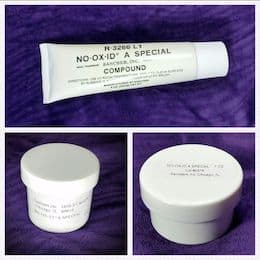
"No-Ox-Id" Compound
on
eBay
or
Amazon
(affil links)
A. There may be a semantics problem here, Greg. I call the rods which sit on top of the tank and from which the anodes hang 'anode rods' not bus bars; to me, bus bars are the conductors which convey current from the rectifier to the anode rods and cathode rods or cathode V-saddles.
The overwhelming majority of anode rods for chrome plating are copper. While aluminum has good conductivity, it has terrible surface resistance because it oxidizes so readily and thoroughly. It is fine as a bus bar material where the joints are made up permanently with a compound like No-Ox-Id, but it is not a satisfactory anode rod material because the anode hooks cannot make good contact on it.
Lead has both low conductivity and very low strength and rigidity; I can't believe the anode rods or bus bar are made of lead. Lead-encased copper perhaps.
Ted Mooney, P.E.
Striving to live Aloha
finishing.com - Pine Beach, New Jersey
A. To get to your question on hydrometers, the real question is, what do you want to do with them? If all you want to do is control the chromic acid, either will do, but the baumé hydrometer is more flexible. You can convert baumé readings to chromic content for a quick and dirty check, but if you want to do anything else, a hydrometer that reads in chromic content will prove to be more complicated.
Personally, I believe that using a hydrometer to control chemical concentrations leads to a false sense of security; there are better methods that can be performed by anyone who has taken a decent high school chemistry course.

James Totter, CEF
- Tallahassee, Florida
2003
Q, A, or Comment on THIS thread -or- Start a NEW Thread