
| Search our quarter-million Q&As |
Home of the finishing HOTLINE since 1989
-----Etching Aluminum for Artistic Purposes
Q. I am a college student taking the second in a series of fine art metals courses, and for my project I would like to etch some designs into 1/8" aluminum stock. The specific finish does not matter too much, however the rougher the texture of the resulting etch the better. I would like to be able to create a mask of the design that would be easily applied, and would prefer to use a liquid bath so that I could control the extent of the etching. I will probably apply a sandblasted finish to the whole piece. I have access to adequate facilities to work safely and properly, that should be no problem, although I will probably have to travel to nearby Austin to obtain the chemicals unless they are easily accessible.
Thanks for any help!
2003
A. 50 or 60 years ago this would have been accomplished by coating the aluminum with an acid resist such as asphaltum. Then you would remove the asphaltum from the areas that you wish to have etched. You would then submerge the aluminum into ferric chloride until the desired degree of etch had been reached. Just keep in mind that the reverse side would have to also be coated with the acid resist or it will be etched as well. I would imagine that the only difference today would have to do with EPA regulations governing the availability of the chemicals. As with any chemical use, you should use proper caution.
Q. In answering your question, it brings me to my question. Where do you purchase the asphaltum and the ferric chloride
⇦ on
eBay or
Amazon [affil link] in a concentration comparable to that which was used 50 years ago?
- Camas, Washington
A. Acid etching with ferric chloride works great on aluminum, brass and copper. Your choice of resist, however, is great today as compared with long ago. In Celtic times it would have been pitch as a resist and nettle juice as acid, most probably :-)
I have done extensive experiments on metals for jewelry using ferric chloride of the type used for circuit board etching
⇦ on
eBay or
Amazon [affil link] , and I've used resists such as grease pencil (like for printmaking). Also used nail polish, asphaltum, contact paper, spray paint, and pnp blue (proprietary melt on transfers). The trick seems to be how each holds up in the acid bath... the wimpier ones undercut too fast, and you must adjust the strength of acid.
Make sure you know how you will remove the resist when the etch is complete. Also be mindful of the environment when you dispose of the spent etchant/acid!
- Anacortes, Washington
Q. How deep is deep-etching? I want to make deep etching over aluminum with NaOH and sodium gluconate but my depth is poor; I need at least 1/16 that's I called deep etching.
Thank you,
- Mexico
2003
A. For etching Aluminum try Such HCl(hydrochloric acid within is solved 56g/l Al).
Peter Easton- Alabama
2005
Multiple threads merged: please forgive chronology errors and repetition 🙂
Q. We are using alkaline etchant to etch copper. Would like to know what do you use to etch aluminum?
Ramesh Jasani1999
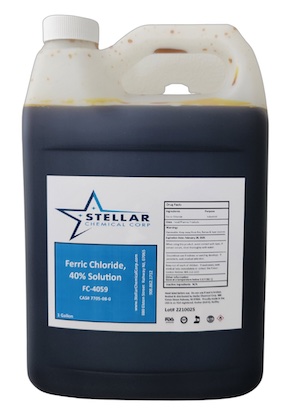
Q. I'm interested in your use of ferric chloride to etch aluminum. I hand pull prints from etched copper using ferric chloride. What is the concentration you use for aluminum?
Regards,
- Thomaston, Maine
2004
A. I have used the same strength on aluminum as for the other metals; however, I always experiment, and test, as it is only exact when under highly controlled parameters.
Q. Since then, I understand there is a way to do the same without icky chemicals, using a reverse plating setup with a solution of common salts. Not sure how, but I have heard of it. Please post if you know of this. Thanks.
Susan C [returning]- Anacortes, Washington
2005
A. For basic salt etching of metal you might start with
www.greenart.info/galvetch/beginner.htm#3
- Nashville, Tennessee
2006
A. Try using this method: copper sulphate
⇦ on
eBay or
Amazon [affil link] with a mixture of table salt to etch zinc and aluminum plates; this is a great method and much safer.
The materials are very inexpensive and easy to come by.
For the advancement of the Fine Arts. Carry on...
- Otisville, New York
2007
A. A local, and cheap, source of copper sulphate would be your hardware store, plumbing section. A product called Root Kill ⇦ on eBay or Amazon [affil link] is almost pure copper sulphate crystals. A 2 pound container of it was just $10.
Barry Smith- Renton, Washington
February 22, 2008
A. Regarding where to obtain Copper Sulphate:
In New Zealand I find that most Garden Centers stock the crystals in 750 gm to 1 Kg packets. Approximately $NZ 10.00 to NZ$19.00. Should be 2/3 that in $US.
- New Plymouth, New Zealand
May 21, 2009
Q. Do you mix the copper sulphate and table salt in equal proportions with water & submerse the aluminum with the resist in place? For how long?
I used to have this type of thing acid etched but the guy who did it closed up due to environmental issues in disposing of the used acid.
Hopefully this will be a better, easier & safer alternative.
- Vancouver, BC, Canada
March 4, 2008
A. Hey all, chiming in on this copper sulphate thing.
The "copper sulphate/sodium chloride" procedure is a electrolytic etching method, as made well-known to printmakers by Cedric Green and the Galv-etch, "Green Prints" articles. It is clean and easy and cheap, but it requires a power source. You need a DC current with the plate on the positive and a metal grid on the negative of the same metal as the plate to be etched. It takes a little reading, and some practice, but it's a great and easy way to etch without acids.
Unfortunately, to do so without electricity would require ferric chloride, as far as I know.
- Fairfax, Virginia
March 5, 2008
A. Ref. the saline etching. The electric power source both speeds up the etch and makes for a crisper/sharper etch but is not a necessity. Etching will still happen without the power. Use equal parts copper sulphate and table salt by weight dissolved in hot water.
More info here www.nontoxicprint.com/etchzincsteelaluminum.htm
- Reading Berks
September 6, 2009
A. For etching aluminum, I've found that a product called Alumiprep 33 ⇦ on eBay or Amazon [affil link] works great. It doesn't etch too deep, but it does etch very even (especially dipping). The product is used for etching aircraft grade aluminum for paint prep, and also cleans the aluminum at the same time. What you end up with is a clean surface that is milky white. The main ingredient is phosphoric acid. As for what to use to resist the acid, I am trying to find that out myself. All I've used so far is painters tape, which a little of the acid bleeds underneath. If you find something that works better for creating designs, please let me know.
Jacob Bybee- Hillsboro, Oregon,
May 9, 2008
Q. Hi all,
What I'm looking for is a do it yourself way to etch aluminium to a 1 or 2 mil profile to receive a polyurea coating
coatings - waukesha Wisconsin
March 10, 2009
Q. I use ferric chloride ⇦ on eBay or Amazon [affil link] on brass and copper for etching. HOWEVER, I see on this thread there are those saying it also works great on aluminum. If that is so, I must be doing something very very wrong, because when I use it on aluminum, the acid bubbles, produces a little steam and then completely eats away at ALL of the aluminum and I am left with only resist (which in my case is clear packing tape). Any solutions to this problem?
Tracy Hochstadt- Plainfield, Illinois, USA
June 13, 2009

|
Q. Hello all, artist - Carbondale, Illinois November 19, 2009 |
Q. I'm working at a company. Here we are doing aluminum etching. We etch the Aluminum with ferric chloride mixed with copper chloride to get high speed when etching.
Now my question is how to change the Ferrous(2) chloride to Ferric(3) chloride.
employee - Malaysia
August 26, 2009

A. KEITH HOWARD
THE CONTEMPORARY PRINTMAKER: .
ferric chloride ETCH - PRIMARY! CLEAN ALUMINUM SURFACE TO BE ETCHED WITH CIF CLEANING CREAM. Resist recommended - self polishing acrylic floor coatings such as MOP 'N GLOW lightly tinted with a couple drops in 2 oz M 'N G (should just become opaque) apply selectively by brush or over an area of surface with small
⇦ on
eBay or
Amazon [affil link]
/ air brush. When dry work like soft or hard ground asphaltum, for the marks to etch they must go through this barrier/stop-out for the etch to bite (you will see the metal through the removed 'resist'- depth of etch depends on aluminum ally, length of etch time, and strength of solution.
*If plate becomes very hot then use caution but experiment by diluting the etch solution 10%, 20%, 30% ...
* see how this works.
you
BARNETT SCULPTURE - TURLOCK, California USA
February 22, 2013
Q. Good afternoon everyone --
This question is for John Burnett-
What product should you use to remove the M&G floor sealer resist?
- PEMBROKE PINES, Florida
March 5, 2018
finishing.com is possible thanks to our supporting advertisers, including:

Sorry! Finishing.com is temporarily Read-Only.
Please maintain your bookmarks! Although Ted Mooney is retiring, finishing.com is not!
It will have a new owner/curator very shortly!