
| Search our quarter-million Q&As |
Home of the finishing HOTLINE since 1989
-----Silver plating on aluminum problem
Aluminum How-To
"Chromating - Anodizing - Hardcoating"
by Robert Probert
You'll love this book. Finishing.com has sold a thousand copies without a return request 🙂
Q. Hello I am working currently on silver plating on aluminium.
Base metal is 6061 machining part needs silver plating of 12microns.After activation we do nitric acid treatment after that there is Bondal for 2 times and then we go for copper. Due to high silicate level of 6061 the nitric acid after activation is getting powder silicate aluminium content; it becomes whitish in colour. That's why we have to do more additions in the bath. Can I use any other chemical there or stick to nitric acid?
- Pune Maharashtra India
December 10, 2021
A. All the rest of the world is using nitric acid on 6061's silicon content of 0.6 %/wt with no problem. It would seem that you may have chloride contamination in the line, probably from tap water or impure reagents. Hold a beaker [beakers on eBay or Amazon [affil link] of tap water up to the light, drop in two drops of 0.1N silver nitrate, if you see a cloud, chloride is over 50 ppm.

Robert H Probert
Robert H Probert Technical Services

Garner, North Carolina
December 14, 2021
⇩ Similar, related, Q&As -- oldest first ⇩
Q. I'm seeking information on Silver plating directly on Aluminium without a copper intermediate layer. Any advice would be appreciated.
Robert Legg- Melbourne, Australia
1999
A. You can vacuum arc deposit silver directly onto aluminum rather easily, with very good adhesion.
Jim Treglio - scwineryreview.com
PVD Consultant & Wine Lover
San Diego, California
1999
A. Well you can use the silver solution used for the silvering of glass the reaction is self limiting and the result is good.
M. KhawarIslamabad, Pakistan
1999
A. Robert, Some years ago we did a lot of silver on aluminium just using zincate coating as an undercoat although today we would use electroless nickel as a barrier layer between the zincate and silver.

Bob Lynch
plating company - Sydney, Australia
1999
2002
Q. Hello all,
The company I work for design and make and finish all in house screening enclosure for Rf purposes we make and design all our enclosure by first using chemical machining techniques then mechanical forming and then chemical finishing.
The job this problem is in regards to is a particularly complex enclosure which has the need for the circuit to only see silver within the enclosure
Well let's get on with it. I am not really conversant with plating processes but I require an answer to a problem that I have. In our company we have an in house finishing shop. But the supervisor of that department can be difficult at the best of times. He is telling me it is impossible to plate aluminium with silver without using a nickel underlay when only a few weeks ago he suggested something about a copper underlay. But we couldn't process that in house so it would have to be subcontracted which was agreeable to me but now he's saying it can't be done full stop.
Also we have another problem with this job. The customer is asking for around 20 microns of 60/40 tin lead to be plated to the bottom edge of the enclosure. This is giving us immense problems as we only want it on the edge and not on the wall at all if you can give me a workable process for doing this I would much appreciate it.
Best regards,
James Reynolds- Weymouth, Dorset, England
A. Silver can be plated directly on aluminium provided you have right type of zincate with you. We in India plate up to 30 microns of silver on aluminium castings used for hi voltage circuit breakers on automatic lines. For plating Tin-Lead in selected are masking taps are used with controlled immersion of the article to be plated.
RAMESH KHARE- Mumbai, India
2002
Multiple threads merged: please forgive chronology errors and repetition 🙂
Q. We have RF components that have silver plating on their flanges which in turn match against aluminum alloy waveguide. These waveguides are exposed to salt fog and need to last 10 years. Obviously the silver to Al alloy galvanic match is less than workable. What would be the best approach to removing the dissimilar metals problem here. We are pumping 2.5 kw of RF power thru these waveguides so I cannot have any arcing going on due to corrosion or gaps in the waveguide flange faces due to an uneven coating at the corners. Would electroless nickel on the aluminum flange be the best choice here for the money and fabrication cost incurred due to the selective plating?
Bob Smithy- Palm Bay, Florida
2003
A. Leaving the galvanic phenomena to other responders, I want to address the problem of silver "migration".
Most likely the aluminum received an immersion zinc(ate) coating before the silver was applied. Silver will march right through zinc, aluminum, gold, and almost anything.
Find a precious metal supplier listed on finishing.com and talk to him about using nickel as a diffusion barrier, or if the galvanic thing is turned around, consider Palladium as a diffusion barrier.
Be aware that proprietary silver brighteners usually contain selenium or antimony both of which co-deposit and lower the RF. You should use the carbon disulfide type brightener.
And I do not believe you will ever get 10 years with bare silver on top.
Robert H Probert
Robert H Probert Technical Services
Garner, North Carolina
2003
A. Aluminum has an electronegativity of 1.5, silver is 1.9 and nickel is 1.8. Nickel offers a slight improvement over silver.
Todd Osmolski- Charlotte, North Carolina, USA
2003
by T.V. Harper
(classic reprint of an old book)
on AbeBooks
or eBay
or Amazon
(affil link)
Q. I experienced a similar problem between aluminium parts (6061T6) and silver-coated C-ring (used for hermetic seal in a non-saline humid environment, expected life: a few decades).
I attempted electroless Nickel of the highest quality (high-phosphor type, thickness 30 microns, no cracks). Absolute failure! After only a limited time in hot wet chamber the Ni turned brown, pits formed, starting a wild reaction with the substrate. I have little explanation, and would welcome some advice.
The next step (in my case) is anodising, as electrical insulation is both possible and desirable. Question: any experience around on highly protective anodising compatible with perfect hermeticity? (insulating with polymers is not an option).
Guillaume FIAULT- Limeil-brevannes, FRANCE
2003
Multiple threads merged: please forgive chronology errors and repetition 🙂
for Shops, Specifiers & Engineers
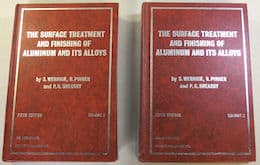
avail from eBay, AbeBooks, or Amazon
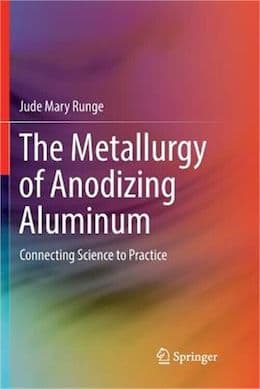
avail from eBay, AbeBooks, or Amazon
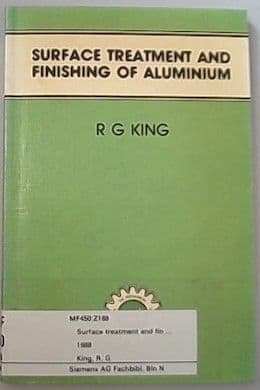
avail from eBay, AbeBooks, or Amazon
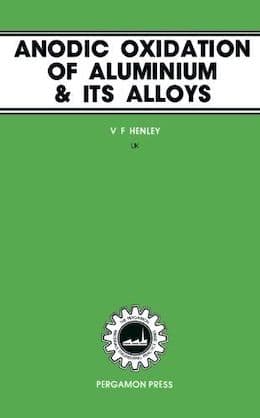
avail from eBay, AbeBooks, or Amazon
avail from eBay or Amazon
(as an Amazon Associate & eBay Partner, we earn from qualifying purchases)
Q. Sir,
For silver coating on aluminium we give a coat of copper on aluminium. Can't it be possible to coat silver directly on aluminium? And will it be feasible for mass production, because at our company it takes 120 min for plating silver. Can I reduce the cycle time & how?
Parag K [last name deleted for privacy by Editor]- Nashik, Maharashtra, India
2004
A. How do you plate copper onto the aluminium? If you don't give us your process, how can we answer your question? I suspect you use a zincate process - if so, the most common "next step" is to use a copper deposit. I have, in the past, used a nickel layer, but that's by-the-by. I have never heard of silver being used, but as long as it is a near-neutral bath, it may work. Give it a try and let us know how you do. The problem with aluminium, as you must be aware, is the tenacious oxide layer on it; I have succeeded in directly plating nickel onto aluminium by using high speed "jet plating", but only on a very small laboratory sample. Alternatively, you can directly plate aluminium with silver by using vacuum technology. When you try these ideas, let us know how you get on.

Trevor Crichton
R&D practical scientist
Chesham, Bucks, UK
"What's the best silver plating and aluminum alloy substrate combo"
Q. Dear Sir
What would be the best aluminum alloy in order to have the best silver plating? What is the best silver plating process for aluminum alloys? The silver plating is important for the surface electrical conduciveness at the Radio Frequency signals and it is recommended that a passivated treatment would not be applied. For Your Attention I thank you very much.
Truly Yours,
Marcos OlandoskiElectronic Telecom Equipment - Curitiba, Parana, Brazil
2004
A. The best way of silver plating on aluminium alloy is: clean with ultrasonic action, then soak clean and wash perfectly with 3/4 rinses, then put in de-smut for the aluminium oxide scale cleaning and make the surface aluminium rich surface, then zincate, strip it with HCl, zincate again for the visually grey in colour, then make e.n. nickel, then plate ac copper for 20 min, then silver for 8 min getting 3-4 micrometers of silver on aluminium alloy; this is standard for the telecom/radioactive arrest.
Chandrasekar Rao- Chennai, Tamil Nadu, India
July 25, 2011
 Hi, Chandrasekar. Thanks for the full details.
Are you sure about stripping the zincate in HCl? It would be nice to use that instead of nitric acid if you can, but I was under the impression that HNO3 was required to prevent attack on the aluminum. Thanks again.
Regards,

Ted Mooney, P.E.
Striving to live Aloha
finishing.com - Pine Beach, New Jersey
Need quick confidential answers? $25
Need project assistance? $100/hr.
July 25, 2011
⇦ Tip: Readers like to learn from others' situations;
some readers skip abstract questions.
Q. Why do we need to plate copper first before silver plating on aluminum?
Bipin Kumar- Nasik, India
2006
A. Hi Bipin. We appended your inquiry to a thread which discusses the general issues. If you post the details of your own situation we can probably expand upon the subject. Good luck.
Regards,
Ted Mooney, P.E.
Striving to live Aloha
finishing.com - Pine Beach, New Jersey
Need quick confidential answers? $25
Need project assistance? $100/hr.
Q. Dear sir,
I am researcher and have hobby to electroplate aluminum (quite uncommon) with bright silver. I think aluminum will require copper plating then nickel plating and then bright silver route to be follow. Am I right? Please guide me urgently.
bye.
have a nice day.
- India
2006
A. Hi Tom. Aluminum requires zincating. Then the copper - nickel - silver plating that you foresee. Best of luck.
If you need help urgently please, hire a consultant. This is merely a public forum where responses come when they happen to come -- sometimes in hours, but sometimes in weeks, and sometimes years or decades later.
Good luck!
Ted Mooney, P.E.
Striving to live Aloha
finishing.com - Pine Beach, New Jersey
Need quick confidential answers? $25
Need project assistance? $100/hr.
2006
Q. Ag plated Aluminum reacts fast in Salty environment (Salt spray test) whereas Sn+Ni plated Al reacts very slow in same environment. What is the reason?
Bharatsinh SindhaStudent - Vadodara, Gujarat, India
March 28, 2018
A. Hi Bharatsinh. Asking people to volunteer to take quizzes may end in disappointment. But we do have an outstanding podcast on Tin-Nickel plating which may help you answer that question if no volunteer steps forward. Good luck!
Regards,
Ted Mooney, P.E. RET
Striving to live Aloha
finishing.com - Pine Beach, New Jersey
Need quick confidential answers? $25
Need project assistance? $100/hr.
March 2018
How to do the silver plating without affecting the powder coat on aluminium die casting?
Q. Dear All,
Please help me out from this problem.
I am doing silver plating with all the base metals but I am facing the issue of blisters on the powder coating after doing the silver.
raw material is ALUMINIUM die casting on that, powder coating had been done on OD and Silver plating is needed at ID.
How to do the silver plating without affecting the powder coat on aluminium die casting?
Plant in-charge - Bangalore, India
April 5, 2019
A. Hi Arun. If the powder coating works fine on other base metals without getting attacked by the silver plating solution, then the problem is probably not that the powder is not resistant ... but that it is applied properly to other base materials but not to the aluminum.
Are you doing a proper chromate conversion coating on the aluminum before powder coating it?
Regards,
Ted Mooney, P.E. RET
Striving to live Aloha
finishing.com - Pine Beach, New Jersey
Need quick confidential answers? $25
Need project assistance? $100/hr.
April 2019
Q. Thanks for your response sir.
On selective area only they need silver coating, remaining area was coated by powder coating.
Base metal is aluminium die casting.
While doing pre-cleaning on aluminium for silver plating due to sulfuric acid, blisters like bubbles formed on powder coating layer.
Powder coating done by other supplier.
What's the remedy for doing silver plating without effecting the powder coating?
- Bangalore, Karnataka, India
April 12, 2019
A. Hi Arun. There may or may not be a satisfactory solution :-(
I have seen powder coating successfully used as a masking material for cyanide and other electroplating, so it's not necessarily impossible. But if you have no control over the powder coating, and the powder coating blisters in the sulfuric acid, and you have to use the sulfuric acid, I don't know what kind of a solution could be suggested. I think it would be very difficult and expensive to apply a masking material over the powder coating and to remove it after the silver plating.
Regards,
Ted Mooney, P.E. RET
Striving to live Aloha
finishing.com - Pine Beach, New Jersey
Need quick confidential answers? $25
Need project assistance? $100/hr.
April 2019

|
Q. Hi. I am using beryllium copper in projection welding as a fixture. Can I change that to Al coated with Silver to have a cost benefit? SRINIVAS NARAYAN- bengaluru , Karnataka , India April 16, 2019 A. Hi SRINIVAS. It's obviously important to research why beryllium copper was specified originally. But if you do not need the springiness of beryllium copper, or you can find a springy enough grade of aluminum, it sounds possible. Why silver plating rather than copper plating? Regards, Ted Mooney, P.E. RET Striving to live Aloha finishing.com - Pine Beach, New Jersey Need quick confidential answers? $25 Need project assistance? $100/hr. April 2019 |
Sorry! Finishing.com is temporarily Read-Only.
Ted Mooney is retiring but I have several offers to take it over.
We're working hard to make sure we find it the best new home.