
-----
Rusting in tap water vs. saltwater
Q. I need your help through my research project about the rusting of nail in salt water and distilled water.
Patavolomo [last name deleted for privacy by Editor]- Honiara, Solomon Islands
October 3, 2022
A. Hi Patavolomo.
You start with a lab book and a hypothesis.
Ideally a lab book is a composition notebook with sewn in pages; but if that is not easily available, staple together about 10 pieces of paper, label it 'Lab Book' with a pen, and number the pages immediately. The reason for using a pen and numbering the pages is that you never erase anything you write in your lab book, let alone remove a page. If you change your mind If you decide that something you wrote was in error, you strike it through, but leave it legible.
After the title you write your hypothesis and the date. Your hypothesis is your best guess about what your research and experimenting will demonstrate. It might look like this:
"Hypothesis: Distilled water rusts nails faster than salt water"
An advanced researcher would probably do things in this order: research, hypothesis, design an experiment, run the experiment several times, and write a conclusion.
But I urge young students to change the sequence to hypothesis, design an experiment, run the experiment several times, form a tentative conclusion, compare that conclusion to research, and resolve your results with the research through further experimenting if necessary. The reason for suggesting changing the order is that young students and newer researchers are very prone to not trusting their own results and therefore shading them to match the research. In other words, if their experiment doesn't match the research they'll tell themselves "I did something wrong; ignore those results." That is called "junk science", and the way to avoid it is by doing the experiment first, and writing everything in a lab book so you can't easily do junk science. One of the world's most famous scientists (and best teachers), Richard Feynmann (deceased), explained this in one minute:
So read on about how other students set up their experiments, and write down in your lab book what you do in your experiment and what you think you are learning/discovering about your hypothesis. After you have a tentative conclusion, start researching :-)
Luck & Regards,

Ted Mooney, P.E. RET
Striving to live Aloha
finishing.com - Pine Beach, New Jersey
Ted can be retained for immediate
answers or long term project help
⇩ Related postings, oldest first ⇩
Q. I am doing a science project on rusting. I placed one iron nail is plain tap water and one in saltwater (I added salt to regular tap water). The one in the tap water rusted within just a few hours while the one in the saltwater is rusting much slower. All of the info I find says that the one in the saltwater should rust faster. Why isn't it?
Thanks, Nick age 10
Nick [last name deleted for privacy by Editor]- Staten Island, New York
2003
Q. I am doing a science project on whether salt water, rain water, or tap water rusts a metal nail the fastest but I can't find any info for the research paper. Where do you find it?
Kayla [last name deleted for privacy by Editor]- Jacksonville, Florida
2003
A. Please describe the results you got and the experiment that you conducted, Kayla. Your teacher or science book should give you a general test procedure, so you don't have to research how to set it up.
After you have a number of science experiments under your belt it may be safe to research the expected outcome before doing the experiment; but when you are just getting started in science, asking what the results of an experiment are supposed to be before you do the experiment creates unbearable pressure to fudge your observations and alter your procedures to get that answer in your own trials -- leading to "junk science", which might earn you an "F" :-)

Ted Mooney, P.E.
Striving to live Aloha
finishing.com - Pine Beach, New Jersey
Ted can be retained for immediate
answers or long term project help
Q. My son is 8 years old and he is doing a science project to see in what solution the nail is going to rust faster. He used bottle water, tap water, tap water + salt and tap water + sugar. We were expecting that the nail in salt + water would rust faster but the one in the bottle water was the first one to rust followed by the one in the tap water. Why did it happen? could you help us?
Denise Rossi- Weslaco, Texas
2004
Q. Please answer ASAP ... this would greatly be appreciated. We are very confused about a iron nail rusting quicker in saltwater or tap water quicker and why?
Joshua D [last name deleted for privacy by Editor]- Philadelphia., Pennsylvania
2006
A. Hello Denise.
I think nails rust faster in salt water because invisible fairies dance in the water and chip away at the nails with their tiny invisible tap shoes, and they prefer dancing in salt water because it soothes their bunions. If you think I'm wrong, you run experiments to the point where you no longer get conflicting results and are confident that your results are duplicatable. Then you try to fine tune the experiment to see if you can demonstrate anything about causality. Like, what happens if you use half as much salt or twice as much salt or a different brand of bottled water
So, you first do an experiment and tabulate the results, then make sure they're repeatable, then try to formulate a testable hypothesis that you think might explain the results. Then you either retest to verify your theory or you leave your theory to be tested next semester or by the next class. If you can't test the explanation, it remains only a wild guess, and my wild guess about invisible tap shoes is as just as good as anyone else's -- trying to guess why things happen, without being sure that they repeatably do happen every time, and without accumulating any quantitative data isn't really science :-)
Good luck!
"Hands-on" learning is fun, maybe try a ...
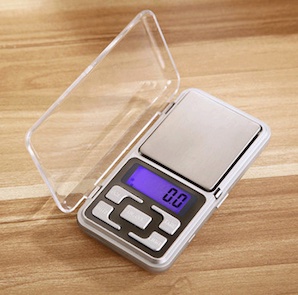
Precision Electronic Scale
on
eBay
or
Amazon
(affil link)
----
Parents and teachers:
It might surprise you, but forget the Hollywood stuff about a few drops of acids burning their way through thick steel plates ... it can't happen. Acids are used in industry primarily to remove rust from steel, not to make steel rust -- because acids dissolve rust faster than they dissolve iron. So, the more acid your solution, the less rust there may be, even though the solution may be very corrosive. So trying to judge the corrosive effect by the amount of rust you see will give erroneous results. This may be why some kids are seeing contradictory results.
The real way to measure corrosion is to weigh the nail before the test and after the test (after rubbing off any rust and drying the nail. Whichever nail lost the most weight is the one that corroded the most. This requires a good "analytical balance" (scale), which sometimes isn't available in grade schools. If the school doesn't have one, and you have the money and a strong interest, you can get a pretty accurate pocket scale pretty inexpensively and see if it will do the job.
If you don't have an accurate scale, then just use this opportunity to teach the scientific method, and allow students to learn laboratory method and how to keep a lab book properly. Good luck!
Ted Mooney, P.E.
Striving to live Aloha
finishing.com - Pine Beach, New Jersey
Ted can be retained for immediate
answers or long term project help
Q. Why does the saltwater rust slower than tap water. I need research for a science fair project. Everything says that salt should rust faster than tap water.
7th grader, Thanks.
- Tarboro, North Carolina
February 5, 2008
A. G'day,
In response to many of your questions, Iron rusts faster in fresh water. Although many people say that it is quicker to corrode in salt water this is not the case. The freshwater used in all of your experiment rusts faster, however after a short time creates a thin film around the rust block preventing it from rusting any further. The SALTY water however rusts at a slower rate, but because it uses electrochemical corrosion (because the salt in it creates a more conductive environment) it does not create the thin film that fresh water does. It is because of this that the salty water can rust until there is no more iron left.
People tend to think that salty water rusts faster - it doesn't. Fresh water will rust faster until it has created the protective film, whereas salty water can rust until no more iron is left.
Hope that helps :D
- Perth, Western Australia
 Hi, Poppy. That is very interesting and fairly believable! Sounds like a student should put their nails in the water very early on to see this effect. Hint: for a long term experiment you should cover your experiment dish with plastic wrap. Otherwise the water will evaporate and build up in salt content over time as you keep adding replacement water.
If I may mention a parallel for the readers' consideration: active metals like aluminum and zinc dissolve in acid much faster than iron or steel does, but they are much more corrosion resistant than iron & steel in everyday use! The reason is very similar to the explanation that Poppy offered. When most metals corrode, the corrosion products tend to be hard, tough, adherent, and impervious. So, after a thin layer of corrosion products has built up, they tend to "seal" the remaining metal away from the air/water, slowing the corrosion. But when iron or steel rusts, the corrosion product (rust) is loose and powdery, and does nothing to seal the remaining iron away from the air. In fact, thick rust can be spongey, tending to hold water and accelerate the corrosion.
So it's not just a matter of what begins to corrode first, it's also an issue of whether the corrosion products offer any "sealing" to slow the corrosion. I can believe Poppy's assertion that a small amount of such "sealing" takes place in fresh water and none takes place in salt water.
Regards,
Ted Mooney, P.E.
Striving to live Aloha
finishing.com - Pine Beach, New Jersey
Ted can be retained for immediate
answers or long term project help
by Steve Spangler
or AbeBooks
or eBay
or Amazon
(affil link)
by Janice VanCleave
or eBay or Amazon
or AbeBooks
(affil link)
Q. I am doing a experiment to what rust first and the salt water rust first it started rusting on the 2nd day and the tap water started rusting on the 3rd day.
emmalee e [last name deleted for privacy by Editor]student - ironton, Ohio
January 19, 2009
Q. I am doing science experiment on iron nail rusting faster in tap or salt water. I notice the results posted say that the tap water will rust first but the salt will be more effective over long period of time. Can you send me some information on how long I will have to run this experiment to show the results of the salt water corrosion. Also how do I set up a log book and practical experiment for the accurate recording of this experiment. I don't know where to start.
Darren A [last name deleted for privacy by Editor]- Sydney NSW Australia
March 1, 2009
A. Hi,Darren. If you don't know where to start, you have to get more complete instruction from your teacher. It's bad to guess what your teacher might have said or meant in your class one day is crazy :-)
But the lab book part is easy. Get a composition pad, number the pages, get an ink pen that you can't erase, and mark the date and time of the things you do. Then write down what you see or otherwise observe. Start by putting identical nails in a little dessert dish of fresh water and salt water. Ideally you should do three or four bowls of each rather than just one. If you see that you've written something that is obviously incorrect, you do not erase it. You just strike it thru once but leave it legible. Good luck!
Regards,
Ted Mooney, P.E.
Striving to live Aloha
finishing.com - Pine Beach, New Jersey
Ted can be retained for immediate
answers or long term project help
Q. Hey everyone =D...
I'm currently having my school holidays... and I have one week left. I'm supposed to finish this (assignment) science experiment about whether salt water rusts steel faster or tap water. I have read many other questions similar to my one on this site but none of them match what I'm looking for.
I have done a few tests which proves my hypothesis wrong (my hypothesis is: salt water rusts steel faster). in my test, I had 3 identical cups. I made the strongest salt solution (by adding heaps of salt until no more could be mixed in at room temperature) and poured 100 ml of salt water into the 1st cup, 50 mls of salt water and 50 ml of tap water in the 2nd cup and 100 ml of tap in the 3rd. I put a steel nail (around 3 cm long) into each cup. the cup with the 100 ml's of salt water didn't rust until after 5 day's while the cup with the 100 ml's of tap water rusted within hours.. (tap was faster).. the one with 50-50 was rusted on the side facing the top. the other side turned black..
My hypothesis was proven wrong, and all my background information is now useless. I have to now gather more information (background info) on why salt water would slow down the rusting of steel as opposite to what I have done earlier. I had many support, through websites saying that salt water will rust steel faster. so going with my experiment and against my support earlier, I can't find any site's or books proving that tap water will rust steel faster then salt.
PLEASE if anyone knows any sites.... or can explain to me why salt water slows down the rusting of steel. (for example; the salt displacing the oxygen? maybe?) but I'm not sure... and most importantly I don't have proof of this.
My teacher said that I needed at least 2 articles and a book to support my findings PLEASE HELP.... if you know anything about this topic =D
student - Sydney, NSW, Australia
April 19, 2009
Ed. note: Poppy Anne has explained this above, Alice, and it seems quite reasonable to us. Take her explanation to google and use it to try to track down some authoritative references on that theory. Good luck
! OH MY GOD Alice, I did the exactly same experiment for my science assignment and the same thing happened to me!
Apparently salt does make the nail rust faster but it takes longer...everything on the internet goes against what my experiment proves which is that people tend to think that salty water rusts faster - it doesn't. Fresh water will rust faster until it has created the protective film, whereas salty water can rust until no more iron is left.
Hope this helps a bit.
- Byron Bay, NSW, Australia
September 24, 2009
Q. Well, I am working on some environmental stuff in science class. I have this assignment to talk about nails (like the kind you nail into the wall) in just plain water. I noticed that the nails were rusting, but why is this and what is it called? I know it is some type of mixture, but I can't remember the name. I think it started with an 'h'?...
But anyway, my question is what is happening to the nails and what is it called? thanks!
student - Brooklyn, New York
March 2, 2010
A. Hi, August. Steel nails will rust whether wet or dry because the steel (iron) reacts with oxygen, and forms iron oxides, which can also be called ferrous oxide. If you want a word starting with an "h" you can call the corrosion product iron hydroxide. You can also call it oxidation, or corrosion, or rust.
The nails rust faster in water than in dry air because the liquid allows ions (charged particles like Fe++ and OH-) to form and migrate around. When a charged particle moves, charge has moved, which is to say electricity has flowed, and corrosion is an electrochemical reaction. Good luck.
Regards,
Ted Mooney, P.E.
Striving to live Aloha
finishing.com - Pine Beach, New Jersey
Ted can be retained for immediate
answers or long term project help
Q. What is the film made out of that protects the nail that rusts in fresh water?
Would aeration speed up the rusting process? I have an aerator from my aquarium that I could use in my experiment. Just want a heads-up to see if it is worth the effort.
Also, I'm thinking of using electrolysis to remove rust from a part that I found that is covered with rust. Any advise?
- Columbus, Ohio, USA
April 19, 2010
Q. K so waiiitt
why does a nail not rust with vinegar
⇦in bulk on
eBay
or
Amazon [affil link] and does rust with salt water ?
- Houston, Texas
October 6, 2010
A. Hi, Eli. vinegar is a mild acid. Metals dissolve (slowly) in acids. But rust dissolves in acid, too, pretty rapidly. The nail doesn't form rust while immersed in vinegar because if any rust did tend to develop it would immediately dissolve into the vinegar.
Let the experiment dish dry up and you'll probably see a lot of rust in it.
Regards,
Ted Mooney, P.E.
Striving to live Aloha
finishing.com - Pine Beach, New Jersey
Ted can be retained for immediate
answers or long term project help
Q. Help! I'm in 7th grade and I'm trying to find out what effect salt-water, water, and vinegar will have on the rusting of nails! I've looked all over the internet trying to get some answers and can't seem to find any!
Sophie J.student - Midlothian, Virginia
October 25, 2010
Q. How is that possible?! All my research says saltwater, saltwater, SALTWATER! I need this question answered today for my science project! HELP!
chelbi r [last name deleted for privacy by Editor]kid - jax, florida
November 11, 2010
A. Hi, Chelbi. What result did YOU get in your experiment? If you found that the nails in salt water rusted the fastest, and all your research supports that finding, what is the problem? There is none :-)
If, on the other hand, you found that the nail in salt water did not rust the fastest, then there is something wrong with the way you are researching the issue or the assumptions you are making in trying to correlate your result to the stuff you are looking up, isn't there? In that case, follow up on Poppy Anne's explanation. What's really nice about this project as an introduction to science is that it is pretty easy as long as you don't start fudging data; but if you do start fudging, then it becomes quite difficult -- that's good!
Regards,
Ted Mooney, P.E.
Striving to live Aloha
finishing.com - Pine Beach, New Jersey
Ted can be retained for immediate
answers or long term project help
A. Hi. water contains CO2 the main part being oxygen. Water and oxygen will rust steel/iron and tin. Adding a small amount of salt to the water should make it rust faster. Put in a large amount of salt and it will slow the process down at first, but after an ungiven time (depends on the amount of salt) it will not only catch up but race away. The salt which is sodium Na + chloride Cl is heavier than oxygen O so it disperses the salt (moves the salt higher in the container) the salt will cover the steel preventing oxygen from helping with the corrosive processes. If you stir the mixture occasionally you will see that it does rust faster. Give it 2 weeks then look and you will find that the salt has had time to act with the water H2O (which is 2 parts hydrogen and 1 part water) and the salty solution will have acted faster than the non salt solution.
Try doing a number of experiments, a control which should have no water and no salt, water only, salt only (ensure keep this one in a dry area), Then do a number of with salt 50 ml water in each test, then add 1, 2, 4, and 8, salt and see what effect the salt has. Keep the experiment going for as long as you can. Hope this helps you all.
- Ccholey Lancs GB
Q. How does temperature affect oxidation rate of different metals like IRON, COPPER, ZINC COATED STEEL.
Design an experiment to find out.
How to do all this; need it for report. If anyone knows, please can you tell the procedure and result of the experiment?
- Abu Halifa, Kuwait
April 29, 2015
Q, A, or Comment on THIS thread -or- Start a NEW Thread