
| Search our quarter-million Q&As |
Home of the finishing HOTLINE since 1989
-----Removing dye from anodized aluminum; changing the color
Quickstart:
In the anodizing of aluminum the components are immersed into a tank of acidic solution and connected to the anodic (+) positive pole of a power supply. The current separates some of the water in the solution into positively charged hydrogen and negatively charged oxygen. The oxygen is attracted to the positively charged components and converts the skin of the aluminum to aluminum oxides.
Readers new to anodizing of aluminum may wish to view our "Intro to Aluminum Anodizing".

this text gets replaced with bannerText


(this entry appended to this thread by editor in lieu of spawning a duplicative thread)
Q. Hi,
I'm a hobbyist here, recently started learning about anodizing. What prompted this is I'm looking at buying/building an aluminum extrusion rig for sim racing, and I'm a little disappointed at the lack of color options. It seems the vast majority are anodized with either black or plain silver, regardless of whether you buy a rig or build your own.
I thought about using etching primer and painting it but I'm not sure how effective that would be, plus the shape of the profile would make it a pain to get in all the nooks and crannies with a decently even coating. I'd really prefer for this to not look terrible after a few months.
So I'd like to change the color of an anodized part, if it's possible. One thing I haven't been able to get a straight answer on: is it possible to "reopen" the pores created from the process, add new dye and then seal it once again? Or would I be best served by stripping the coating off and then going through the entire anodization process myself with custom dyes? And if that's the case, would there be any special considerations to consider that differ from normal anodizing?
If it changes the answer at all, it seems the most common aluminum alloys in this niche are 6105, 6061, and 6063. There may be more but I'm not sure.
- Tyler, Texas
November 4, 2022
A. Hi Luke. In commercial practice some limited success might be possible using the process described below by Ward. But I think there is little realistic chance of you opening the pores and bleaching out the color. I think you'd need to strip the anodizing and then re-anodize, re-dye, and re-seal.
Type 6xxx alloys are easier to anodize than type 2xxx or type 7xxx, but that doesn't mean anodizing is easy. The next step is either to find an anodizing shop who will strip and recolor this for you, or to start practicing on scrap if you intend to try to anodize it yourself.
Luck & Regards,
Ted Mooney, P.E. RET
Striving to live Aloha
finishing.com - Pine Beach, New Jersey
Need quick confidential answers? $25
Need project assistance? $100/hr.

|
Q. Thank you for the reply Ted! - Tyler, Texas A. You must remove old anodizing and re-anodize your object. There are special anodizing pastes and you can paint with them (at least you can buy that stuff in Europe, don't know the situation in USA market). Very good info on that is expired USA patent US3290232A. Don't forget there are chemical oxidation processes for aluminum too. Chemical coloring of aluminum is another option. Hope it helps and good luck! Goran Budija- Cerovski vrh Croatia |
⇩ Similar, related, Q&As -- oldest first ⇩
Q. Is there a way to remove dye from anodized parts without damaging the anodized surface?
Dennis Nolan1998
Treatment &
Finishing of
Aluminium and
Its Alloys"
by Wernick, Pinner
& Sheasby
on Amazon or eBay
or AbeBooks
(affil link)
A. Hi Dennis. Bleach readily destroys organic dyes but, assuming the parts have been sealed, I don't think the bleach will be able to get at the dye effectively enough, although it is very high in caustic so it will attack the anodizing and the dye. What would you intend to do with the parts . . . just leave them natural aluminum color?

Ted Mooney, P.E.
Striving to live Aloha
finishing.com - Pine Beach, New Jersey
Need quick confidential answers? $25
Need project assistance? $100/hr.
A. You can try a stripping solution made of the following:
85 % Phosphoric acid
20 % Chromic acid (200 grams/liter)
Top with Water
I believe we got this formula from one of the "Metal Finishing" publications.
It has proved effective for us and it doesn't harm the metal.
Hoping this will help you.
Regards,
P.S. Do check with the different publications ( Metal Finishing [ed. note: unfortunately, Elsevier closed down Metal Finishing in December 2013], Products Finishing, etc.) for more info.
 Thanks, Ariel, that doesn't attack the aluminum base metal but...
It removes the anodizing as well as the dye ... which is fine as long as Dennis realizes it.
Ted Mooney, P.E.
Striving to live Aloha
finishing.com - Pine Beach, New Jersey
Need quick confidential answers? $25
Need project assistance? $100/hr.
A. Depending upon what the purpose is, and for what period of time the parts have been dyed and sealed, it is possible to remove dye without damaging the coating. We are talking about organic dye impregnation of Sulfuric Acid produced anodic films as the dying process. One has to "break" the seal with a deox or 10% Nitric Acid solution. A deox solution works better if the parts have been sealed for very long, or if sealed in Hot Nickel Acetate. Monitoring of the part while breaking the seal will show a slight leaching out of the dye at the part surface. If using a deox solution to break the seal, as soon as the seal is broken immediately rinse, and then place the part in the Nitric Acid solution until the dye completely leaches out. This usually works if one is redyeing with the same color, or one is dying a darker color over a lighter one. Nickel Fluoride (cold seals), and Hot Water DI seals are easier to break and leach out the dye than parts sealed in Hot Nickel Acetate. This process sometimes leaves slight residues or light color tints. In an emergency, I have broken the seal, right after sealing in a cold seal, and re-anodized for another 15 minutes, and redyed which turned out fine. The parts remained wet and were never unracked. However, we all thought we were pretty lucky that one time. I would not ever recommend it.
Ward Barcafer, CEFaerospace - Wichita, Kansas
Ed. note: Thanks for the benefit of your experience, Ward! We didn't know that this was a realistic possibility.
Multiple threads merged: please forgive chronology errors and repetition 🙂
Selective stripping of anodizing
Q. I am looking for an acidic stripper of colored anodizing to selectively remove areas using photoresist masking to protect the other areas. If it just strips the color and leaves the clear anodizing, better yet.
Ron Squibbsengraving company - Easton, Pennsylvania
1999
Aluminum How-To
"Chromating - Anodizing - Hardcoating"
by Robert Probert
You'll love this book. Finishing.com has sold a thousand copies without a return request 🙂
A. Typical organic dyes for anodizing are little different than fabric dyes and ought to be leachable/bleachable (before sealing). Whether it can be done in a reasonable time, with bleaches/nitric acid that are weak enough to not harm your photoresist or the anodizing, I don't know. Once the surface is sealed, you would actually have to strip the anodized finish using the chromic acid-phosphoric acid stripper described in thread 2776, or at least 'break the seal' as described by Ward above.
Ted Mooney, P.E.
Striving to live Aloha
finishing.com - Pine Beach, New Jersey
Need quick confidential answers? $25
Need project assistance? $100/hr.
A. Years ago we tried a strip that was basically a fine silica and nitric acid to de-color dyed anodize. Required a little manual agitation to work well. I have no idea who we bought it from.
James Watts- Navarre, Florida
A. It depends on the nature of the dye and the condition of the anodize. If the anodize is sealed, the only way to remove any dye is to remove the anodize with the chromic/phosphoric stripping solution that Ted mentions, or with an alkaline etch if you don't mind attacking the metal. If the anodize is unsealed and relatively fresh, 10-15% nitric acid will remove most dyes, but not all. Keep immersion times less than 15 minutes, as a slight acid attack will occur, and the film will become more porous and harder to seal, if required. Even if the anodize is supposedly unsealed, this may not work if the oxide is exposed to the atmosphere for days or weeks, as air and humidity will partially seal the film. If you intend to re-dye with a different color, the new dye will absorb faster after the acid treatment. I never learned why, but not all dyes will strip this way, and we used to sometimes be able to tell which dyes were actually mixtures of other colors, as sometimes one color would strip, but leave another color behind. I like Ted's idea about bleaching out the colors, but I believe that peroxide should be used for bleaching rather than hypochlorite, as any residual chlorides in the pores would be bad for corrosion resistance. Again, bleaching would not work if the anodize is sealed.

Phil Johnson
- Madison Heights, Michigan
A. The proper way to strip anodizing is as follows: 30% phosphoric acid to 70% DI water. If you stay on top of the stripping tank, you should be able to test when the nickel acetate is dissolved , and the dye is starting to dissolve. Test by rinsing in running water. The above solution is designed to attack only the anodic coating, and not the substrate material.
Best of luck,
Gene SmallRetired - Albany, Oregon, USA
2002
Multiple threads merged: please forgive chronology errors and repetition 🙂
Q. Hi! I tie-dyed with RIT dye ⇦ on eBay or Rit Dye [affil link] and was wondering if there is a way to remove the dye....I know of Rit Dye Remover ⇦ on eBay or Amazon [affil link] but it isn't sold in my part of the country. Bleach lightened the dye but didn't remove it. Any suggestions?
Thanks!
Katryn McCully- Boise, Idaho, USA
2001
A. You can remove dyes using thiourea dioxide
⇦ on
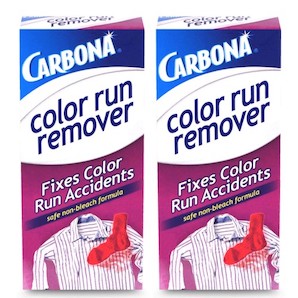
Amazon [affil link] . This is available from vendors on-line. If you do a search, you should come up with places that specialize in supplying dye-stuffs to the home crafter. Carbona, the spot removal people make a dye remover ⇨
Probably the same as Rit. It can be found in grocery stores or at places like K-mart. I would not use bleach if I could avoid it. If you are removing dye from cotton fabric, the bleach will weaken the fibers a lot. It will totally dissolve silk.
- Amherst, Massachusetts
Removing anodize dye before sealing
Q. We are a small anodizing shop that has recently started to delve into the world of multi-color anodizing. We are having some issues in removing dye after the parts have been dyed. For instance, we will dye a part black, then remove some dye and then over dye with a lighter color such as orange. We have been using a mild bleach solution to remove the dye, but it hasn't been able to remove all of the dye to bring it back to the clear oxide. Typically it just becomes a brownish color, so when the lighter color is applied it turns out a darker shade than we want it to be. Also with this method, there has been some issues with the pores that have had the dye removed not taking the second dye color. I have seen some of this multi-color done where it has been dyed black then parts have been washed out and retain the clear/silver color without the silver tinted at all. It looks like silver clouds in the black dye. What can I do to duplicate this?
Randy Fairbank- Lewiston, Idaho, USA
2005
A. You are basically talking about what is commonly referred to as splash anodizing. You will find that the few people that can do it well are not going to talk. Why should they? If all of the finesse and witchcraft became public it would cost them dearly on the bottom line. Add to that the few companies that can do it very well hold their employees to a very ridged non-disclosure and non competition agreements.
All of that said, it is my understanding that most people do it the opposite of you. Put the light color on first and the darker colors on last. That hides the off color parts.
- Navarre, Florida
Ed. update: Aug. 2025: although splash anodizing was trade secret back in 2005, it's quite generic two decades later 🙂
A. Another thing to consider is that using bleach will quite possibly accelerate corrosion after anodize. You may want to use Nitric acid instead.
Good luck.
Compton, California, USA
Ed. note: Jim is completely right! Although in one sense our mention of bleach was correct -- it does remove the color (we've used it in wastewater treatment systems to deal with anodizing dyes), exposing anodized aluminum to bleach is an all-around poor idea.
Thank you for all the help. I have the splash down where you dye the lighter color, then mask and remove then dye the darker color. What I am having problems with is an acid wash finish. There are no defined lines, and the only way I can get it to work is if I lay the darker color, then wash some out by dabbing it with a sponge with the bleach. I haven't tried to use nitric, but will try that next. So I thank all of you for your help.
- Lewiston, Idaho, USA
Multiple threads merged: please forgive chronology errors and repetition 🙂
Changing Anodizing color?
by Runge & Kaufman
on Amazon or eBay
or AbeBooks
(affil link)
Q. Hello, my name is Steve. I am an Aerospace Engineer Major at Embry Riddle Aeronautical University in my Junior year. In my spare time a play paintball. I have been looking into anodizing some parts on my gun myself instead of spending a few hundred dollars to have someone else do it.
My problem is that the parts I want to anodize already have a black anodize on them. My question is if I can simply anodize a new color over the black or if I will have to remove the old anodizing first? If I did need to remove it, I could use the chem lab on campus, but I am not exactly sure of the best way to do so without damaging the aluminum parts.
I would also consider powder coating over the existing black, but I am not exactly sure of the process. Whatever I do, I plan on using the chem lab and practicing on some spare parts first. Thanks.
student/hobbyist - Holly Hill, Florida, United States
2005
A. To do a good job, the equipment will cost several hundred dollars, and then you have the haz waste to dispose at a very high cost.
You can do an internet search and find all kinds of ways people have tried to do garage anodizing. some have good luck (so they say) and others have terrible luck. The main problems, is you need a controllable power source. A 12 volt battery charger simply will not do as good a job as something that you can ramp up to 15 volts and has enough amperage to not blow it up on the initial surge and has the amperage to get the part anodizing rapidly enough that you can raise the power to the final voltage in a matter of about 3 minutes.
Next, it generates a lot of heat. Decorative anodizing needs a constant temperature of about 72 °F, so you need some method of regulating the temperature. No, you cannot put ice cubes in the tank.
The dye step requires a given concentration, temperature and pH.
RIT dye ⇦ on
eBay
or
Rit Dye [affil link] may work in some cases, but do not expect a permanent color.
Boiling DI water is a decent seal, but a nickel acetate seal is more permanent.
NO, you can not anodize over the existing anodize. It has to be stripped. When you strip the old anodize, you will remove about a thousandth of an inch from the existing size.This is going to affect the fit and function of the weapon, some. Your gun may be clear coated or waxed. This gives several more challenges to be overcome.
Spend the money and have more time to enjoy your paintball hobby. On second thought, the beautiful gun will not work a bit better. Spend the time and money on practice and become a winner.
- Navarre, Florida
Q. I need to remove ink from one of our Anodized T2C2 parts, what solvents can I use to remove the ink? and to cure the ink what temperature is recommended so I don't ruin the anodized coating?
Carlos J. Martinez- Paso robles California
September 14, 2016
A. Hi Carlos. The dye was 'sealed' into the pores of the anodized coating by closing the tops of those pores to lock it in. How 'ruinous' the process is depends not only on how it is done, but upon what standards you apply in saying whether the anodizing has been ruined :-)
You can carefully consider the previous replies on this thread which we appended your question to, and decide whether carefully following the prescribed plan 'ruins' the anodizing in your view. Best of luck!
Regards,
Ted Mooney, P.E. RET
Striving to live Aloha
finishing.com - Pine Beach, New Jersey
Need quick confidential answers? $25
Need project assistance? $100/hr.
Q. Hi all, I have a piece of 7075-t6 aluminum that was anodized with a type 3 class 2 finish and dyed what was supposed to be a dark green. It looks more like a booger green to me though. Is it possible to remove the sealant and re-dye or darken the color of this part? Or preferably maybe do something to darken the appearance without removing the seal coat?
Francis Savage- Michigan
December 18, 2019
A. Hi Francis. If this item is just for your own personal and casual use, and it will be kept indoors, it might be possible to just darken it with a dark green permanent marker (that stuff does work pretty well on aluminum). If you are selling it or really want to actually fix it, the least you must do is break the seal, leach the dye, apply the darker dye, and re-seal.
Regards,
Ted Mooney, P.E. RET
Striving to live Aloha
finishing.com - Pine Beach, New Jersey
Need quick confidential answers? $25
Need project assistance? $100/hr.
Q. We do double process first Anodising then Champagne Electrocolour, then mild golden dye colour to obtain golden Champaign colour ... so can we remove the dye colour without effecting the Champagne Electrocolour? Can anybody help us to just remove the dye on top of Electrocolour? ⇦ Answer?
Regards
Praveen Kumar

Praveen Kumar
plating process supplier
Mumbai, India
July 11, 2022
A. Hi Praveen. I don't think it is possible after it's sealed, but we've posted your inquiry and we'll see if anyone can offer encouragement.
Luck & Regards,
Ted Mooney, P.E. RET
Striving to live Aloha
finishing.com - Pine Beach, New Jersey
Need quick confidential answers? $25
Need project assistance? $100/hr.
Sorry! Finishing.com is temporarily Read-Only.
Please maintain your bookmarks! Although Ted Mooney is retiring, finishing.com is not!
It will have a new owner/curator very shortly!