
| Search our quarter-million Q&As |
Home of the finishing HOTLINE since 1989
-----Rhodium plating that jeweler didn't mention
Q. I just want to express that I think that it is unjust and unbusinesslike for a jeweler NOT to inform a costumer that their "white gold" is rhodium plated. The thing is -- most jewelry salesman do not exactly know what their "white gold" is made of or in fact what their manufacturer uses in their "white gold". I know many people who have white gold rings which have never yellowed in years. I have been to numerous jewelry stores and they have all stated that their "white gold" will never show any yellowing in time. Some have never even heard of something like this happening. Someone is misinforming these sales personnel.
I received a $6000 dollar "white gold" engagement ring and never thought I would encounter such problems with such an expensive ring. I had the ring 2 weeks and noticed a yellowing of my ring right after washing dishes. I immediately returned the ring and the salesman said it was the lights in the store. I knew he did not know that he was talking about. I talked to another associate and they said it need to be "re-rhodiumed". Then I felt as if my fiance had been taken advantage of. They sent it off and it looked wonderful and new. Then I got it sized about 2 weeks later and when I went to pick it up, it was as yellow as I have ever seen it. I can't believe the salesman didn't see that before he called me to tell me it was ready to be picked up. I have had the ring for 7 months and it has been re-rhodium plated 5 times. The last time I requested a heavy plating instead of their "flash plating" they do since I have heard that this may last a lot longer. It lasted a bit longer but not much. I am so outraged that I have been through so much problems with this ring.
The store calmed me by ordering a platinum ring that looks identical and charging an additional small price to exchange. It looks great but now I am hearing that platinum will scratch up very quickly. Is platinum all that harder? Am I going to be dissatisfied with platinum now too? How easy is it to polish the ring to it original shine after it scratches? How is a ring marked to ensure it is platinum? PLT,PT. Is platinum the way to go? Nickel must be removed from the jewelry business for good.
Dina L [surname deleted for privacy by Editor]- Omaha, Nebraska
2002
Ed. note: This is an interesting thread, but before readers get too confused, they might want to start with our FAQ on Rhodium Plating and White Gold to get a quick overall understanding of what is going on :-)
A. Hi Dina.
You are right from top to bottom! Some jewelers, whether it's due to duplicity or simple ignorance, are selling consumers $6000 rings that are a major problem quality-control wise, and which also cause the well known and long recognized disease of "nickel itch".
And to make it worse, then they often start in with this 'special sweat' nonsense, trying to make the wearer feel guilty for having some kind of shameful defect in their sweat glands that destroys heirloom jewelry :-)
I usually have little sympathy for trial lawyers and consumers who want to sue at the drop of a hat, but not this time. Eventually a major jewelry manufacturer or distributor is going to make a lawyer rich with a class action suit over rhodium plated gold, and they will richly deserve it. I still pass by jewelry counters full of rhodium plated white gold rings that are not identified as plated. If the underlying white gold was of the highest "whiteness value", it might not be a problem; but the underlying gold is often rather yellowish. Please read the FAQ. Platinum is much more precious than gold and I doubt that it will ever be a problem.

Ted Mooney, P.E.
Striving to live Aloha
finishing.com - Pine Beach, New Jersey
Need quick confidential answers? $25
Need project assistance? $100/hr.
2002
Q. I am curious, Ted.... I have a "white gold" engagement and wedding band. I have worn the wedding band for 18 years and it hasn't changed color. It is whiter than yellow gold, but yellower than sterling silver. Does this mean that it probably *isn't* rhodium plated? I have never noticed an "itching" problem, but I am not sensitive to any metals that I know of. I even had a nickel/silver ring once and that caused no problems.
Does white gold get its "white" color from more nickel or chromium? What alloy is high-quality "white gold" supposed to be made of? Do they mix platinum in? My ring was designed locally and sent to a foundry that the jeweler normally used for all of his castings (lost wax process). I have been perfectly happy with it. Was white gold made differently 18 years ago? I suspect that it is nickel that they mixed into the gold, since the jeweler told me it would be harder than yellow gold.
Ronna Erickson- Amherst, Massachusetts
2002
2002
A. I was totally ignorant about this subject until a couple of years ago, Ronna, but I've read a great deal in the meanwhile.
In brief, gold is an element that is always yellow, there is no isotope which is white. White gold jewelry is an alloy made by mixing gold with other metals, most notably nickel or palladium because these have the ability to "bleach" it. The resultant color is whitish, but it can vary and there is a recognized scale of whiteness. These days white gold is usually rhodium plated for the popular dazzlingly bright white look, and what apparently happened was that the "we're going to plate it anyway" mentality let jewelers talk themselves into using white gold of lower whiteness under the rhodium than in the old days when white gold rings were not rhodium plated.
If you don't join the fight, our days are numbered.

The issues revolve around at least four different problems:
- The chief alloying metal in European rings is palladium, while in the USA it's nickel these days. That means palladium white gold doesn't cause nickel itch but nickel white gold does. Some say palladium golds are whiter, and some say old rings were palladium, but I can't say if these assertions are true, and it looks like there are nickel alloys that score well on the whiteness scale.
- It's difficult to plate rhodium thick, whereas jewelers use low quality, contaminated solutions and ultra low-tech equipment. So most rhodium plating is too thin for good wear, and is also so porous that it does little towards abatement of nickel itch.
- Apparently some jewelers have also gotten into the mode of rhodium plating yellow gold rings as a quick solution to giving the customer the setting they want in the color they want. Because of the high contrast, wear is far more obvious than with white gold. Some people (count me in) feel it is deceitful to put rhodium plating on a yellow gold ring because dissatisfaction is guaranteed.
- Something that I did not realize until recently is that gold jewelry is very sensitive to harsh chemicals including bleach and hot tub additives like bromine. Contrary to what I assumed, rings must be removed before going into a swimming pool or hot tub because, while pure gold is highly resistant to chemicals, jewelry is not gold but an alloy of gold and other metals.
Our FAQ about white gold includes a lot of good responses from jewelers, plating engineers, and others.
Ted Mooney, P.E.
Striving to live Aloha
finishing.com - Pine Beach, New Jersey
Need quick confidential answers? $25
Need project assistance? $100/hr.
Q. I have the same situation with my white gold rings. My rings are only 6 months old and the bottom of my rings are turning a little yellowish. I went to the jewelers and I questioned it and they told me that the rings have some nickel in them and maybe I was allergic to nickel. I found out I was allergic to nickel about a year ago when I had a crown put in and I was getting swollen gums and I had to replace my crown.
My question is, could this be the reason my rings are turning yellowish faster than what they should be? Also, is there anything I can take either a vitamin or anything to prevent it? Or I just really need to replace my bands with platinum.
Do you have any suggestions?
Adriana V [surname deleted for privacy by Editor]- Chicago, Illinois
2002
A. Vitamins will not relieve a nickel allergy, but ingesting medicine to try to bring your body into alignment with your jewelry would be the wrong answer even if it worked :-)
There really should not be nickel in new jewelry anyway as it has been banned in much of the world (not the USA), and a product which is widely recognized as being dangerous should not be sold. It is dangerous because it causes nickel allergy that persists for your lifetime. But here in the USA product design sometimes seems to be driven more by personal injury law rather than proactive innovation.
If the rhodium were thick enough, there would be no yellowing for a longer period and the leaching through of nickel would be somewhat reduced but not eliminated. The problem is not your 'nickel itch', and don't let a jeweler get away with claiming such! Your allergy to nickel is the result of your being assaulted by nickel, and it's quite possible that everyone would acquire this disease if exposed to enough nickel. The problems are:
- there really should be no nickel in the ring in the first place
- the ring material should be white, not yellowish
- a low quality rhodium plating job may be wearing through too quickly.
Good luck.
Ted Mooney, P.E.
Striving to live Aloha
finishing.com - Pine Beach, New Jersey
Need quick confidential answers? $25
Need project assistance? $100/hr.
2002
Q. I, too, am experiencing discoloration on my white gold ring band. I had my 18k white gold engagement ring resized. The Jeweler who resized it had informed me that it might be rhodium plated. The ring went into the jewelry shop in perfect condition. When I got it back I noticed that there was discoloration on the band. Tiny little white/copper colored dots have appeared all over the band but appear centralized around the area where the resizing was done. Are these dots due to the process used to resize the ring? Could the method used for resizing have damaged the rhodium thus leading to discoloration? According to the jeweler who resized the ring these dots are a manufacturer's defect. Is this true? I have only had the ring for 3 months. From what I have gathered from your site it should be a year before it has to be replated. Why would it tarnish so suddenly? Thank you for your help in this matter.
Regards,
Katherine T [surname deleted for privacy by Editor]- Montreal, Quebec, Canada
2002
A. You are a customer who is easy to please, Katherine. All you are asking is that your ring survive a year or more between replating. I would be very unhappy if a ring lasted less than 5 years before needing work :-)
But you should not be having to try to figure out exactly what went wrong, and we probably can't do it from this distance. We can guess that the rhodium got burned off or worn off by the tooling or the ring was made bigger and the replacement material not plated--but that's all a guess. The point is that the ring is 3 months old and is now defective due to error on the supplier's fault or the resizer's fault. I would tell the resizer that he broke it and must fix it; he'll probably rhodium plate it.
Ted Mooney, P.E.
Striving to live Aloha
finishing.com - Pine Beach, New Jersey
Need quick confidential answers? $25
Need project assistance? $100/hr.
2002
Q. I'm trying to find some information on this, but all I seem to find is that platinum is supposed to resist most (if not all) kinds of yellowing or tarnishing.
Well ... I received my platinum engagement ring on New Year's Day. A week or so later, I noticed that the base of the prongs, where it connects to the band, has started to yellow. The ring is stamped PLAT (which I read means that it is at least 95% platinum), so I was dismayed that it started to discolor so quickly. The ring was custom-made by my fiance's family jewelers, and when we spoke to them over the phone (they are in Ohio, we're in California), the only explanation they could give was that it could be the solder used to connect the head to the band. They also suggested trying a little Tarn-X but that didn't do anything. I take the ring off when cleaning and washing dishes, but usually leave it on when I normally just wash my hands (with regular soap).
So now, it looks like our only option is to send the ring back and have them fix it (although I'm not quite sure how they're going to do that, without mildly recreating the ring). If anyone has any other suggestions -- or even guesses as to why this happened -- please let me know! I'd rather not part with my new ring! (I know, it's better to get it fixed now, but still, I'm sentimental.)
Help! And thanks ...
Maria V [surname deleted for privacy by Editor]- Orange, California
2003
Q. I'm having the same problem with my Platinum ring. The solder area between the prong and the band is yellowish. I noticed the discoloration about 3 months after I bought it. Does anyone know why?
Phuoc Luu- San Francisco, California
2003
2004
Q. Can rhodium plating disappear on the whole ring when resized? I hope someone can explain the following to me.. I can't seem to find any information online...
I had two rings resized recently and to my amazement and anger, both rings had changed color!
Ring #1 has a white gold shaft but the "flower" design of the ring had a rose-gold rhodium plate finish on it to make it look like petals. When I received the ring, the rose-gold had disappeared and the white gold had shown through. How is this possible if the shank had to be made larger? The person I spoke to said it was due to the heat of the soldering. I can't see how the whole ring changed color.
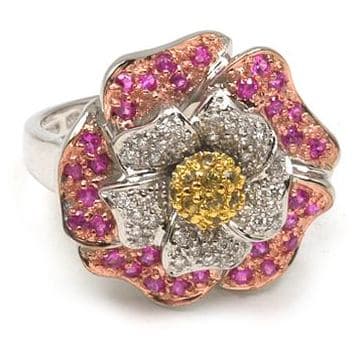
Ring #2 has a yellow gold shaft but the "flower" design is white rhodium plated. The shank of the ring had to be made smaller. When I received the ring, ALL of the white plating disappeared and the yellow showed through.
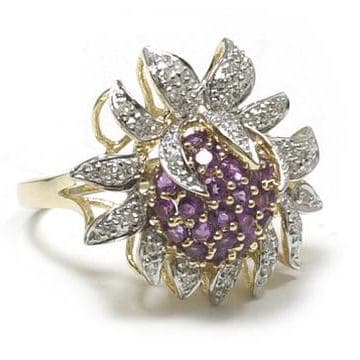
Please explain this phenomenon! I never thought that ring resizing would completely take out rhodium plating.
Laura W [surname deleted for privacy by Editor]consumer - Glen Cove, New York
Q. I own a 9K white gold engagement and wedding ring. I have had it Rhodium plated within this month(September 2007) and have noticed a yellowing tinge to the bottom of my rings. I do try not too work too harshly with my rings but I have noticed some fine to medium scratches on the bottom and sides of my rings. If I have them replated, would the rhodium plating damage my rings in the long run? How often could I rhodium plate my rings without wearing off too much gold by the polishing/buffing process? Will the rhodium plating remove fine/medium scratches? Please help me, as I am very distressed and want to ensure that my rings are well cared for.
Inga G [surname deleted for privacy by Editor]Customer - South Africa
2007
Q. I want to say that my husband and I are beside ourselves regarding both my wedding ring & engagement ring. I don't even want to go there is essence of the hardships we had with two different custom Jewelers on Long Island, both highly recommended. Well both rings are white gold, not Rhodium dipped. Both were also appraised after we purchased them and the value is high on both, so we know we got what we paid for. I had to get a V band instead of a regular solid round band for my wedding ring as my engagement ring had two outside stone, so we designed it with the jeweler and it came out very nice. But the first issue is why is the top of the wedding band (the side that is facing the engagement ring getting a discoloration on it, that are not rubbing, its looking like it may be a chemical reaction to the two pieces of white gold facing one another, its discoloring my ring and my band isn't yellow yet, as it's only about 6 months old, but my engagement ring is turning a bit gold. Help, is it safe to rhodium plate over the white gold. As I said it was appraised and is all white gold. Not sure what to do, will the Rhodium finish damage my ring. Will it give it the shine and sparkle it so deserves. also I clean my rings at least once a day is this a safe thing to do with diamonds and white gold. If so what is the safest solution to us for cleaning.
Help-- I'm at my wits end right now the rings total 17,000 together.
Consumer - Smithtown, New York
March 11, 2008
A. Yes, the rings can probably be safely rhodium plated and they will be dazzling. Discuss the plating in detail with one of the jewelers or a jewelry plating shop though because -- although most stones are resistant to the plating chemicals -- pearls, artificially colored stones, and a few certain jewels may not be.
Ted Mooney, P.E.
Striving to live Aloha
finishing.com - Pine Beach, New Jersey
Need quick confidential answers? $25
Need project assistance? $100/hr.
March 11, 2008
Q. I have just had my wedding band rhodium plated. It appears to be more like a platinum coloured ring and not the "white" gold colour I was hoping for. The shop assistant told me that the darker colour was a result of the high quality products used. Is this right?
Catherine Peersbuyer - Sydney, Australia
June 27, 2008
A. Most likely not, Catherine. Rhodium is the most reflective of all metals (this is a slight simplification because silver and aluminum would be more reflective if they didn't tarnish, but they do), so super reflectivity is what you should get, and lack of reflectivity is more likely the result of a contaminated rhodium plating solution than a super quality one :-)
Regards,
Ted Mooney, P.E.
Striving to live Aloha
finishing.com - Pine Beach, New Jersey
Need quick confidential answers? $25
Need project assistance? $100/hr.
July 2, 2008
Q. I took my engagement ring into a department store instead of where we got it in order to save a buck and have it resized. I also took another ring given to me to be sized as well. Both of them came back rhodium plated! I want it off of my ring ASAP. They even plated it over my yellow gold part of my two tone ring. I about died. I told them that I was having them sized and specifically told them to NOT plate my rings. The manager acted like they did me a favor in doing so. I told her:
I bought and wanted gold for a reason. It is shiny alone. I love the classic white gold/yellow gold look. If I scratch it, I will pay to get it cleaned and polished by a good jeweler right? What did our grandma's do for crying out loud! It is called good old fashioned maintenance.
I think any jewelry plated with anything should be labeled as FRAUD and jewelers should have to state that it is plated with it. Anything plated with anything cheapens jewelry.
The reasons above are WHY I would rather go to Chicago and get my wedding ring from Tiffany & Co. They don't sell nickel and rhodium rings there. I truly believe you get what you pay for. When we bought the ring it was perfect and NOT rhodium plated. Too bad my finger had to grow a little.
J C Penny's is sending the ring back to be polished supposedly. I told her I wanted the rhodium removed. It looks dull and I hated it when I went to pick my rings up. I cried for a week. Now I am just playing the waiting game. I hope and pray to God they just restore my ring back to the way it was.
Do you think they will and how would they go about removing the rhodium plate?
Consumer - Cedar Rapids, Iowa
January 7, 2010
A. Hi, Teresa, sorry for your troubles. It's a matter of taste: some people love the look of dazzling rhodium plating: no solid metal can ever come anywhere close to the scintillating dazzle of rhodium plating -- so I don't call it fraud nor think it should be outlawed. But I certainly agree that all plated rings should be labeled as such so people can choose intelligently!
The jeweler should certainly not assume it is okay to turn a two color ring into a single color! You are not alone, see letter 53900. Rhodium plating probably cannot be chemically removed, but can be carefully polished off (see letter 10337). Good luck.
Regards,
Ted Mooney, P.E.
Striving to live Aloha
finishing.com - Pine Beach, New Jersey
Need quick confidential answers? $25
Need project assistance? $100/hr.
January 7, 2010
A. Another option I don't hear anyone talking about is palladium . It is in the same family as platinum but far less expensive. Like platinum it is very white (although slightly more gray then platinum ) and will stay white . Also it has no nickel in its alloy which some have an allergic reaction to in white golds . If you don't want to spend the money on a new ring you can ask a jeweler to first palladium plate your jewelry before rhodium plating it. This will make for a thicker plating which will not wear off as quickly . A good plating job should last at least a year , but is something that will have to be repeated . A good jewelry store should offer free maintenance on your jewelry for life; if not you bought the piece from the wrong store, sorry.
Jimi Fortune- Grass Valley, California
April 9, 2010
Q. As a gift from my mother-in-law I'm receiving her grandmother's engagement ring to use as my own. We are having it sized and cleaned, as it is almost 100 years old. The jeweler told me in order to get the ring as bright as my wedding band, which is brand new, they are going to have to rhodium plate it. Is this a bad idea? Even though the ring is very dirty it doesn't seem to have any yellowing to it. Once the plating starts wearing off will it look more yellow? This ring is far more special than any ring I could have purchased new and do not want to ruin it. Is having it plated a bad thing?
Tasha Caruthers- belle chasse, Louisiana, usa
December 10, 2010
A. Hi, Tasha. It sounds like your ring is platinum or unplated white gold. The rhodium plating will not "yellow" it, it will make it dazzling white. If the plating wears off in spots, those spots will return to the former color of the ring. But it won't wear off uniformly, so you will need periodic replating; and the plating can be quite tedious to polish off if you change your mind.
Regards,
Ted Mooney, P.E.
Striving to live Aloha
finishing.com - Pine Beach, New Jersey
Need quick confidential answers? $25
Need project assistance? $100/hr.
December 12, 2010
Q. I have had a PD950 engagement ring for 3 years. When I bought my wedding band I noticed the diamonds shined whiter and brighter than those on my engagement ring. My engagement ring now looks grayish in comparison. My question is, does this have to do with the metal, as my engagement ring is palladium and my band is white gold or does it have to do with the diamond settings (pave vs. chanel)? My rings look mismatched now on my finger since my engagement ring looks grayish in hue and my pave diamond band is shining much whiter.
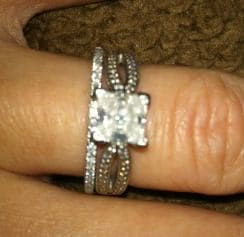
Is it possible to rhodium plate my engagement ring to bring out a whiter shine? I see a lot of inquires about platinum/white gold but none on palladium. Is it safe to plate palladium or will it ruin my ring?
The jeweler I go to says he can make the two rings "match" but I am skeptical as it may have more to do with the setting and less to do with the types of metals. From face on, my rings look mismatched but from the bottom, the two metals don't look much different.
- Valencia, California USA
April 3, 2012
A. Hi Samantha. Listen to your jeweler :-)
Rhodium is the most highly reflective metal there is; and there is no polishing that you can do to platinum, palladium, or unplated white gold that will make it look like rhodium. The only way you will get your engagement ring to match the dazzle of your wedding band is to have it rhodium plated.
Look at the picture of your wedding band. You can't clearly see the specific diamonds from a short distance -- not because of the setting style, but because the rhodium is so bright that it's hard to tell where the diamonds end and the metal begins. When you have your engagement ring rhodium plated, the same will be the case. Good luck.
Regards,
Ted Mooney, P.E.
Striving to live Aloha
finishing.com - Pine Beach, New Jersey
Need quick confidential answers? $25
Need project assistance? $100/hr.
April 3, 2012
Q. Hello. I have had my engagement ring and wedding band for 2 years. I have had the rhodium added only 3 times because my jeweler told me I am going to ruin the ring if I do it any more. The yellowing looks horrible. For 10K we feel ripped off. Is there any truth to this, does the rhodium procedure damage the structure of the gold band?
Thanks!
- Minneapolis, Minnesota
September 10, 2012
Q. I recently (within 2 weeks) had my white gold engagement ring rhodium plated. It is already starting to dull and look yellow. How can I find a jeweler that uses higher quality materials or a least adds a thicker layer? I'll pay more to have a better quality.
Rachael Gaan- Folsom, California, US
April 28, 2014
Ed. note: This RFQ is outdated, but technical replies are welcome, and readers are encouraged to post their own RFQs. But no public commercial suggestions please ( huh? why?).
Q. Hi. Is there a way to know if my white gold ring made in the 80's was made of nickel or palladium? Is there some kind of test? I just got it so I haven't noticed any allergy.
Andrea Vogel- New York, New York
September 3, 2014
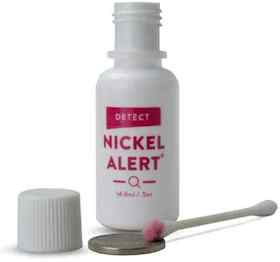
A. Hi Andrea. There are expensive ($35,000 and up) X-ray Fluorescence machines that can give you an exact chemical analysis ⇦ on eBay or Amazon [affil link] . But for home use, perhaps the easiest thing is a nickel test kit. Good luck.
Regards,
Ted Mooney, P.E.
Striving to live Aloha
finishing.com - Pine Beach, New Jersey
Need quick confidential answers? $25
Need project assistance? $100/hr.
Plating my white gold ring with rose gold
Q. I seem to be allergic to my new white^rose gold diamond wedding ring. I have been reading about rhodium dipping/plating but nowhere do I see whether this can be done to rose gold.
Thoughts? Will this protect my skin? Where would I get this done?
- new orleans, Louisiana
August 15, 2017
A. Hi Caroline. You said your ring is made of white gold. Are you saying you want to plate it with rose gold rather than rhodium?
It can be done, of course. But the issue is both longevity and tarnish resistance: rings are very high wear items and rose gold plating is thin; and rose gold has alloying materials in it (like copper) that make it more prone to tarnishing than rhodium or high karat gold.
If your issue is only nickel allergy rather than appearance, a specialty plating shop can apply the rhodium thick enough to greatly reduce the nickel leaching, maybe even eliminate it. See the Powerpoint presentation on Rhodium Plating courtesy of David Vinson of Artisan Plating.
Regards,

Ted Mooney, P.E. RET
Striving to live Aloha
finishing.com - Pine Beach, New Jersey
Need quick confidential answers? $25
Need project assistance? $100/hr.
August 2017
Q. So sorry! I meant to say... I have a ROSE gold ring (not white gold). So my question is whether I can have a rhodium coating on the inside to buffer my skin from the metal. I have never had metal allergies before and I've worn white and yellow gold rings.
caroline helwick [returning]- new orleans, Louisiana
August 15, 2017
A. Hi. Anything can be done, but I think you'd be better off if a jeweler or plating shop would gold plate the inside of the ring for you. I doubt that you would be allergic to pure gold, and your previous experience indicates that you're probably not. It's easier to plate a good heavy non-porous layer of 24 kt gold than a non-porous layer of rhodium, and it would probably look less jarring.
Make sure they understand that it's only the inside that you want plated. Simply telling them is not always the same thing as making sure :-)
Regards,
Ted Mooney, P.E. RET
Striving to live Aloha
finishing.com - Pine Beach, New Jersey
Need quick confidential answers? $25
Need project assistance? $100/hr.
August 2017
Sorry! Finishing.com is temporarily Read-Only.
Ted Mooney is retiring but I have several offers to take it over.
We're working hard to make sure we find it the best new home.