Summary for copper oxidation removal Discussion
Copper oxidation removal is the central issue here, because the questioner needs a clean copper surface for reliable wood-to-copper bonding after brazing. They report that Sparex pickling compound removes the blackened layer well, but rinsing in tap water sometimes triggers a fast reddish-brown oxidation that ruins adhesion. They also experimented with a vibratory tumbler using glass abrasive and water, which produced a satin finish that may be better for glue. The thread notes that Sparex is preferable to lemon juice or vinegar and avoids table salt, which could cause later corrosion. In the only direct answer shown, Nanette C. says she uses Bar Keepers Friend in an ultrasonic jewelry cleaner for 4–5 minutes and says it works wonderfully. The discussion also raises practical concerns about batch processing, safety, disposal, and whether changing water chemistry may be causing the sudden oxidation problem.
Q. I can’t tell you how thrilled I am to stumble upon this site. I’ve been using the site’s search engine to find answers to my question, but I’d like to go a little deeper than previous questions.
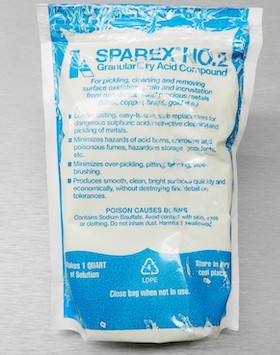
My wife and I are artists. We work with both copper and wood, but more wood. A key process for our success is gluing small pieces of wood onto the copper. Our goal is to improve the bond between the wood and copper. Prior to gluing, the copper is brazed with a torch. Afterwards, there is a blackened layer (carbon? oxidation?) that needs to be cleaned off. We use a sulfuric acid product, Sparex
⇦ on
or
Amazon [affil link] to clean off the “black”. Prior to rinsing, the copper “looks” very clean. We rinse the pieces in tap water and set them out to dry. Most of the time the copper has remained “clean enough” after drying for the glue to hold. Recently, however, we’ve had a serious problem with a reddish brown oxidation forming (as well as other discoloration) very soon after contact with the tap water. It gets worse as the pieces dry. As a result, the glue bonds with the oxidation and the glued wood easily pulls away from the copper.
Today, I went to the internet for a solution and found this wonderful web site! I’ve been trying a couple of experiments based on what I’ve read about removing oxidation from copper. I don’t know if I have everything totally figured out so I want to share my thoughts and observations and try to iron out the remaining uncertainties.
First, I’m assuming that I’m dealing with *two* different problems. The “blackened” deposit, which I assume to be carbon, and oxidized copper. The thought is that I now have to clean the copper with two or possibly three solutions.
The first would be the sulfuric acid solution (Sparex
⇦ on
or
Amazon [affil link] ). This does a great job of removing the black. At room temperature, I’ve been leaving the pieces in that solution for a couple of days.
After rinsing with tap water, I’m torn how to proceed next. Based on information from this site, I tried two different cleaning solutions, lemon juice, then vinegar
⇦ in bulk on
or
Amazon [affil link] and salt solution. I don’t have the benefit of time and experience to be able to know the difference. This is our livelihood and how quickly find solutions will have a big effect on our small (but ever-so-important) pocketbook.
Both solutions cleaned well, but the lemon juice took much longer than the distilled white vinegar and salt solution. That solution took less than 30 seconds to clean the sample parts. The biggest difference came when the parts came out of the solutions, or when I tried to “wipe-on” the solution.
Typically, I’ll be able to immerse the copper pieces into the solution using five gallon buckets to hold the solution and a fabricated plastic container/strainer to hold the parts. Unfortunately, I currently have some partially finished pieces (several) that I’ll have to figure out a “wipe on” remedy.
I tried wiping on the two different solutions directly onto the surfaces of the partially finished pieces. The lemon juice took a couple of reapplications and a little scrubbing to work. The end result was nicely cleaned parts, but the time invested is a concern. The vinegar solution started to work a little quicker. By the second application it was starting to work, especially with a little rubbing. I was shocked when the vinegar solution started turning the copper black. Then, after rinsing the parts with water, the pieces turned a yellowish-reddish color.
It seems that, although the vinegar/salt is faster, I may end up having another surface problem as the pieces dry. I’m wondering why the lemon juice doesn’t have the same type of problem. Does the lemon juice leave the copper better protected? The answer to this helps to determine what cleaning process I use.
The current idea is that I might use both solutions after the acid bath. I would start with the vinegar/salt solution to expedite the process, rinse with water, then immerse in the lemon juice (if the lemon juice has any beneficial residual value), then rinse, and air dry.
Maybe, if I’m not in a hurry, I’ll just use the lemon juice.
Are there any other thoughts about this? Is there another product I should try, other than the lemon juice or vinegar, that would be better? Should I add something else to my sulfuric acid (I read something about
hydrogen peroxide
⇦ on
eBay or
Amazon [affil link]
)? After the immersed sample parts were dipped in lemon juice, rinsed, and dried, there was a little black residue left that rubbed off with my finger. Is there something else I should use to clean that little bit of residue off and make the glue bond better?
Any insight would be appreciated!
Brian H [last name deleted for privacy by Editor]
– Apple Valley, Minnesota
2002
 |
⇦ on eBay [affil link] will give you better results than lemon juice or vinegar, and will not contain table salt which might give corrosion problems further down the road.
A. There is one piece of critical information you have left out of your detailed description. What type of glue are you using? You might find that Sparex does a wonderful job of removing firescale. However, that may not help with glue adhesion if the surface to be glued (either the copper or the wood) has been contaminated with oils (possibly from handling the pieces). Have you tried wiping down the surface prior to gluing with alcohol or (better yet) acetone ⇦ on eBay ? This may be a possible answer to your adhesion problem. Ronna Erickson |
Q. The name of a commercial product is appreciated. We work alone and learn much from experience alone. I needed an immediate solution to a serious problem and the kitchen remedies worked well enough to provide a bridge to better information.
I’ll look into Copper Glo
⇦ on
eBay [affil link]
. Any other names of products that might be appropriate would be appreciated.
One thing I tried which I am very excited about is finishing the process in a vibratory tumbler. The copper pieces had a little residue and contamination left on them after the baths and subsequent rinsing. I pulled out a small vibrating rock tumbler and filled it with the copper pieces, some glass abrasive medium, and tap water. I left it on over night. The resultant finish seems “satin”, which I’m assuming would be the perfect finish for glue to hold. The visible, non-glue-surface also looks better, which is a bonus.
To answer the question about the glue- we use both epoxy and a solvent based glue with some flexibility. We’ve evolved our choice of glue over the last 5 years and, except when we have a problem of copper oxidation, they have both performed well.
I still don’t know why the copper oxidation became a problem “all of a sudden”. Maybe they’ve been adding more chlorine or something to our water, and that’s the cause. The change was drastic. For the last several months, it was not a problem. At this point, I’m…
*tumbling more parts to gain enough experience to feel comfortable purchasing a larger tumbler… also waiting to see if it is truly needed. We’ll finish enough work to give us a track record. I’m learning about tumblers, as well as tumbling abrasives. The glass has worked well, but I don’t know if I’ve by chance stumbled upon the
“best” abrasive, or if there is something better.
*Looking for a better solution to use to remove the copper oxidation. Factors include the ability to immerse hundreds of parts in a bath all at once, the time needed to dissolve the oxidation, the safety factor of handling the solution in a non-commercial workshop, and any problems in the disposal of the spent solution.
*Looking for a source for Copper Glo
⇦ on
eBay [affil link]
, and any other product that we may find.
Once again, I can’t express my gratitude to those who can offer insight.
Brian H [returning]
– Apple Valley, Minnesota
Ed. note: We’ve now hotlinked the product to sourcing at Amazon. But we’re not suggesting that it is better than a host of other copper cleaners.
A. Brian,
May I suggest, if possible, that you ‘attack’ your problem in a different way.
Firstly I am clueless about what is the ‘best’ cleaner for copper. Ask an expert.
But adhesion is always better if the surface area can be increased, by, crudely speaking, sanding. A fresh utterly clean surface may promote ‘tracking’ instead of ‘wetting’ …
Have a gander @ # 10932 &
13168 ,.. but only in the sense of the
3M pads for cleaning, sic. scouring, sic. increasing the surface area.
When we used to bond fibreglass to thermoplastics (using the appropriate bonding agent) we ALWAYS, ALWAYS sanded down the surface first of all. The French used to say that sandblasting was sufficient but that isn’t quite so!
Food for thought.

Freeman Newton [deceased] (It is our sad duty to advise that Freeman passed away
April 21, 2012. R.I.P. old friend).

A. I think you are on the right track with the rock polisher style machine. At least it is a start. After finishing the parts in the machine I would try acetone to keep the finish. Also I would change the medias that you are using to something that is more suited to cleaning and giving you a good polish. Someone else wrote about roughing the part up in the area that you put the glue-this is also true you will get a better adhesive seal if you can rough up that area.
Ron Benton
– Delano, Minnesota, USA
2002
A. I’m not sure you want to use any commercial copper polishing products. They usually include an ingredient to protect the copper from future tarnishing that may inhibit bonding. I soak my copper pieces in straight apple cider vinegar – no salt – and it always cleans up beautifully with no residue in about 15 minutes. You may need to soak longer.
J Swarts
– Fort Worth, Texas
2002
A. Try and solve the problem by reducing variables. Try distilled water to see if you get the same second corrosion. If you don’t it’s something in the water. All you need then is a ready supply of unpolluted water. If not look for any other change in your process (suppliers, location, abrasives, etc.)
Rick Edwards
– Minneapolis, Minnesota
2003
Q. Greetings
My name is Wm Varney. I found this site through a google search (one of literally hundreds I have tried) concerning the subject of laminating copper to wood (in this case, baltic birch). I don’t want to get into a great deal of explanation at this point because this is a new site to me and I don’t even know if its still active or not or whether I will get a response. I have been trying to find a laminating process (copper to wood) for a long time. I saved this site to my favorites and if someone could email me, just to say “yes, this is a site that is still interactive”, I would most certainly appreciate it and like I said, I do have some experience in the matter. Also, I have a patina I have developed, through much trial and error, that yields beautiful results. I do high-end scroll artwork, all hand made frames, and have been searching for the copper solution for 5 years (but not very diligently) I have all the chemicals and fillers and epoxy but nothing seems to work to any satisfactory degree.
Hopefully this is not falling on deaf ears. I am certain it would be a mutually beneficial acquaintance. Like I said, I do have some experience $%^&^&** lol.
Wm Varney
Wm Varney
– Wagoner, Oklahoma USA
2007
 Although this site was founded in 1995, so some postings are old, it is very active, and every page is continuously monitored.
Freeman usually visits the site a couple of times a week, and Ronna happened to have been here yesterday.
:-)

Ted Mooney, P.E.
Striving to live Aloha
finishing.com – Pine Beach, New Jersey
Need quick confidential answers? $25
Need project assistance? $100/hr.
2007
Q. My name is Jim. I’m a painter. I have run across a large number of residential homes with copper roofs over the exterior bay windows. These roofs are all oxidized and I would like to know how to clean them without scrubbing for 4 hours and getting nowhere. Is there a chemical that can be wiped on and then removed? Thank You!
Jim Derr
painter, residential/commercial – Carmel, Indiana, USA
April 22, 2008
! I am not sure about how you clean copper, but I know that if you use smart nano coatings you will never have to clean the copper again. These coatings come from many small outlets in Germany.
Dermott Reilly
– London UK
October 22, 2010
October 22, 2010
A. When coatings are engineered at the nano level, new properties sometimes emerge at nano scale as Dermott says. Still, if you are looking for the copper to acquire a classic appearance, you have to let it age . . .


… whereas if you just want a perennial bright copper look, you may be better served with copper-look powder coating than with real copper. Good luck.
Regards,
Ted Mooney, P.E.
Striving to live Aloha
finishing.com – Pine Beach, New Jersey
Need quick confidential answers? $25
Need project assistance? $100/hr.
A. I use Barkeepers Friend
⇦ on
or
Amazon [affil link] (that I used for my pots and pans), and put a few splashes of this in my ultrasonic jewelry cleaner
⇦ on
or
Amazon [affil link] and run it for 4-5 minutes … works wonderfully.
Nanette C [last name deleted for privacy by Editor]
– Bradenton, Florida
January 1, 2016