
| Search our quarter-million Q&As |
Home of the finishing HOTLINE since 1989
-----Plating rhodium on white gold (cont'd)
Ed. note; This is an interesting but ridiculously long thread, and only one of many. Before you get too confused, you might want to start with our FAQ on Rhodium Plating and White Gold to get an overall understanding :-)
Sorry if I've missed the answer to this question, but I've read through the entire thread ... I know palladium is better than nickel for making white gold, but will palladium white gold dis-colour if it's not rhodium plated?
Thanks,
Alan W [last name deleted for privacy by Editor]- UK
2003
Hi, Alan. Although it is possible for white gold alloys to become discolored, that is not exactly the issue. The issue is actually whether the alloy you are considering is white enough to satisfy you, or whether rhodium plating would be necessary before it would be white enough to satisfy you.
Regards,

Ted Mooney, P.E.
Striving to live Aloha
finishing.com - Pine Beach, New Jersey
Need quick confidential answers? $25
Need project assistance? $100/hr.
I've read through most of these postings and am very concerned. My husband just bought me an anniversary ring with 1.2 total weight diamonds in a white gold ring. My original set is yellow gold so I never knew of this yellow ring. I have only had this ring on for 5 days and it's already turning yellow. If I'm going to have this problem with plating every couple years am I better off to ask the Jeweler about transferring my diamonds to a platinum band? Will a jeweler even do that? We purchased it at Zales so they have been around for a long time.
Kerri C [last name deleted for privacy by Editor]- La Quinta, California
2003
I have recently had a similar problem with white gold rings. My spouse and I each have a white gold engagement band, and a white gold civil union band. The engagement bands were purchased in July. For the nine months we had them they were beautiful and shiny and stayed their white color. On May 7th we had our civil union and put on our new bands. The very next morning all four rings were yellow. The inside of the 2 rings from July and the bottom of my spouses new ring were the original color, but the rest was yellow. The only thing we had done within that time period was eat dinner, go in a jacuzzi tub, and sleep. So we assumed it was the tub. It was not a hot tub, just a regular bathtub with jets. We then went to other jewelers to verify the rings were 14K white gold, which they were...and that is when we found out about rhodium plating. It seemed odd that two of the rings would be ok for so long and that 2 would change in a matter of hours.
After speaking to our jeweler we found out our rings were never rhodium plated to begin with. He made the gold using gold, iridium, and palladium. According to him it was a chemical reaction to something in the tub (there was a bluish green ring around the tub when we emptied it, possibly cleaner) (also the town has very hard water). But, we are not sure what has caused it. As everyone else has mentioned we have been extremely distressed over this, and since it happened the very next day, we haven't gotten to fully enjoy the fact that we had a civil union. From what most people mentioned this happened over time or when their ring was sized. For us it happened almost instantly and they were never plated. One thing I have noticed from all of the posts is that this problem has only been happening with new rings (purchased within the last few years.) Yet many people seem to know people with white gold rings that are 15-50 years old that have never had this problem. It seems odd to me that it is such a recent problem. Any suggestions or answers.
Thank you,
Deborah T [last name deleted for privacy by Editor]- Little Falls, New Jersey
2003
Yes, the chemicals in hot tubs, like chlorine and bromine, can tarnish/discolor gold alloys. I was thinking the wrong way on that issue for a while myself. Although pure gold is exceptionally resistant to chemical attack, rings are made of alloys, not pure gold. The good news is that this is probably a surface-only situation, and I think your jeweler will be able to polish the tarnish off, and get your white gold back to a whiter color.
Ted Mooney, P.E.
Striving to live Aloha
finishing.com - Pine Beach, New Jersey
Need quick confidential answers? $25
Need project assistance? $100/hr.
My fiance recently purchased an engagement ring for me. I was with him at the time of purchasing it. It cost him $1,400.00 including insurance. One year later I notice that my ring finger was starting the itch, now I have a little rash on my finger. Is White/Gold jewelry safe? and what was the cause of this break out from wearing this ring? I also, have a co-worker that had the same problem. This is very scary...
Stacy H [last name deleted for privacy by Editor]- Richmond, California
2003
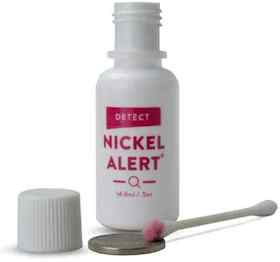
Probable sad news, Stacy; you've possibly become allergic to nickel. There is a pandemic of nickel allergy these days, probably related to the dramatic increase in piercings in recent years. Rhetorical question: do you and your co-worker have piercings?
You can test your ring for the presence of nickel .
and a dermatologist can test you to determine whether it is a nickel allergy or some sort of bacterial or yeast problem.
Ted Mooney, P.E.
Striving to live Aloha
finishing.com - Pine Beach, New Jersey
Need quick confidential answers? $25
Need project assistance? $100/hr.
My husband just recently bought me a white gold wedding set. It is beautiful. I got in December. In January I noticed the ring yellowing. I brought it back to the jeweler who traded my ring out for a new ring. I have had the new ring about 6 weeks and it is now yellowing also. They offered to have it re-rhodiumed and I chose not to. I told them I wanted the ring re-made in 18KT yellow gold. I do not want to play the game of getting my ring dipped every month. I wish I would have been told about this in the beginning before we bought this set. This is a pain. I think jewelers should only offer the true stuff, yellow gold or platinum. All of this adding alloys to gold to make it something it is not does not work. Eventually it will turn to yellow gold sooner or later. I believe all of the people who say they have had their white gold for years and years and have never had a problem probably have platinum and did not even realize it. I really wish I would have known this from the beginning. I have really enjoyed all of your posts and I appreciate knowing that I am not the only one with this problem.
Thanks for all of the advice.
Chrissy F [last name deleted for privacy by Editor]education - Marrero, Louisiana
2004
I work in a Jewelry store and recently brought one of our white gold rings in for sizing. I was asked by the jeweler if it was real white gold or if it was flash plated rhodium. I didn't know because I do not make the rings. She told me how a lot of jewelers only use flash plated rhodium and the ring underneath is actually yellow gold. She said one of their customers was told there was no such thing as real white gold, but that that wasn't true. When I picked it up, she told me it WAS real white gold. When you go to buy a ring, you should just ask if it is real white gold or just flash-plated rhodium. My mom's wedding set is white gold, and she has had it sized and even welded with some yellow gold rings that my dad bought her. Her wedding set has stayed white for 26 years. Just ask before you buy.
Jennifer F [last name deleted for privacy by Editor]Jewelry - Austin,Texas
2004
I happened upon this thread looking to see if it was possible to turn a yellow gold ring into a white gold ring using Rhodium. I believe I got my answer...
Anyway, to those of you who have written in of whether to buy white gold or platinum wedding sets, please go platinum! Like many others here, I had a "white gold" engagement ring that I had to get sized, and low and behold, when it came back it was yellowish! They ended up dipping it in Rhodium again, but eventually I changed the setting to platinum. The platinum may not be as shiny as gold, but it looks and feels durable which is important. To note, I was bartending and wearing my wedding set and my finger did turn red which is normally caused by nickel. It has been more than a year and my skin there is still a bit thin. So, platinum ring wearers, be careful of nickel in your rings if you are allergic to it!
Christy B [last name deleted for privacy by Editor]- Jacksonville, Florida
2004
2004
I became engaged on Memorial Day this year. I wore my white gold ring for 2 days and dropped to the jeweler for sizing. It took a week for it to be returned, and when it came back there were dings along both sides of the channel set diamonds along the side! The manager of the store said she would just 'buff them out' which not only did not work, but also smooshed some of the setting. I was outraged. My fiance advised the store manager to order me a brand new ring (the exact same setting) in my size. I kept the damaged ring until the new one came in. After 2 days it started to yellow. I have white gold earrings and necklaces with charms that have never appeared yellow. I was given the rhodium plating story by the store manager. I have a life time maintenance so replating will be free. Does any one have any advice on how to ensure that the jeweler plates the ring with ~1u of rhodium? I don't want my 'white' gold ring yellow after 2 days.
I am so disappointed! To make matters worse after 6 weeks the 'new' ring came in it wasn't even the same setting...So I had to order another one!
PS --Kay Jewelers has been terrible. My advice is to stick to your local 'been in the town for 50 years' jewelry stores. They are more concerned with their reputation then the large chain mall stores are and the employees are more educated!
Leigh L [last name deleted for privacy by Editor]- Massachusetts
2004
To those who wonder why their white gold is turning yellow, it is because "white gold" is actually yellow gold mixed with other metals such as zinc, copper, nickel ect, the method of which it was mixed, the ratio etc. has an effect on how long it will remain white. The alloy can oxidize or wear away allowing the yellow color of the real gold which does not oxidize to surface. This is because "White Gold" is usually only 10 to 14 kt, the rest is "cut metals" used to make the yellow color disappear. I believe that "White Gold" was actually created to replace the use of platinum in jewelry during the war when platinum was a restricted metal, White gold was created to take its place and is still in use today as platinum is twice as expensive as yellow gold making it more difficult to afford.
The conclusion I come to is that all white gold is not the same, its quality will depend on the type and mixture of "cut metals" to pure gold used, different mixtures create different quality "White Gold" alloys. Shrooms
Jack K [last name deleted for privacy by Editor]- Agra, Oklahoma
2004
To Lisa D in Brookfield, OH -
Sorry for the delay in responding to your question! I forgot that I had posted here, and recently returned. To answer your question, yes, Rhodium can be plated over an older rhodium plating. The secret is proper cleaning and activation of the surface. If there are no scratches, it can go through the plating process. If there are, it needs to be polished - which will remove most of the plating anyway. Unfortunately, there is no way to realistically measure plating thickness unless you bring the ring to a plating shop that has an XRF machine. They can do a very quick and simple test that will not ruin your ring.
As far as softened vs. hard water exposure, I really don't know what would happen. Theoretically, there should not be any damage, just water spots. However, without knowing exactly, you should take your ring off when doing dishes, taking a shower, or washing your hands. usually the soaps will do more harm than good.
Good Luck!
Larry Smith- Stamford, Connecticut
I usually never post on this sort of thing but I was surfing the net for jewelry and came across what was being said here. I had to comment because if nothing else the very first post bothered me. I work for a well known jewelry corporation and it exasperates me to no end that people don't investigate information regarding metals. I mean the internet is available and it is plain as day on the sites that white gold is not white gold. It is not however yellow gold plated with rhodium. White gold is simply yellow gold with alloys added such as nickel or palladium to give the yellow gold a white color. White gold will begin to turn yellow gold in as early as 6 months in some cases. It can have to do with washing with the jewelry on but it is more often due to your skin and the products you leave on it such as lotion. White gold coming in to contact with certain lotions can turn it almost instantly. I pity the jewelry store that had to deal with the people who returned their jewelry for this reason. If you returned it shortly after purchase because you now learned about white gold and wanted to switch to a different metal that would be fine. Yet to blame the store for your ignorance and inability to see that what they told you was in fact a fact is exactly the reason I have found that people buying jewelry are crazier than the customers I've ever had at any other job. I love my job but there is something this world needs to learn about jewelry and jewelers. NOTHING IS PERFECT!
Jewelry won't last forever without upkeep. Jewelers are humans not machines. When you see a jeweler work you develop a huge appreciation for how close to perfection they come. Mistakes can happen, and do not expect perfection. That is the beauty of the handcrafting that goes into everything that a jeweler must do it is not cookie cutter perfect. As I always say, before you yell about something make sure you know that what your yelling is correct.
Kim [last name deleted for privacy by Editor]- Michigan
2004
Dear all,
As a professional jeweler I have rhodium plated white gold now for over 21 years. My advise to all of you white gold owners is to find a jeweler that actually electro-cleans your ring before rhodium plating (about 20 seconds - in motion). Rhodium plating time after that crucial step should be about 60 seconds. Failure to electro-clean or too short of a rhodium plating time will result in a very poor quality rhodium plating which can look "spotty" or is so thin that it wears off rapidly.
BUT NOW THE GOOD NEWS: I recently came across a brand-new white gold alloy which will change the industry within the next few years. Rings cast with it do not need to be rhodium plated. The patented white gold retains its shine and luster with no special treatment since there is no rhodium to wear off revealing a less pleasant color. Not only can it be polished and finished as easily as yellow gold, it is not brittle like some other white gold alloys, having the ductility and ease of use for diamond setting. This alloy is also safer for nickel-sensitive people.
Learning about this new product as a jeweler is exciting news to me and I am looking forward to offer this product to my customers as a welcome alternative to the traditional yellowish white gold rings that need rhodium plating.
Christoph R. Malzl- Provo, Utah
2005
I HOPE YOU CAN HELP ME JUST GOT ENGAGED AND I HAVE MY RING FOR MORE THEN 6 MONTH ITS WHITE GOLD AND IT IS TURNING I TOOK IT BACK TO THE PLACE I GOT AND THERE GIVING ME A BS LINE SAYIING THAT MY BODY IS CHANGING THE RING OR THE FOOD I EAT. THEY SELL RINGS THAT ARE CHEAP WITH A HIGH PRICE THINKING THAT YOU'RE GEETING YOUR MONEY's WORTH BUT YOU'RE NOT. WHAT IS THE REASON WHY IT IS CHANGING DID I GET A A BAD RING? PLASE HELP ME I don't KNOW WJAT TO DO
RACHAEL CIRELLI- NEW JERSY
2005
Gold is naturally yellow in color. However, gold is too soft of a metal to use in its pure state to make jewelry that will withstand the everyday wear and tear. Other metals are mixed with the gold to harden it. 10 karat gold contains more metal alloy than gold, 14 karat gold contains more gold than 10 karat, 18 karat gold contains more gold than 14 karat, etc. It is very rare that you will have 24 karat jewelry, it is too soft. White gold will contain the same percentages of gold versus metal alloy (to harden it), but the alloy used is "white." Over time, the yellow color of the gold will begin to show through as the alloy wears thin. Rhodium plating simply coats the gold to restore its "white" color, and in many cases will restore some sheen as well. Rhodium plating is a common practice in the jewelry industry. Some people will need to coat their white gold jewelry with rhodium once a year, others can wait 2-3 years. It all depends on the wear and tear your jewelry gets, and yes, on your body chemistry. Just know that when your white gold begins to turn yellow you can take your items to the jeweler and get them rhodium plated.
Jessica Garayua-Johnson- Chester, Virginia
2005
2006
I am a jewellery designer in South Africa and I have read all the letters above, especially the ones pertaining to white gold fading colour.
As also stated this is quite common, as the properties of white gold are as follows:
yellow gold + silver (alloy to make it 18 kt or 14 kt., etc.) + Palladium
(Pd).
Palladium, is used in this mixture as a bleaching agent, but because of the golden yellow of the gold in the first place, it still retains a slight yellow tinge even after bleaching. It it is though rarely seen, and after bleaching looks more steel grey in colour.
There after the jewellery is, as previously stated, Rhodium plated to give it a bright white look.
When I am consulting with a client, I always advise them to go for the non-plated version, as within 6 months of plating, depending of course on how thick the plating is, it will wear off.
In this way your rings always have a greyish steely look to it and won't change colour per se. The risk with plating is that the change in colour is emphasised and well you never know what you are truly buying unless you have asked the informed questions.
I hope this helps everyone.
- Durban, Kwazulu Natal, South Africa
2006
I am an experienced bench jeweler that makes and buys gold and platinum jewelry. "White gold" jewelry made by most manufacturers use nickel. This will usually be very slightly yellowish until it is rhodium plated. A few manufacturers that sell to jewelry stores such as Cobb are only now starting to sell non-nickel jewelry with different combinations of gold, palladium, and other alloys. You will see more manufacturers using this soon. Jewelry stores do not like the expense and trouble of rhodium plating white gold jewelry either. Most jewelers do not know the correct way to rhodium plate jewelry, as evidenced by many of the comments above. One example is the jeweler who uses copper wire in his plating solution. Copper and many other materials easily contaminate rhodium plating solution.
Pure platinum is soft and scratches easily. The best platinum jewelry is hardened with 10% irriium or ruthenium.
The inside of a ring will be stamped 10% irid or 10% ruth.
- Birmingham, Alabama
Here in the UK this has been a problem for many years.
A well known bullion dealer here in the UK has teamed up with the Assay office to come up with a grading system for the colour of white gold under the rhodium plating.
It is now possible to purchase white gold jewellery that is a very good white and does not turn yellow after short periods of wear.
More information can be found on the grading system of white gold here.
http://www.qualitysilver.co.uk/acatalog/White-Gold-Rhodium-Plating.html
- Maidstone, Kent, England
2007
Thanks, Jason. That link is quite terrific, and the further links to the Gold Bulletin are even better!
The article "White Gold Alloys: Colour Measurement and Grading" at www.goldbulletin.org/downloads/Henderson_2_38.pdf is a bit detailed and heavy, but it clearly explains everything anyone would want to know about white gold color and the ASTM D1925 standard.
Now if only jewelers would adopt this standard and label their better jewelry by color class and freedom from nickel, as well as by karat, we'd have happier consumers. In the meanwhile, customers can inquire of their jewelry store clerk if the item is nickel-free and what color class the white gold alloy is. The clerk will probably say "huh?", but it's a start.
Ted Mooney, P.E.
Striving to live Aloha
finishing.com - Pine Beach, New Jersey
Need quick confidential answers? $25
Need project assistance? $100/hr.
2007
Sorry! Finishing.com is temporarily Read-Only.
Ted Mooney is retiring but I have several offers to take it over.
We're working hard to make sure we find it the best new home.