
| Search our quarter-million Q&As |
Home of the finishing HOTLINE since 1989
-----How to do printing onto Anodized Aluminum

this text gets replaced with bannerText

⇦ Tip: Readers like to learn from others' situations;
some readers skip abstract questions.
Q. Hi
I've read through your responses on anodizing alum. We're interested in understanding the steps involved in silk screening images onto aluminum, then somehow sealing the sheet to lock the images into the pores of the alum. Any tips, what chemical is used to lock the pores, etc would be appreciated!
Does the sheet first need to be anodized, then we screen the images?
Thanks
Chris
- Edmonton Alberta, Canada
February 20, 2022
Treatment &
Finishing of
Aluminium and
Its Alloys"
by Wernick, Pinner
& Sheasby
on Amazon or eBay
or AbeBooks
(affil link)
A. Hi Chris. Yes, after anodizing, the lettering ink or image is put onto the aluminum article and absorbed into the pores of the anodizing; then the article is sealed by immersion in boiling water or other sealing chemical. I've seen and worked with many aluminum electronic panels with black lettering on them, and have a good understanding of the anodizing process, but I do not have the hands-on experience you are looking for with lettering let alone images. Hopefully another reader will.
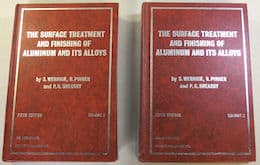
If you are a hobbyist, the descriptions here may be enough for you to start experimenting. But if you are considering installing a production facility I think you need to get to a library for access to Wernick, Pinner, & Sheasby, which is the authority on all aluminum finishing issues and has many pages describing the details of the several alternate approaches, and make a preliminary decision which of those approaches you will follow. But I think you should find a consultant with experience in it before committing to installation because it sounds very easy to pick a path which is theoretically workable but which, depending on precisely what you have in mind, is far less practical than others :-)
Luck & Regards,
Ted Mooney, P.E. RET
Striving to live Aloha
finishing.com - Pine Beach, New Jersey
Need quick confidential answers? $25
Need project assistance? $100/hr.
February 2022
⇩ Similar, related, Q&As -- oldest first ⇩
Q. Is it possible to take a plate of 6061 alum., clear anodize it and then put a part number or a picture on it using other colors of anodize ?
Thank you,
Alan Miller1995
Treatment &
Finishing of
Aluminium and
Its Alloys"
by Wernick, Pinner
& Sheasby
on Amazon or eBay
or AbeBooks
(affil link)
A. Absolutely!
I don't have 'hands-on' experience in this, so I can't give you the process step-by-step, but I do know that anodizers commonly anodize aluminum plates, silk-screen the legend onto the plates, then seal the inks into the anodized film.

Ted Mooney, P.E.
Striving to live Aloha
finishing.com - Pine Beach, New Jersey
Need quick confidential answers? $25
Need project assistance? $100/hr.
A. Regarding putting pictures on aluminum, there has been a process for doing this for at least 20 years. I don't have the article I read about this anymore. You would have to go to a technical library and look it up. As I remember, it involves absorbing the photographic silver salt chemicals into the porous anodizing coating. This would have to be done in a light-tight room with only dark room red lights. Sorry I can't help you more.
Joseph l. andersom, jr.1996
A. The process the writer is referring to was developed by Peter Laakmann of Synrad Corporation (CO2 lasers) and first published in the early '90s. Basically it involves laser etching the desired information into the anodized plate, then using the remaining anodization as a sort of resist. Dye is applied to the etched areas, given a few moments to be absorbed, the excess wiped off the resist area, and the whole is sealed. Synrad is in a northern suburb of Seattle, I'm sure they can supply a copy of the article. Problems are: a) its labor intensive; secondary and then *tertiary* operations, and b)frankly, we've never had particularly good success with it, although I can't say we've really applied ourselves to getting it right either. Laakmann claims it works great.
Q. What about re-anodizing plates which have been selectively laser-etched back down to bare metal? Has anybody had any experience with this or similar processes?
Josh Drexler- Pepperell, Massachusetts
1998
Try www.se.shibaura-it.ac.jp/~sato/, this is the address of Anodizer's Plaza. You might want to leave a message for Dr. Sato. I know that he is interested in the subject of anodized nameplates.


Tom Pullizzi
Falls Township, Pennsylvania
1997
----
Ed. note 11/27/06: Sorry readers, that page is no longer functional
Multiple threads merged: please forgive chronology errors and repetition 🙂
Q. Hello, This is Chaithanya from Bangalore, India.
We are printing on open pore anodised unsealed aluminium for applications such as name plates. Soon after printing we seal the pores in nickel acetate solution.
The open pore anodised unsealed plates are being purchased from a sub-contractor and now with increasing demands and also complaints on quality, we have decided to set up a plant of our own. We feel that having the plant in house would help us with better quality , various options in finish and delivery time with respect to our application.
I would like to know from you the type of anodizing required for our printing application and books you recommend us to read and understand. Also since I can travel , would like to know if there are any training programs conducted on this subject.
Thanks
Printer - Bangalore, India
2007
A. You are making a lot of assumptions in thinking that you can do it better than the vendor. That presupposes that your vendor is not much good. Try another vendor first while you do the homework for setting it up in house. Far too many people think that the process is a "just dip it" which is far from the truth. For books, take a look at the gotta have it books in the library at this site.
Do not forget that you need a laboratory for maintaining control of the tanks.
- Navarre, Florida
2007
Q. I've seen anodized aluminum with a pattern that looks like a print of dollar bills scattered all over the floor. Any ideas on the process?
Tyler Andersonhobbyist - North Branch, Minnesota, United States
2007
Treatment &
Finishing of
Aluminium and
Its Alloys"
by Wernick, Pinner
& Sheasby
on Amazon or eBay
or AbeBooks
(affil link)

Aluminum How-To
"Chromating - Anodizing - Hardcoating"
by Robert Probert
You'll love this book. Finishing.com has sold a thousand copies without a return request 🙂
A. Hi, Tyler. The general idea involved in coloring or printing onto aluminum is that anodizing the aluminum builds sort of a honeycomb pattern on the aluminum surface, with billions of tiny "drill holes" extending into the anodized layer that can absorb dyes; after exposing this honeycomb to dyes or inks which are absorbed into the drill holes, the aluminum is put into boiling hot water or other agents which swells the aluminum oxide and "seals" it, closing off the tops of the holes.
Thus, aluminum is often colored by dipping into a vat of dye after anodizing and before sealing. Or lettering is put on aluminum by silk screening it with inks after anodizing and before sealing.
----
When it comes to more complicated patterns, "splash anodizing" is common. Exactly how it is done by different companies is usually still trade secret info, but may involve masking before dyeing, and/or overpainting. However, this process probably applies mostly to one-of-a-kind patterns, like fades, rather than intricate repeatable patterns.
When we look at a repeatable intricate pattern, like dollar bills, you have to start thinking to yourself that the manufacturer probably started by printing that pattern onto paper and then transferring it to the parts. Two ways of doing such a transfer are "sublimation printing" and "water transfer printing".
In sublimation printing onto anodized aluminum (although I can't pretend to have seen it done or to know the trade secrets involved in doing it well), the pattern is printed onto paper with inks that turn to gasses when heated. The paper is pressed against the aluminum, heated to cause the dyes to sublimate, absorbed into the anodized pores, then sealed.
In water transfer printing, the pattern floats off from the paper onto the surface of a tank of water, sort of like a stretchable decal. the part is dipped into the water and pulled up through it, and the "decal" wraps around it. Again, although I've seen this done on metals in general as sort of a paint, whether it works as an absorbable dye into the anodized film is not something I actually know. Good luck.
Ted Mooney, P.E.
Striving to live Aloha
finishing.com - Pine Beach, New Jersey
Need quick confidential answers? $25
Need project assistance? $100/hr.
August 13, 2012
Q. I represent a medical company that manufactures not only implants and tools, but the casing in which they are shipped, stored, and re-cleaned in. Typically, we manufacture the cases from 5051 aluminum, and the bulk of our printing occurs on this material.
However, we have recently begun considering bringing both the silk screen and deep image anodizing in-house, due to disappointment with our various suppliers.
I have done extensive research on both processes, finding myself time-and-again directed to this plethora of knowledge along my journey.
However, I have some more questions, and a thirst for advice, on a few topics.
1: Dye Sublimation to Aluminum - Any recommendations in regards to preparation and process would be greatly appreciated. As of right now, we do not have the fullest understanding of all options before us. Our current working theory is anodize, die sub, seal. However, the actual substrate process is hazy at best.
2: UV Inks and Curing for our Silk Screen Process - The Lead Supervisor does not take well to the idea of a conveyor fed oven or curing station, citing the space requirements. So far, UV Ink seems the most economic and space-efficient method, but I'd like to hear more options. Suggestions for saving space and cost are a very large hinge point for this particular project. Has anyone had any luck with LED Cure Lamps so far? Or should the process be formed around Mercury Arc Lamps still?
Thanks for your input, and forgive my lack of formal understanding.
Medical Manufacturing Employee - Fort Wayne, Indiana, USA
A. Hi Zane.
Although I have a good understanding of anodizing, I think you know a lot more about these imaging processes than I do. Maybe thinking out loud to bring myself up to speed will help bring others up to speed, especially if you correct me where my thinking is wrong.
Robust anodizing is a process not a single step. The aluminum is caustic cleaned, etched, and de-smutted before the anodizing step. The etching and desmutting parameters depend upon the alloy and exactly what is sought. You can see our "Introduction to Anodizing" for a better understanding of the process.
Dry ice going directly from solid to carbon dioxide is a well known example of sublimation -- the process of a material going directly from solid to gas without the intermediate step of liquid phase. Sublimation printing, as I understand it, starts with printing an image onto paper with an inkjet printer, but using special sublimation inks in the cartridges rather than conventional inks. When the paper with the image is sandwiched with another item and heated, the ink sublimates, which transfers the image to the T-shirt, coffee cup, or whatever. I have not seen sublimation printing on aluminum, but I suppose that after anodizing and before sealing, the aluminum is sandwiched with an image printed onto paper, and heated so the image sublimates into the anodized aluminum pores, which are then sealed.
This seems to me like it would be an ideal process for high resolution graphics or multi-color printing, but it wouldn't seem to be as simple, quick, and inexpensive as silk screening or other older technologies for simple black lettering.
Something to recognize about anodizing is that it is an EPA categorically regulated metal finishing process -- CFR 433 (Code of Federal Regulations). That doesn't mean you can't do it in house, but metal finishing was the first operation that most large manufacturers like automobile and appliance manufacturers outsourced, and not without reason. It is frankly a pain to operate these wet process lines with their acids & alkalies, exhaust & fume scrubbing, wastewater treatment, and hazardous waste accumulation headaches if you can outsource it to anodizing jobshops. But I understand that you may not be able to. Good luck.
Regards,
Ted Mooney, P.E.
Striving to live Aloha
finishing.com - Pine Beach, New Jersey
Need quick confidential answers? $25
Need project assistance? $100/hr.
Anodizing digital images onto complex 3-D aluminum parts
December 22, 2014Q. I've seen parts on the internet that are anodized and then have a digital image somehow printed into them. I don't understand how this could be done on some more complex three dimensional parts.
Anybody know how this is done?
Hobbyist - Rexburg, Idaho, USA
February 2015
A. Hi Nick. We appended your inquiry to a related thread. Depending on how complex the three dimensional shape is, I'd bet that the pattern is transferred to the aluminum either by sublimation printing or water transfer. Look at "water transfer printing" on youtube and see if it looks promising for what you are envisioning. Good luck.
Regards,
Ted Mooney, P.E.
Striving to live Aloha
finishing.com - Pine Beach, New Jersey
Need quick confidential answers? $25
Need project assistance? $100/hr.
A. Why not directly print onto the anodized aluminum using a normal inkjet printer that has a CD / DVD printing tray, assuming the parts are small enough? Just tape the part to the tray and print as normal. Any high-quality, waterproof, fade-resistant ink should work.
Note that the anodizing must be unsealed, so the pores are still open and can absorb ink. After printing (and the ink dries fully), submerge the part in boiling water to seal the pores.
- Adelaide, SA, Australia
August 3, 2015
Problem with sublimation coating on aluminum
Q. Hello
My name is Mayank soni. I am from India. We are doing sublimation print on aluminium sheets. We have a problem which is, after transferring the image onto aluminium sublimation sheet, then after 2 or 3 months that Image is split automatically. We don't know how this is happening; all we are doing sublimation ink and in transferring print. Please advise me for this problem if someone knows.
Thanks, regards,
- India [ Mumbai]
August 6, 2016
August 2016
? Hi Mayank. Sorry but I am not understanding what you mean by "image is split automatically". Can you try some additional words? Are you working with anodized but unsealed aluminum, or have you coated the aluminum with a polyester coating, or what? Thanks.
Regards,
Ted Mooney, P.E. RET
Striving to live Aloha
finishing.com - Pine Beach, New Jersey
Need quick confidential answers? $25
Need project assistance? $100/hr.
Q. Can someone get me a direction for printing on aluminum. Printing on Aluminum should be open-pore anodized and then the oxide layer is closed in a sealing salt bath. Aluminum anodizing should print in all colors and biocompatible. This anodizing print should be scratch-proof, solvent resistant, thermally stable and weather resistant.
SATISH BOKADEAdler Mediequip. - Pune, Maharashtra, India
July 3, 2017
July 2017
A. Hi Satish. You may wish to start with our Intro to Anodizing Aluminum, and then move on to the two previously mentioned anodizing books. After you have an understanding of the overall process, it will be easier to visualize what people are talking about regarding dyeing while the pores are open, then sealing in the dye. You can have as many colors as you want, but each will need a vat of that color dye and one or more rinse stations, or a silk screen printing station. Good luck.
Regards,
Ted Mooney, P.E. RET
Striving to live Aloha
finishing.com - Pine Beach, New Jersey
Need quick confidential answers? $25
Need project assistance? $100/hr.
Q. Can someone guide me to a good info source for screen printing onto anodized aluminum? I have seen issues with random and only 1 or 2 pcs peeling of the ink and mainly on the lids of sterilization cases for medical instruments. I am wondering if end users cleaning parameters may be too aggressive? Any suggestions?
Robert Combs- Monument, Colorado USA
September 18, 2019
A. Screen printing into the anodize but still unsealed pores is done with DYE based inks. The unsealed pores tend to vary in diameter from 10-100nm depending on the chemistry used to create the anodic coating. The pores are 100-1000 times smaller than the diameter of human hair. Solvent dye molecules in solution will easily fit into these pores. Pigment particles may also be used if they are milled down to under the pore diameter. Solvent dyes and pigments that are dispersed in a solvent medium or vehicle will resist the water based sealing bath and remain in the pores.
The same is true for inkjet printing into the unsealed anodize pores for high resolution multi-color images. Pigment inkjet inks typically have particle sizes too large to fit into the unsealed pores. The same is true for UV inks. UV inks contain monomers and oligomers that are polymerized or crosslinked using UV light that act as a binder or adhesive for the pigments. These binders will just adhere to the anodic surface.
Dye sublimation also transfers the dye into the anodic pores before sealing. Dye sublimation films may be wrapped around non-planar parts to transfer images into the pores.
scientist - Chicago, Illinois USA
May 24, 2020
A. Readers, you may wish to search the site for related topics, or review the following closely related topics:
Thread 14847, "Safe acid etching of aluminum"
Thread 22035, "Need a replacement process for etching aluminum"
Thread 40756, "Laser etching of anodized aluminum"
Luck & Regards,
Ted Mooney, P.E. RET
Striving to live Aloha
finishing.com - Pine Beach, New Jersey
Need quick confidential answers? $25
Need project assistance? $100/hr.
Sorry! Finishing.com is temporarily Read-Only.
Ted Mooney is retiring but I have several offers to take it over.
We're working hard to make sure we find it the best new home.