
| Search our quarter-million Q&As |
Home of the finishing HOTLINE since 1989
-----How to Electroplate Plastics, Flowers, Leaves, Insects, Skulls ...
Quickstart:
Readers may recognize that flowers and bone and plastic are non-conductive, whereas electroplating will require that the surface of the object be made conductive. So one of the first steps required will be to 'metallize' the object to make it conductive.
In many cases this can be as simple as painting the object with a copper-based or silver-based paint ... and we should keep it simple if we can :-)
But there are cased where that just won't cut it. Think about shiny automotive grills -- virtually all are chrome plated plastic. They must endure scrub brushes in car washes and gravel hits on the highway, but the truly difficult problem is the temperature extremes from frigid northern winters to blistering desert sun. The plastic expands much much more than the rigid metal plating, and the two would quickly separate and the plating peel off if paint were the metallization technique. When you need outstanding adhesion between the plastic and the plating, you need a different approach than conductive paint
In between the simple painting method of metallizing and the quite complex methods used for automotive brightwork, are four other metallization approaches that we're aware of, for a total of six choices depending on the nature of the substrate and the end use of the item:
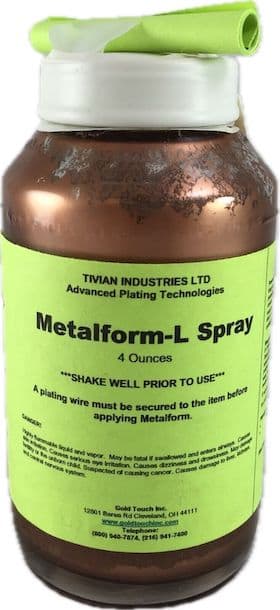
- The easiest to understand approach was mentioned first: simply painting the items with a paint that contains metal particles or flakes, usually copper, silver or zinc.
- You can apply a spray of colloidal conductive material, either carbon or metal. This is not very different than the first approach except that the particles are extremely fine, and the process is designed specifically for the purpose of allowing fine decorative plating onto non-conductors.
- The familiar gold edging you would see on fine china is an example of a third technique involving brushing a solution onto ceramics and then firing in an oven.
- Two-part silvering solutions are used for many different applications including plating of lacquer masters for vinyl records. You simultaneously spray a soluble silver salt and a reducing agent in order to reduce an extremely thin layer of highly conductive silver metal directly onto the item in question. This is essentially the same method (Brashear process) used to make mirrors and the lining on thermos bottles.
- The fifth method is vacuum metallizing. Under high vacuum, metal is evaporated and it deposits onto the item you want to metallize. This requires a vacuum chamber, so it's probably not highly applicable for hobbyists. Although vacuum metallizing can be used in this way as a metallization method prior to electroplating, it is more often an alternative to plating than a metallization method before electroplating.
- The sixth and most complex method is the one usually done for plating on plastics for automotive use: after a special etch of the material gives it a sponge-like outer surface, you dip it into stannous chloride or palladium chloride, or both in sequence, and use the conductive seeds that you have thus formed as nucleating points for electroless copper or electroless nickel deposition. This is usually a high volume industrial process and invariably relies on proprietary chemistries available from the major suppliers, but offers the advantage of a truly robust process where the metal is truly locked to the plastic for difficult environments like the previously mentioned automotive exterior brightwork. See thread 31550, "How high quality plating on plastics is done".
When doing it yourself it is good to remember that metallization is a carefully honed artform; if you are trying to plate flowers or leaves and so on, don't expect to get the same kind of results in early trials as are achieved by artisans who have been working for decades to perfect their trade.
You also should appreciate that plating chemicals can be aggressive, and you will probably have to develop some techniques with wax or lacquers to keep the plating chemicals from attacking the organic materials. If the item is important to you, don't try to plate it until you are good at it. You will see plated flowers and leaves and such stuff for sale on the web; try search terms like "gold plated orchids" for examples.
A vocabulary note on "electroplating" vs. "electroforming": it's actually the same process ... but when the metal you are depositing actually becomes the object of interest, and what you plated it onto becomes of no consequence, it's called electroforming. For example, when you chrome plate a truck bumper you make it shiny and corrosion resistant but it remains a strong, heavy, truck bumper; whereas if you make hollow gold teardrop earrings by doing heavy gold plating onto disposable wax pieces of teardrop shape the gold plating itself is the object of interest.
Public Q&As:
Q. I am trying to electroform copper onto organic materials. I've purchased a zinc weld through primer which has metal in it, also graphite powdered graphite, to create a conductive paint, and sulfuric acid. I have muriatic acid as well.
I have read several different articles and I am a bit confused about the best solution or a way to go about this. I have a machine that is meant for electroplating, it has the two connections. My question is about solutions and how the ratio of sulfuric acid or Muriatic acid, how much water would you need to dilute that. I also read articles about using just vinegar ⇦ in bulk on eBay or Amazon [affil link] and hydrogen peroxide. I am confused and not sure where to start if you have any advice on a simple instructions I would greatly appreciate it. Thank you so much.
Debbie lewis2nd nature - Homer alaska usa
September 6, 2018
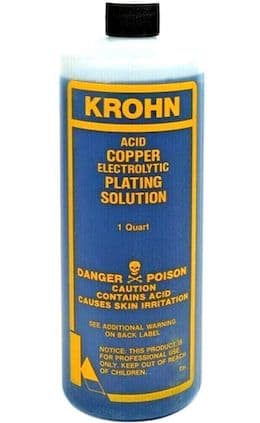
A. Hi Debbie. We have such a lesson on line here, of how to do copper plating with kitchen chemicals: "How Electroplating Works", and we have many threads about copper electroforming. But I think an important starting point is this:
Your high school science teacher probably showed you simple electroplating from basic chemicals, too, because the purpose was to see science without any hocus-pocus of secret ingredients.
... but real, robust, electroplating and electroforming isn't done from home-brews of kitchen or commodity chemicals. Rather we let specialists carefully formulate electroplating solutions with the proper copper concentration and acid ratio, and which include that hocus-pocus of levelers, brighteners, & surfactants. I think what you'll want to do is lacquer your organic materials to make them waterproof, then apply a metallizing solution (zinc-based cold galvanizing primer might work, I haven't tried it), then do your copper plating with a commercially available copper plating solution.
There are good youtube videos, including this one about buying or making the metallizing solution

Good luck, Regards,

Ted Mooney, P.E. RET
Striving to live Aloha
finishing.com - Pine Beach, New Jersey
Need quick confidential answers? $25
Need project assistance? $100/hr.
A. One way to make a non-conductive surface electrically active and ready for plating without losing any surface detail is to silver it using the same chemicals you use to make a silver mirror on glass. We have tried this with plastic and also with a leaf (of tarragon in case you're interested).
Sarah KingBroadview Illinois USA
⇩ Similar, related, Q&As -- oldest first ⇩
Q. Can you suggest sources of info on electroplating or bronzing organic material such as animal skulls?
1995[name & town deleted for privacy by Editor]
A. I can tell you what is done to finish non-conductors in the (vinyl) record industry and in our business (electroforming coaxial cable devices).
In vinyl record production (I did this years ago) an acetate master is cleaned, sensitized, then sprayed with a two component silver compound which lays down a very thin coating of pure silver. This silver is the conductor on which nickel is then plated. When plating is done the acetate is peeled off, the silver is stripped, and you have a negative image from which to press additional records or from which to make "Mothers" from which to make additional pressing plates, ad infinitum. Each plating cycle introduces more micro defects which show up as hiss, etc., so there is a limit as to how far you can go.
In our current process, a shape is injection molded with special wax, then cleaned, sensitized, and sprayed with the same silver spray system as above. Then we copper plate to a thickness of 10-20 mils. The wax is evacuated and the remaining shape (a precision electrical cable/connector assembly) is trimmed to spec and undergoes final test/assembly.

Bill Vins
microwave & cable assemblies - Mesa (what a place-a), Arizona
A. Besides the electroplating societies (www.nasf.org) and the links you find from finishing.com, and the electroplating texts we recommend, I can tell you quickly what my experience has been for this kind of work.
1) I always used "other people's" electroplating facilities. That is, it was a hobby for me, so I used a plating tank during lunchtime or whatever. If you have an electroplating facility available, that's great. If you are thinking of setting up your own tanks, it's possible, but in today's world, it means wastewater, waste sludge, permits, etc.
2) I never plated big stuff, but for the nuts and berries and leaves I fooled with, I used a silver conductive paint. I think it was called Electrodag or something. I think you might be able to airbrush the paint onto the subject.
3) It requires a little technique for starting the plating strike with low current and many contact points so you don't burn off the silver paint.
4) The biggest problem, I think, that you need to overcome with organic material is sealing the thing so plating solutions are not absorbed during immersion. It ruins the job when you have tiny points of bleed-out which corrodes and destroys the look. You might try multiple dips or sprays of a wax, then paint the wax and plate. So watch out for hot solutions which will expand the trapped air. (I know a person who plated a banana and it blew up in his desk, so remove the brain before plating skulls.) Or how about making a mold of the skull, then a reverse of plaster, then plate that?
5) Ted Mooney is getting a copy of this letter. He told me that they electroplate orchids somewhere in the Far East. Those are the people you want to talk to!
6) Good Luck, and send me a photo of your work when it's done. I may want one for my house in Vail, if I ever get a house in Vail.
7) If I did or did not help, I would be glad to try again.


Tom Pullizzi
Falls Township, Pennsylvania

|
Q. There was a reference to plating orchids there. I wondered if this was a put-on, this is mighty close to gilding the lily. Ward W [surname deleted for privacy by Editor]aeronautical & navigation - Louisville, Kentucky
But gold plated orchids and roses are a reality.  Ted Mooney, P.E. Striving to live Aloha finishing.com - Pine Beach, New Jersey Need quick confidential answers? $25 Need project assistance? $100/hr. |

Q. I am interested in finding a method to gold plate ostrich eggs for display at crafts shows. I heard of a spray used to activate the egg surface prior to plating. If anyone else has any answers, it would be appreciated.
Franklin D Asbell1997
A. Yes, Franklin, you may be describing "two-component silvering solution". You simultaneously spray a silver salt and a reducing solution on the item in question. The silver in the salt is reduced to metallic silver. This is the same process that is used for silvering mirrors (research "the Brashear process").
But the silver will soon tarnish to black if not protected from the atmosphere, so you must electroplate a layer of something else onto the silver.
Alternately you may be looking for a conductive paint; this is heavily filled with copper or silver flakes for good conductivity. Best of luck.
Ted Mooney, P.E.
Striving to live Aloha
finishing.com - Pine Beach, New Jersey
Need quick confidential answers? $25
Need project assistance? $100/hr.
Q. Hi. I am conducting an independent study project on the topic of electroplating. I have only found very little and vague information on this topic. If anyone has any helpful information they can provide me with a.s.a.p. it would be greatly appreciated. Please send me anything and everything you may know on electroplating.
Thanking you in advance,
1998
A. Dear Newsha,
You have found perhaps the greatest repository of non-vague information about electroplating (and metal finishing) this side of Alpha Centuri (and I do mean universe) here at finishing.com, and I am being modest.
Look in our FAQs (Frequently Asked Questions) Off Our Home Page (OOHP), there is a section showing photos of an actual plating shop (I can't recall where it is, but try the library OOHP. There are formulas, book lists, and a petting zoo, deli, and a world class juice bar (the last three are not available on line).
Sincerely,
Tom Pullizzi
Falls Township, Pennsylvania
Q. I am interested in knowing all different methods available for plating on nonconductors especially plastics, with all it's scientific details, might someone has any info., or recommend any article or book in this subject.
Alex Kaven1998
Ed. note: Our FAQ on Plating Organic Materials lists all of the various ways to metallize non-conductors. Each has advantages and disadvantages, but automotive plastics (grills, etc.) are invariably metallized via electroless plating on plastics because the adhesion is sufficient for this very tough service
A. Dear Alex,
Basically, you need to make the surface conductive, so that it will carry an electric current. If you do not have access to a university library, you might be better off looking around these pages at finishing.com. A lot of letters have been posted over the years. See our library section off our home page, www.finishing.com
Regards,
Tom Pullizzi
Falls Township, Pennsylvania
Electroplating small non-conductive items
avail from eBay, AbeBooks, or Amazon

avail from eBay, AbeBooks, or Amazon
"Plating of Plastics with Metals" by John McDermott (1974)
avail from AbeBooks, or Amazon
avail from eBay, AbeBooks, or Amazon
avail from AbeBooks, or Amazon (rarely)
"How to Electroplate Non-Metallics" by Warner Electric Co. (1967)
[more appropriate for hobbyists than for industrialists]
avail from eBay, AbeBooks, or Amazon
avail (rarely) from eBay, AbeBooks, or Amazon
(as an Amazon Associate & eBay Partner, we earn from qualifying purchases)
Q. I really could do with some help. I'm trying to establish a small cottage industry by electroplating insects and other small non-conductive items. I have never plated anything since school days long passed. Do you know of any company in New Zealand that can supply me with the information and the chemicals that I will need?
There is no problem with waste disposal as my established company meets with all local requirements.
I know kits are available but the exchange rate along with the freight and the duty make this option out of the question.
Any help will be most appreciated.
Thanks...
- Waipu, Northland, New Zealand
2002
A. Hi Philip, good luck. In principal it's easy: you just lacquer the item, with lacquers available from companies like
G.J. Nikolas [a finishing.com supporting advertiser], metallize it with two-part silvering solution or a conductive paint available from companies like Acheson Colloids, and then you plate it with plating processes available from companies like EPI / Electrochemical Products Inc. [a finishing.com supporting advertiser] and Macdermid, or hobby & jewelry plating suppliers.
But sometimes I almost wish schools would discontinue their electroplating demonstrations because my experience is that many students jump to unrealistic expectations about what is achievable on a casual basis :-)
Jewelry-level plating of insects, flowers, leaves, and other inorganic items is clearly possible -- but it is usually done by artisans who have both artistic ability and a lifetime of experience -- sometimes multi-generational experience.
So doing it the first few times, with no experience and perhaps unrealistic budget constraints can be a problem. It's been said that when painting something, the chemistry is all already in the paint can, but when electroplating it, the chemistry lies in the skill & experience you bring to the process.
I hope my personal opinion on this inspires those with fire in their souls to create works of art with electroplating, but discourages those who think plating will be easy :-)
Good luck!
Ted Mooney, P.E.
Striving to live Aloha
finishing.com - Pine Beach, New Jersey
Need quick confidential answers? $25
Need project assistance? $100/hr.
Q. Thank Ted for your response which is a theme that I keep following in your replies to people that want to start their own little enterprise.
My question was however, does anyone know of companies in New Zealand that can supply me with the technical information and/or the chemicals plus equipment to start a small business? was not answered.
Ted, I am 60 years old and have my own company which I work from home. Home being a 3 acre block with my home and also a large and well maintained workshop with a laboratory at one end.
I am both mechanical and artistic and have no 'budget constraints' you mentioned, my mention of the kits is purely a profit and loss equation.
I apologize if this sounds a bit gruff, but for some of us that want to learn and develop something for and by themselves have thought about the negative issues before continuing in their quest. I look forward to someone knowing of a company in New Zealand and replying to this enquiry.
- New Zealand
A. Cool it, man. Ted gets so many letters from idiots, he's taken by surprise when a sensible one turns up. A quick web search gave me Atotech New Zealand Ltd in Auckland, and a 'Courts Ltd in I don't know where. There's also the yellow pages, of course...

Bill Reynolds [deceased]
consultant metallurgist - Ballarat, Victoria, Australia
We sadly relate the news that Bill passed away on Jan. 29, 2010.
 My whole career has been in the electroplating industry and entirely dependent upon it, Phillip -- so I'm all in favor of the technology and anyone wanting to engage in it! We have an FAQ on Plating Organic Materials that you may find helpful.
But the internet is a one-room schoolhouse where 3rd-graders and post-docs view this same page, and I don't apologize for giving fair warning to people who say they want to do it out of their cottage and have never done it except 40 years ago in school. Electroplating was the very first environmentally regulated (categorically regulated) business in the USA. An acquaintance from Pennsylvania is in the penitentiary after starting a plating operation in his garage, being sucked in by degrees until the disposal cost grew unthinkable, then making a bad choice of what to do instead of losing his house over the disposal costs (which happened anyway). I was in court in Midland Texas where millions of dollars has been spent on legal fees and tens of millions will be spent on the cleanup of the aquifer caused by chrome contamination from a plating shop operating out of a garage. And this is not the only acquaintance serving prison time for plating-related environmental crimes, nor the only environmental contamination suit I've testified in. So I'm not gung-ho when someone says they want to start an electroplating shop in their cottage -- but New Zealand is not the USA and things may be different.
Sorry, I don't know the local electroplating distributorships in New Zealand beyond what Bill mentioned. Hopefully other readers will.
Ted Mooney, P.E.
Striving to live Aloha
finishing.com - Pine Beach, New Jersey
Need quick confidential answers? $25
Need project assistance? $100/hr.
Thank you for your replies and I apologize for my 'hasty reply'. I've been given the run-a-round from all sorts of people who are not willing to share their knowledge and frustration is the only explanation I can offer. I will certainly try the companies you suggest and let you know in the fullness of time the results of my investigations. Once more thank you for your help.
Regards,
- Waipu, New Zealand
A. Hallo Phillip,
I have information for you Contact Gold Touch [a finishing.com supporting advertiser] in USA, they have an agent in New Zealand. I'm sure that what you are finding you will get from them.
Good Luck!

Dipen Pattni
jeweler/goldsmith - Dar-Es-Salaam, Tanzania
A. I have little experience with plating insects but I do artistic flowers and leaves and the process would be similar I suspect.
I would make sure the insect is dead -- most would not appreciate a gold-plated Tree Weta crawling across their desk!
With flowers I use this technique; Dry them in a sheltered place for several days. Once dried pick them up with tweezers and spray them with two coats of hair lacquer to seal up the pores. Then dip them in the conductive coating and plate as usual.
If you can, avoid using cyanide solutions as they need specialist disposal. Very costly.
- Hokitika, New Zealand
Multiple threads merged: please forgive chronology errors and repetition 🙂
Copper Coating on Non-Metallic Materials?
Q. Good Sir,
Pardon me, I am a complete layman in these matters. Wondering whether in your experience, if you have ever coated a material with copper that is non-metallic?
My challenge is that I have a specific shape in mind for production, and I would like to make it look like copper while being as light as possible. Any suggestions on a base material and method of achieving this?
Gratefully,
Student, Dalhousie University - Toronto, Ontario, Canada
2006
A. Hi, Radek.
There are a number of ways of metallizing non-conductive materials, and we have an FAQ on the subject" "How do you electroplate flowers, leaves, animal skulls, and other organic materials?".
But virtually all of the grills you see on today's automobiles are plastic that has been copper plated, then nickel and chrome plated. So you might consider making the component from ABS and copper plating it. Good luck.
Ted Mooney, P.E.
Striving to live Aloha
finishing.com - Pine Beach, New Jersey
Need quick confidential answers? $25
Need project assistance? $100/hr.
A. Dear Radek ,
You can consider the following techniques
1-Gilding using a metallic foil
2-Using conductive paint and then copper plating
3-Resin coating(if required)- etching - activation - electroless copper - copper plating build up.
Good luck

Khair Shishani
aircraft maintenance - Al Ain, UAE
Q. I would like to electroplate a flower with copper. The problem is that the flower is a non-conductor of electricity. So, do anyone have any ideas of how to electroplate the flower? Thank you.
Jennifer H. [surname deleted for privacy by Editor]Student - Singapore
2007
A. Pour glue all over the flower and sprinkle carbon powder over it (make sure to cover all places) conduct the electroplating.
shaun Chee- Singapore
March 3, 2010
Q. I am a GCSE student in Chichester, England. I have taken is art & design. I saw something on the net about electroforming over leaves, I would love to do this as part of my project and was wondering whether anyone could tell me how I would go about this? Any help would be very helpful.
P.S. I can probably get everything from school but a list would be helpful.
-Chichester, England
Sounds very interesting. I hope you will succeed. Good luck!
- Qingdao, China
A. Hello William. Please see our FAQ about plating organic materials for a start.
Good luck!
Ted Mooney, P.E.
Striving to live Aloha
finishing.com - Pine Beach, New Jersey
Need quick confidential answers? $25
Need project assistance? $100/hr.
Q. Does anyone know how to metallize (different metals/colors i.e. bronze, pewter, silver, etc.) skulls or bone?
Jim Spencerhobbyist - Greenwood, Indiana
May 17, 2009
A. Hi, Jim.
We appended your inquiry to a thread that will at least partially answer it. Once the object is metallized you can electroplate it with nickel, bronze, copper, silver, or whatever plate-able metal you wish as an alternative to gold plating. Good luck!
Those who are interested in this topic will probably also find the following threads interesting as well:
thread 00284, "Metallizing and plating resin",
thread 00934, "Coatings for metallizing non conductors",
Regards,
Ted Mooney, P.E.
Striving to live Aloha
finishing.com - Pine Beach, New Jersey
Need quick confidential answers? $25
Need project assistance? $100/hr.
Q. Pardon me, I am a complete layman in these matters too. Can you provide complete technology of this subject?
Gratefully,
Teacher, Institute of Medical technology - Bogra, Bangladesh
April 6, 2011
A. Hi, cousin Shafiullah.
After reading the suggested FAQ, please try a quick scan of this site and google for the technologies suggested on this thread and then decide, based on the needs of your particular parts, which of these technologies sound applicable. Then you can ask deeper questions.
Excellent adhesion of the plating to the substrate is probably critical for surgical tools but not so important for statues and ostrich eggs.
Alternately, tell us about the parts you have in mind and people can probably suggest which technologies sound most promising for you to consider. Good luck!
Regards,
Ted Mooney, P.E.
Striving to live Aloha
finishing.com - Pine Beach, New Jersey
Need quick confidential answers? $25
Need project assistance? $100/hr.
Q. Could you please help me to find an etchant (it is probably some acid, but I am not sure) to slightly etch some organic materials, like dry leaves or flowers, to better reveal their internal structure.
Ekoba M [surname deleted for privacy by Editor]- Cleveland, Ohio
December 18, 2011
A. Hi, Ekoba.
Sodium hydroxide/caustic soda ⇦liquid caustic soda in bulk on Amazon [affil link] is very aggressive towards organic material, including leaves, flowers, and you. So be sure to wear goggles ⇦ on eBay or Amazon [affil link] and rubber gloves ⇦ on eBay or Amazon [affil link] as a minimum. It's dangerous stuff. Start with lukewarm water and add a few crystals. It probably doesn't need to be too strong, but never attempt to dilute it: always add the crystals to water, making it stronger if necessary, never add water. The old adage "Do as you oughter, add acid to water" applies to caustics as well.
You can neutralize the leaf or flower with diluted vinegar.This is book knowledge, I haven't personally done it, so practice on some old leaves or flowers first. Good luck.
Regards,
Ted Mooney, P.E.
Striving to live Aloha
finishing.com - Pine Beach, New Jersey
Need quick confidential answers? $25
Need project assistance? $100/hr.
Quickstart: Alloy Plating:
If we look at the lemon batteries and potato batteries that grade schoolers make for science projects, we see that a copper penny vs. a galvanized nail will generate about 1.0-1.1 volts, as copper from the penny migrates through the solution and coats the nail.
So it is a wonder that can we do an alloy electroplating of brass (copper and zinc) or bronze (copper and tin) when the plating layer is "fighting back" against us, desperate to throw the zinc back into solution and plate out only copper.
More advanced students will want to look into the "Nernst Equation" and the concept of "complexing" the copper to understand how this strange thing can be accomplished.
But the quick take-away is that it's electrochemically difficult to electrodeposit alloys, and we rely on the plating solution suppliers to provide a chemical solution to complex the copper so that it is not readily "available" to plate out.

Nernst Equation
Q. I am a graduate student who wants to bronze plate dried cotton boll stems. I am choosing to bronze plate them because it will reference mementos like bronze baby shoes, etc.
The cotton will be removed for plating, of course, and then be returned to the boll part afterwards. There will be 9 stems in total ranging in lengths from about 4 to 7 inches. They range in width at the boll or burrs (hard dried leave-like structures) area from 3 to 4 inches. These will be used as part of an installation about memory. They will each represent women in my family, alive and deceased, and will be accompanied by a fine art video.
I need to do this very soon so any assistance in getting properly and safely set-up is great. Instructions would be awesome too. I thank all of you very much.



Stephanie Wagner
- Las Cruces, New Mexico, United States
November 18, 2013
A. Hi Stephanie. I haven't done it and can't give exact directions; but earlier on, we linked to our FAQ on the subject, and I can add a few more comments --
Bronze plating is quite difficult because bronze is an alloy. As a minimum you should do copper plating first so that the difficult bronze plating is done onto a stable copper layer rather than onto a frail metallization layer. But it would be easier to do copper plating and then some sort of patina to obtain a bronze color rather than doing actual bronze. If you insist on real bronze plating, I think you'll need to buy a proprietary process for it.
Good luck.
Ted Mooney, P.E.
Striving to live Aloha
finishing.com - Pine Beach, New Jersey
Need quick confidential answers? $25
Need project assistance? $100/hr.
Hi Mr.Mooney
Thank you so much for your response. After poking around to try to figure it out, I can see that adding the layer of bronze over copper is a touchy process. I find it interesting that some "bronze" plating of baby shoes are not actually bronze. They stop at the copper plating stage and add a patina to achieve a near-bronze look. So, I will consider copper plating with patina. I can see, too, how you would recommend a specific bronze plating kit of sorts. They seem to be fairly straight forward. Again, I thank you for your kindly assistance!
Stephanie
Stephanie Wagner [returning]
- Las Cruces, New Mexico, United States
Q. Good Afternoon,
I realize this is an older posting, but since there seems to be no shortage on expert advice, I'll take my chances. I'm attempting to electroplate inorganic materials (rocks, feathers, leaves, bones etc.) on a strictly hobbyist basis (small quantities, low budget). Having read through the previous posts, as well as watched some tutorials, I have a few remaining questions.
The first is, is it necessary to lacquer the object being plated prior to using a conductive paint on it? (my current favorite is a micronized graphite powder dissolved in gum arabic) and if so, why?
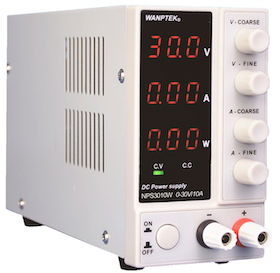
The second question is about voltage. I currently have a power supply I'm using for electrolysis cleaning of iron artifacts, but the lowest voltage I can produce is 12 VDC. Will this be too much voltage to use with a copper tube anode and copper sulphate pentahydrate
⇦ on
eBay or
Amazon [affil link] solution?
- East Earl, Pennsylvania, United States
October 16, 2015
A. Hi Will. No, it is not always necessary to lacquer the article first. It's just a question of whether the micronized graphite powder will adhere properly, and whether it or the plating solution will attack the substrate, and whether the substrate is robust enough. For example, I would think that a delicate flower usually must receive multiple very thin coats of lacquer before anything else is applied -- for holding its shape if for no other reason.
12 VDC is going to be too much. I would estimate that about 2-3V will be more appropriate for small objects with reasonable anode-to-cathode spacing of a few inches.
Regards,
Ted Mooney, P.E. RET
Striving to live Aloha
finishing.com - Pine Beach, New Jersey
Need quick confidential answers? $25
Need project assistance? $100/hr.
Ed. note: Not long ago precision power supplies were very expensive, so there was good reason to try battery chargers and such. These days excellent power supplies cost little more that a battery charger and are a much better idea.
Grainy shiny electroformed surface suddenly
Q. I have been electro-forming for my work successfully for the last 4 years or so. I am an artist and also a jeweler. I use a 5 amp digital rectifier and a small commercially purchased bath. I prefer to apply my coatings in a slow process over many hours. I use non organic and also organic items. All organic items are sealed well before applying a commercial graphite conductive paint. I regularly clean my bath and have replaced it several times.
Just recently I have had some trouble. Nothing has changed except a new batch of solution. Several of the things I have done in it have been perfect but the most recent attempt is different than anything I have seen before. Hence searching the net to solve this problem.
The wires attached to the objects hanging in the bath have a grainy deposit on them that I can rub off with my finger. The deposit on the prepared pieces [this time rocks that I have done before perfectly] is shiny but grainy. It does not rub off at least. In the bottom of the bath I can see copper residue building up quickly.
Since I have not changed anything much other than the new solution I am wondering if it might be too strong? I want to dilute it with some distilled water?
Any suggestions?
artist - Penong, South Australia
October 19, 2015
A. First, check basic chemistry - sulfuric acid and copper metal. I do not have the spec in front of me but that info is not hard to come by.
If those are OK, you might try adding a bit of molasses.

Dave Wichern
Consultant - The Bronx, New York
Is there a Preparation for chrome dipping bone?
Q. My situation: I'm an ethical sculptor using animal skulls
I want to chrome dip them but understand they need to have Metallic coating? Is it possible to chrome dip bone please?
Artist - Harpenden Herts UK
June 13, 2018
A. Hi Karen. Almost anything can be plated with any plateable metal, but there is a lot more involved that dipping into a single tank.
The bone probably has to be cleaned, then covered with an acid-proof lacquer. After that it must be cleaned again, painted with a conductive paint, copper plated, nickel plated, and then chrome plated.
Please see our "Introduction to Chrome Plating"
Regards,
Ted Mooney, P.E. RET
Striving to live Aloha
finishing.com - Pine Beach, New Jersey
Need quick confidential answers? $25
Need project assistance? $100/hr.
Sorry! Finishing.com is temporarily Read-Only.
Ted Mooney is retiring but I have several offers to take it over.
We're working hard to make sure we find it the best new home.